H.Res. 953 explained · 119th Congress · Pending in Congress
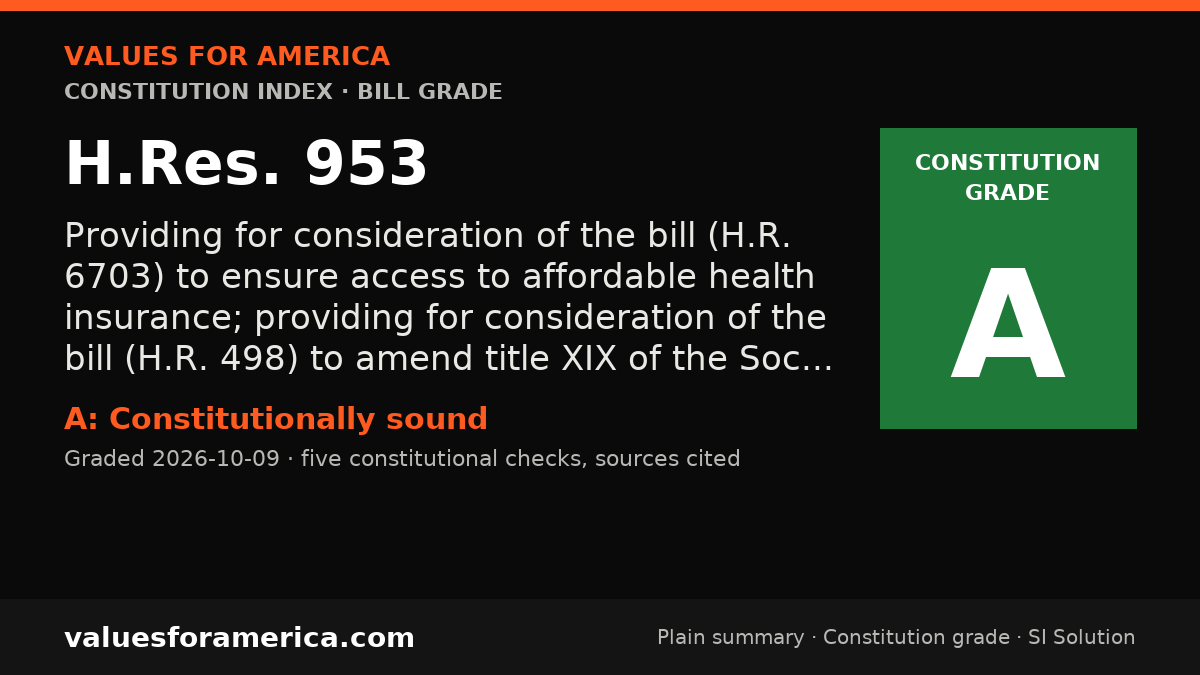
Providing for consideration of the bill (H.R. 6703) to ensure access to affordable health insurance; providing for consideration of the bill (H.R. 498) to amend title XIX of the Social Security Act to prohibit Federal Medicaid funding for gender transition procedures for minors; providing for consideration of the bill (H.R. 3492) to amend section 116 of title 18, United States Code, with respect to genital and bodily mutilation and chemical castration of minors; and relating to consideration of the bill (H.R. 4776) to amend the National Environmental Policy Act of 1969 to clarify ambiguous provisions and facilitate a more efficient, effective, and timely environmental review process.
Cosponsors: none · per Congress.gov, 2026-10-09
Introduced: 2025-12-17
Latest action (2025-12-17): Motion to reconsider laid on the table Agreed to without objection.
What H.Res. 953 does, in plain terms
This resolution provides for the consideration of the bill (H.R. 6703) to ensure access to affordable health insurance; providing for consideration of the bill (H.R. 498) to amend title XIX of the Social Security Act to prohibit Federal Medicaid funding for gender transition procedures for minors; providing for consideration of the bill (H.R. 3492) to amend section 116 of title 18, United States Code, with respect to genital and bodily mutilation and chemical castration of minors; and relating to consideration of the bill (H.R. 4776) to amend the National Environmental Policy Act of 1969 to clarify ambiguous provisions and facilitate a more efficient, effective, and timely environmental review process.
Official summary by the Congressional Research Service, via Congress.gov.
Constitution Index
“VFA Constitution grade”
Constitutionally sound
Graded 2026-10-09
SI-generated grade · five published checks · not individually reviewed by a person · methodology
This resolution is a special rule governing floor consideration of four separate bills. It does not itself enact substantive law, appropriate funds, or restrict individual rights. The House's power to determine its own proceedings is expressly granted by Article I, Section 5, Clause 2. Therefore it passes all constitutional checks.
-
✓ Passes · Enumerated powers
Article I, Section 5, Clause 2 gives each House of Congress the power to determine the rules of its proceedings. A special rule setting terms for debate, amendment, and consideration of specified bills is a direct exercise of that internal authority. It does not claim any new regulatory power beyond the House's express constitutional role. -
✓ Passes · Bill of Rights
The resolution does not enact any law affecting speech, religion, press, assembly, petition, the right to keep and bear arms, quartering of soldiers, search and seizure, self-incrimination, due process, trial by jury, protection against cruel and unusual punishment, unenumerated rights, or reserved powers. It only governs how the House considers other legislation, so no provision of the Bill of Ri… -
✓ Passes · Individual sovereignty
No person's life, liberty, property, speech, labor, or belief is directly restricted by this resolution. It imposes no mandate and no prohibition on private individuals. The burden on government to justify restrictions is not triggered because this parliamentary measure creates no restriction. Any substantive constitutional concerns in the underlying bills would need to be evaluated separately. -
✓ Passes · Decentralization
A rule for proceedings in the House of Representatives cannot be set by an individual, a local community, or a state. The Constitution assigns this function exclusively to each house of Congress. There is no upward consolidation beyond the minimum necessary because the House must act at the federal level to regulate its own floor procedure. -
✓ Passes · Due process and takings
The resolution does not adjudicate anyone's rights, deprive any person of life, liberty, or property, or take property for public use. It does not bypass procedural or substantive due process. House floor procedures provide notice and opportunity for members to debate and vote. The Takings Clause of the Fifth Amendment is not implicated.
Sources: Congress.gov: HRES 953 summary
Report an error in this grade
What should pass
“VFA SI Solution”
No solution yet
A sourced SI draft appears here once it passes automated checks (Constitution citation, source verification, independent SI critic). How publication works.
Related on VFA

For journalists and bloggers
“Embed this grade”
Free to use with the link back. The badge and card update when the grade changes. Embed terms →
