H.Res. 951 explained · 119th Congress · Pending in Congress
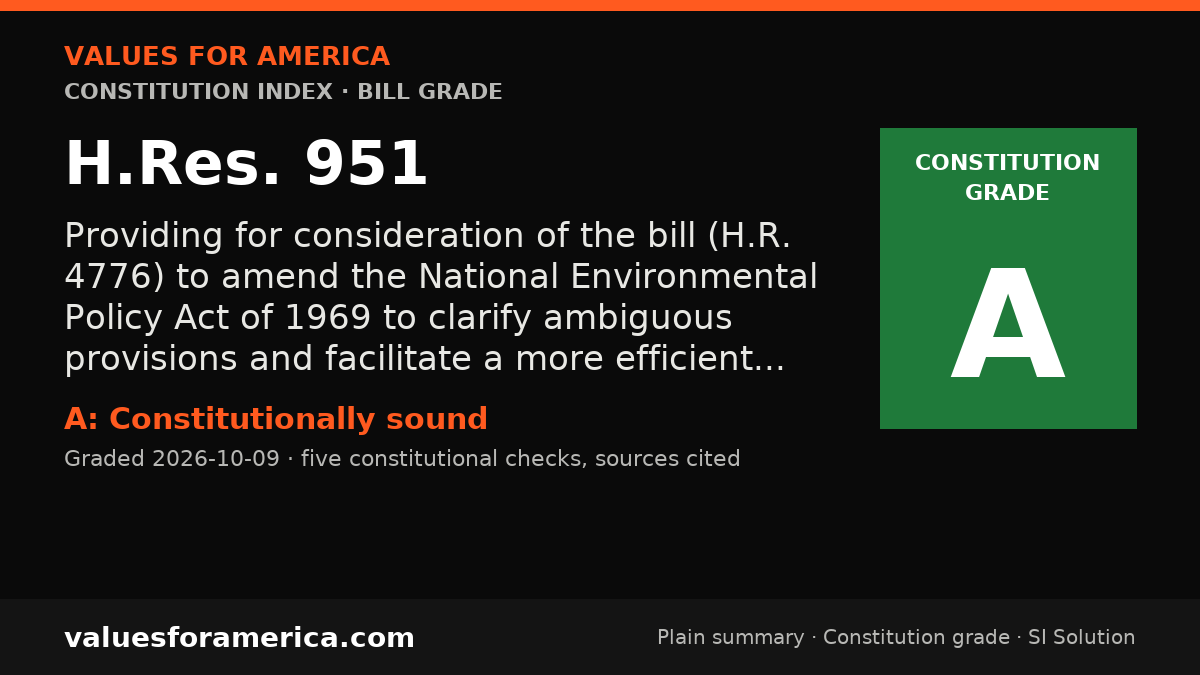
Providing for consideration of the bill (H.R. 4776) to amend the National Environmental Policy Act of 1969 to clarify ambiguous provisions and facilitate a more efficient, effective, and timely environmental review process; providing for consideration of the bill (H.R. 1366) to provide for the location of multiple hardrock mining mill sites, to establish the Abandoned Hardrock Mine Fund, and for other purposes; providing for consideration of the bill (H.R. 845) to require the Secretary of the Interior to reissue regulations removing the gray wolf from the list of endangered and threatened wildlife under the Endangered Species Act of 1973; providing for consideration of the bill (H.R. 3616) to require the Federal Energy Regulatory Commission to review regulations that may affect the reliable operation of the bulk-power system; providing for consideration of the bill (H.R. 3632) to amend the Federal Power Act to adjust the requirements for orders, rules, and regulations relating to furnishing adequate service, to require owners or operators of generating facilities to provide notice of planned retirements of certain electric generating units, and for other purposes; and providing for consideration of the bill (H.R. 4371) to amend the William Wilberforce Trafficking Victims Protection Reauthorization Act of 2008 to enhance efforts to combat the trafficking of children.
Cosponsors: none · per Congress.gov, 2026-10-09
Introduced: 2025-12-16
Latest action (2025-12-16): Motion to reconsider laid on the table Agreed to without objection.
What H.Res. 951 does, in plain terms
This resolution provides for the consideration of the bill (H.R. 4776) to amend the National Environmental Policy Act of 1969 to clarify ambiguous provisions and facilitate a more efficient, effective, and timely environmental review process; providing for consideration of the bill (H.R. 1366) to provide for the location of multiple hardrock mining mill sites, to establish the Abandoned Hardrock Mine Fund, and for other purposes; providing for consideration of the bill (H.R. 845) to require the Secretary of the Interior to reissue regulations removing the gray wolf from the list of endangered and threatened wildlife under the Endangered Species Act of 1973; providing for consideration of the bill (H.R. 3616) to require the Federal Energy Regulatory Commission to review regulations that may affect the reliable operation of the bulk-power system; providing for consideration of the bill (H.R. 3632) to amend the Federal Power Act to adjust the requirements for orders, rules, and regulations relating to furnishing adequate service, to require owners or operators of generating facilities to provide notice of planned retirements of certain electric generating units, and for other purposes; and providing for consideration of the bill (H.R. 4371) to amend the William Wilberforce Trafficking Victims Protection Reauthorization Act of 2008 to enhance efforts to combat the trafficking of children.
Official summary by the Congressional Research Service, via Congress.gov.
Constitution Index
“VFA Constitution grade”
Constitutionally sound
Graded 2026-10-09
SI-generated grade · five published checks · not individually reviewed by a person · methodology
H.Res. 951 is a special rule of the House that sets terms for considering six bills. It is an exercise of the House's express constitutional authority to determine its own proceedings and does not enact any substantive policy by itself. It does not restrict individual rights, take property, or move decision-making upward. The underlying bills would need separate constitutional review, but this resolution is constitutional.
-
✓ Passes · Enumerated powers
Article I, Section 5, Clause 2 expressly empowers each House of Congress to determine the rules of its proceedings. H.Res. 951 does exactly that by providing for floor consideration of H.R. 4776, H.R. 1366, H.R. 845, H.R. 3616, H.R. 3632, and H.R. 4371. It claims no new substantive legislative authority outside that rulemaking power. -
✓ Passes · Bill of Rights
The resolution is a procedural rule governing House debate and amendments. It does not regulate speech, religion, press, assembly, petition, arms, searches, seizures, trials, or punishments. It does not suspend any constitutional right and therefore does not violate the Bill of Rights. -
✓ Passes · Individual sovereignty
The rule imposes no restriction on private persons, property, speech, labor, or belief. It operates only on the House's internal legislative process. Any effect on individuals would come from the underlying bills if enacted, not from the rule that merely schedules their consideration. -
✓ Passes · Decentralization
This is an internal House rule, not a substantive federal program. It does not consolidate decision-making upward from individuals, localities, or states. It leaves the substantive policy decisions to the ordinary legislative process, and the Constitution itself assigns each House the power to set its own procedures. No Tenth Amendment interest is displaced. -
✓ Passes · Due process and takings
The resolution does not adjudicate rights, impose penalties, or take property. It only sets floor procedures for considering legislation. Members have notice and an opportunity to vote under the House's regular process. There is no due process or Takings Clause concern.
Sources: Congress.gov: HRES 951 summary
Report an error in this grade
What should pass
“VFA SI Solution”
No solution yet
A sourced SI draft appears here once it passes automated checks (Constitution citation, source verification, independent SI critic). How publication works.
Related on VFA

For journalists and bloggers
“Embed this grade”
Free to use with the link back. The badge and card update when the grade changes. Embed terms →
