H.Res. 719 explained · 119th Congress · Pending in Congress
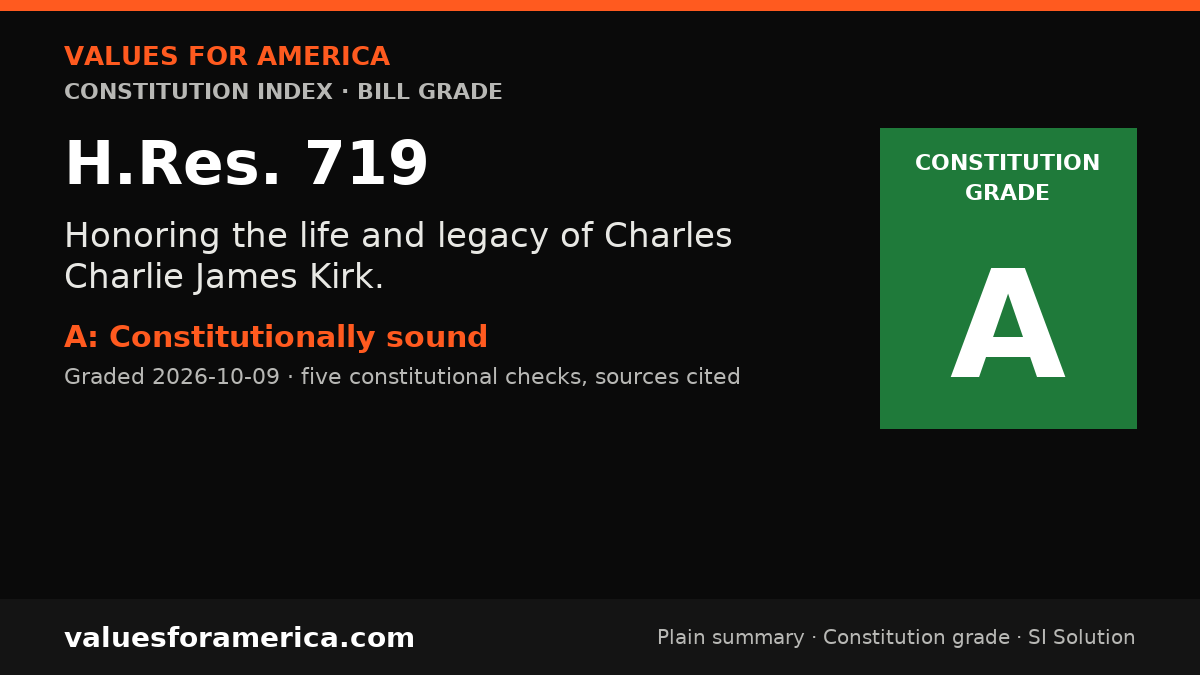
Honoring the life and legacy of Charles Charlie James Kirk.
Cosponsors: 196 (0 D, 196 R) · per Congress.gov, 2026-10-10
Introduced: 2025-09-16
Latest action (2025-09-19): Motion to reconsider laid on the table Agreed to without objection.
What H.Res. 719 does, in plain terms
This resolution (1) condemns the assassination of Charles "Charlie" James Kirk and all forms of political violence; and (2) honors the life, leadership, and legacy of Charlie Kirk.
Official summary by the Congressional Research Service, via Congress.gov.
Constitution Index
“VFA Constitution grade”
Constitutionally sound
Graded 2026-10-09
SI-generated grade · five published checks · not individually reviewed by a person · methodology
This resolution is purely symbolic and non-binding. It expresses Congress's condemnation of political violence and honors an individual. It does not create law, authorize spending, regulate conduct, or infringe any constitutional right. Congress has inherent authority to pass such resolutions as part of its deliberative function under Article I. No enumerated power is exceeded, no rights are restricted, and no due process or takings issues arise. The resolution is fully constitutional.
-
✓ Passes · Enumerated powers
Congress has the inherent authority to pass non-binding resolutions expressing its views, as part of its legislative and deliberative functions under Article I. No specific enumerated power is required for a purely symbolic expression. The resolution does not purport to regulate, tax, or spend, so it does not exceed any enumerated power. -
✓ Passes · Bill of Rights
The resolution does not restrict speech, religion, press, assembly, petition, arms, quartering, search and seizure, self-incrimination, due process, takings, trial rights, or cruel and unusual punishment. It is a statement of opinion and honor, which itself is an exercise of First Amendment-protected speech by Congress. No Bill of Rights provision is implicated. -
✓ Passes · Individual sovereignty
The resolution imposes no restrictions on any individual's person, property, speech, labor, or belief. It does not command, prohibit, or penalize any action. Individual sovereignty remains entirely unaffected. -
✓ Passes · Decentralization
The resolution is a non-binding expression by the federal legislature. It does not preempt state or local action, does not consolidate decision-making upward, and does not prevent individuals, families, communities, or states from handling any matter. It passes all four decentralization questions. -
✓ Passes · Due process and takings
The resolution does not deprive any person of life, liberty, or property; does not impose any penalty; does not take private property; and does not bypass any procedural or substantive due process. It is a purely honorary statement with no legal effect.
Sources: Congress.gov: HRES 719 summary
Report an error in this grade
What should pass
“VFA SI Solution”
No solution yet
A sourced SI draft appears here once it passes automated checks (Constitution citation, source verification, independent SI critic). How publication works.
Related on VFA

For journalists and bloggers
“Embed this grade”
Free to use with the link back. The badge and card update when the grade changes. Embed terms →
