H.Res. 713 explained · 119th Congress · Pending in Congress
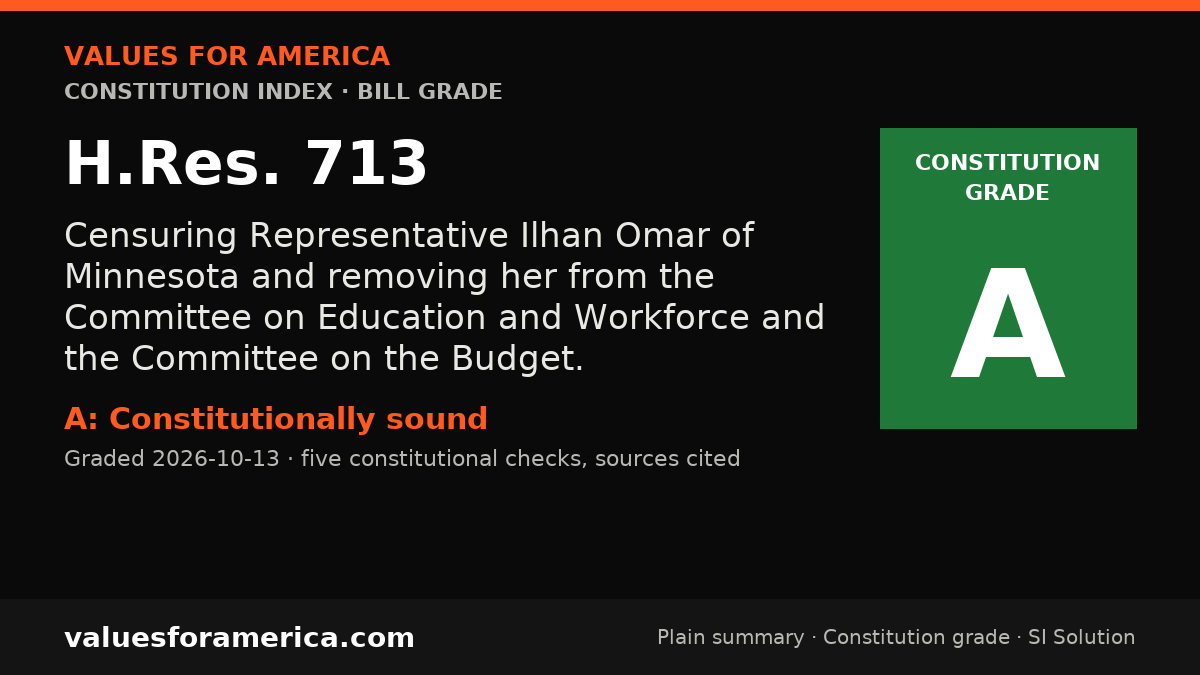
Censuring Representative Ilhan Omar of Minnesota and removing her from the Committee on Education and Workforce and the Committee on the Budget.
Cosponsors: none · per Congress.gov, 2026-10-10
Introduced: 2025-09-15
Latest action (2025-09-17): Motion to reconsider laid on the table Agreed to without objection.
What H.Res. 713 does, in plain terms
This resolution censures Representative Ilhan Omar of Minnesota and removes her from the Committee on Education and Workforce and the Committee on the Budget.
Official summary by the Congressional Research Service, via Congress.gov.
Constitution Index
“VFA Constitution grade”
Constitutionally sound
Graded 2026-10-13
SI-generated grade · five published checks · not individually reviewed by a person · methodology
The resolution is a disciplinary action by the House of Representatives against one of its members, a power explicitly granted to each chamber by the Constitution. It does not infringe on any constitutional rights, as the speech of a member in the context of House discipline is subject to the chamber's own rules and the Speech or Debate Clause does not protect against internal disciplinary proceedings. The action is internal to the House and does not involve federal power overreach, rights restriction, or surveillance. It passes all constitutional checks.
-
✓ Passes · Enumerated powers
Article I, Section 5, Clause 2 of the U.S. Constitution grants each House of Congress the power to 'determine the Rules of its Proceedings, punish its Members for disorderly Behaviour, and, with the Concurrence of two thirds, expel a Member.' Censuring a member and removing them from committees is a lesser disciplinary action than expulsion and falls squarely within this explicit grant of authorit… -
✓ Passes · Bill of Rights
The resolution does not infringe on any of the first ten amendments. It does not restrict speech, religion, assembly, press, or petition (First Amendment) in a general sense; rather, it is an internal disciplinary action by the House regarding a member's conduct. The Speech or Debate Clause (Article I, Section 6, Clause 1) protects members from arrest and questioning for legislative speech, but it… -
✓ Passes · Individual sovereignty
This action does not restrict what a person can do with their own person, property, speech, labor, or belief. It is a disciplinary action against a member of Congress for conduct related to their official duties, not a restriction on the general public. The member retains their full rights as a citizen and as a member of the House, except for the specific committee assignments removed. The governm… -
✓ Passes · Decentralization
This action is internal to the House of Representatives and does not involve any question of federal versus state or local authority. The four-question test is not applicable to internal legislative discipline, but if applied, it would pass: an individual or family cannot handle this (it is a matter of legislative governance), a local community or county cannot handle it, a state cannot handle it,… -
✓ Passes · Due process and takings
The resolution does not bypass due process or take property without just compensation. The House has its own procedures for disciplinary actions, and the resolution was subject to debate and a vote. The member was given notice and an opportunity to be heard, as is customary in such proceedings. There is no deprivation of life, liberty, or property; the removal from committees is a political conseq…
Sources: Congress.gov: HRES 713 summary
Report an error in this grade
What should pass
“VFA SI Solution”
No solution yet
A sourced SI draft appears here once it passes automated checks (Constitution citation, source verification, independent SI critic). How publication works.
Related on VFA

For journalists and bloggers
“Embed this grade”
Free to use with the link back. The badge and card update when the grade changes. Embed terms →
