H.Res. 682 explained · 119th Congress · Pending in Congress
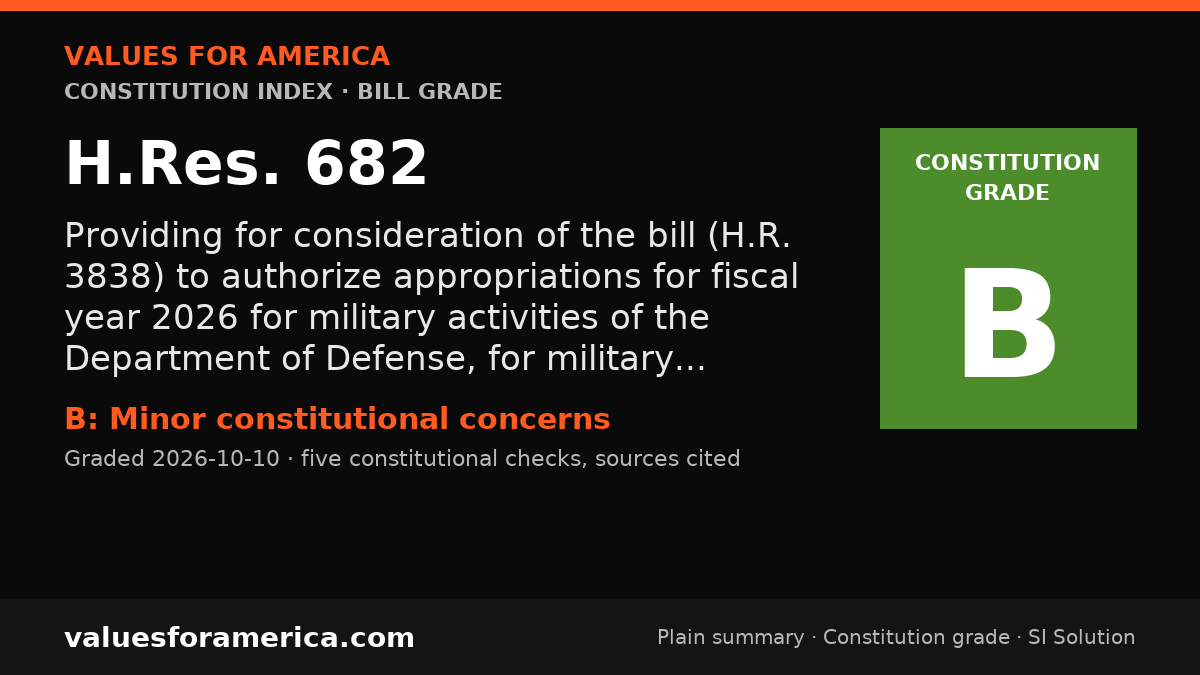
Providing for consideration of the bill (H.R. 3838) to authorize appropriations for fiscal year 2026 for military activities of the Department of Defense, for military construction, and for defense activities of the Department of Energy, to prescribe military personnel strengths for such fiscal year, and for other purposes, and providing for consideration of the bill (H.R. 3486) to amend the Immigration and Nationality Act to increase penalties for individuals who illegally enter and reenter the United States after being removed, and for other purposes.
Cosponsors: none · per Congress.gov, 2026-10-11
Introduced: 2025-09-09
Latest action (2025-09-09): Motion to reconsider laid on the table Agreed to without objection.
What H.Res. 682 does, in plain terms
This resolution provides for the consideration of the bill (H.R. 3838) to authorize appropriations for fiscal year 2026 for military activities of the Department of Defense, for military construction, and for defense activities of the Department of Energy, to prescribe military personnel strengths for such fiscal year, and for other purposes, and providing for consideration of the bill (H.R. 3486) to amend the Immigration and Nationality Act to increase penalties for individuals who illegally enter and reenter the United States after being removed, and for other purposes.
Official summary by the Congressional Research Service, via Congress.gov.
Constitution Index
“VFA Constitution grade”
Minor constitutional concerns
Graded 2026-10-10
SI-generated grade · five published checks · not individually reviewed by a person · methodology
This resolution is a procedural rule governing floor consideration of two substantive bills. It does not itself enact policy, but it facilitates consideration of a defense authorization bill and an immigration penalty bill. The defense bill falls within Congress's enumerated powers under Article I, Section 8, Clauses 11-14, and the immigration bill falls within the naturalization power under Article I, Section 8, Clause 4. The resolution itself raises no direct constitutional rights concerns, but the underlying immigration bill's increased penalties for illegal entry and reentry warrant scrutiny under the Eighth Amendment and due process. The resolution is a routine exercise of congressional rulemaking authority under Article I, Section 5, Clause 2, and does not consolidate power beyond the necessary level. Overall, the resolution is mostly sound, with minor tensions arising from the underlying immigration provisions.
-
✓ Passes · Enumerated powers
The resolution is a procedural rule for considering two bills. The defense authorization bill (H.R. 3838) falls squarely within Congress's enumerated powers under Article I, Section 8, Clauses 11-14 (declare war, raise and support armies, provide and maintain a navy, and make rules for the government and regulation of land and naval forces). The immigration bill (H.R. 3486) falls under Article I, … -
✗ Concern · Bill of Rights
The resolution itself does not infringe on any enumerated rights. However, the underlying immigration bill (H.R. 3486) increases penalties for illegal entry and reentry. While the Eighth Amendment prohibits cruel and unusual punishment, increased penalties for illegal entry are generally not considered cruel and unusual, as the Supreme Court has upheld immigration penalties as civil or criminal sa… -
✓ Passes · Individual sovereignty
The resolution does not directly restrict individual liberty. The underlying immigration bill increases penalties for illegal entry and reentry, which is a legitimate exercise of federal power to regulate immigration. While this restricts the freedom of non-citizens to enter the country, the government has a compelling interest in controlling its borders, and the restriction is not arbitrary. The … -
✓ Passes · Decentralization
The resolution is a procedural rule for Congress, which is inherently a federal function. The defense authorization bill addresses national defense, which cannot be handled by individuals, local communities, or states alone, as it requires a coordinated federal military. The immigration bill addresses border control and immigration enforcement, which is also a federal responsibility under the Cons… -
✓ Passes · Due process and takings
The resolution itself does not bypass due process or take property. The underlying immigration bill increases penalties for illegal entry and reentry, which must be applied through the criminal justice system with procedural due process protections, including notice and a hearing. The defense bill authorizes appropriations and does not involve takings. No due process or takings violations are evid…
Sources: Congress.gov: HRES 682 summary
Report an error in this grade
What should pass
“VFA SI Solution”
No solution yet
A sourced SI draft appears here once it passes automated checks (Constitution citation, source verification, independent SI critic). How publication works.
Related on VFA

For journalists and bloggers
“Embed this grade”
Free to use with the link back. The badge and card update when the grade changes. Embed terms →
