H.Res. 580 explained · 119th Congress · Pending in Congress
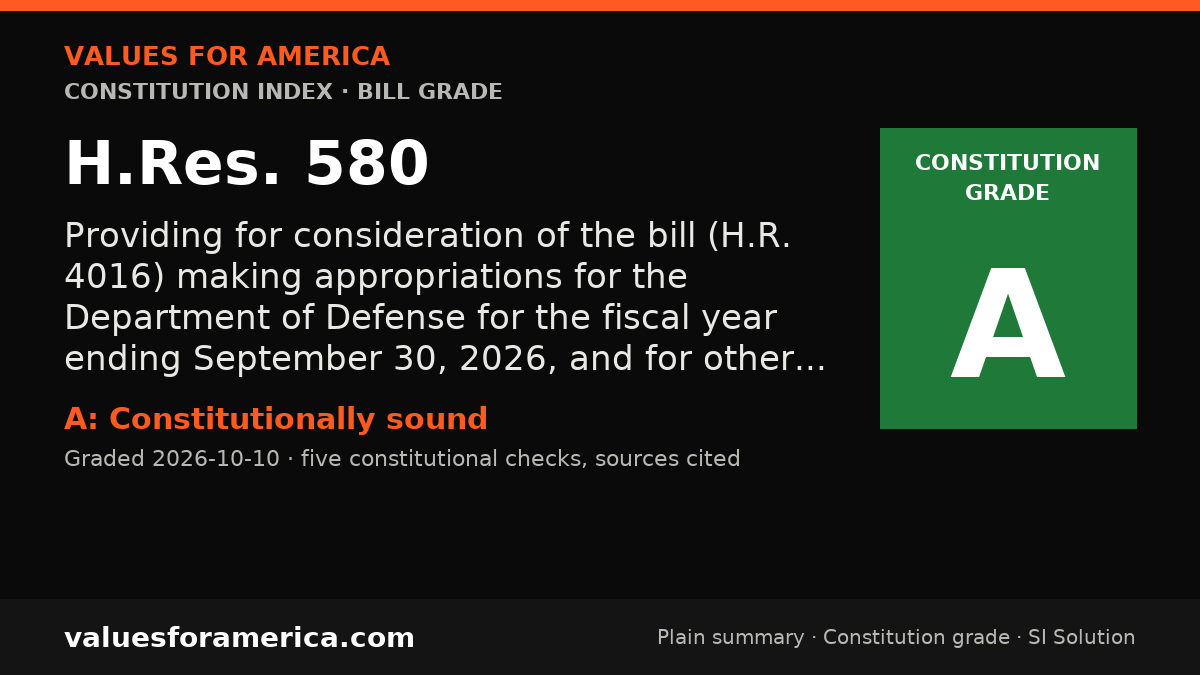
Providing for consideration of the bill (H.R. 4016) making appropriations for the Department of Defense for the fiscal year ending September 30, 2026, and for other purposes; providing for consideration of the bill (H.R. 3633) to provide for a system of regulation of the offer and sale of digital commodities by the Securities and Exchange Commission and the Commodity Futures Trading Commission, and for other purposes; providing for consideration of the bill (H.R. 1919) to amend the Federal Reserve Act to prohibit the Federal reserve banks from offering certain products or services directly to an individual, to prohibit the use of central bank digital currency for monetary policy, and for other purposes; providing for consideration of the bill (S. 1582) to provide for the regulation of payment stablecoins, and for other purposes; and waiving a requirement of clause 6(a) of rule XIII with respect to consideration of certain resolutions reported from the Committee on Rules.
Cosponsors: none · per Congress.gov, 2026-10-11
Introduced: 2025-07-15
Latest action (2025-07-16): On agreeing to the resolution Agreed to by recorded vote: 217 - 212 (Roll no. 198).
What H.Res. 580 does, in plain terms
The Congressional Research Service has not published a summary of H.Res. 580 yet. Its official title: “Providing for consideration of the bill (H.R. 4016) making appropriations for the Department of Defense for the fiscal year ending September 30, 2026, and for other purposes; providing for consideration of the bill (H.R. 3633) to provide for a system of regulation of the offer and sale of digital commodities by the Securities and Exchange Commission and the Commodity Futures Trading Commission, and for other purposes; providing for consideration of the bill (H.R. 1919) to amend the Federal Reserve Act to prohibit the Federal reserve banks from offering certain products or services directly to an individual, to prohibit the use of central bank digital currency for monetary policy, and for other purposes; providing for consideration of the bill (S. 1582) to provide for the regulation of payment stablecoins, and for other purposes; and waiving a requirement of clause 6(a) of rule XIII with respect to consideration of certain resolutions reported from the Committee on Rules.”.
Constitution Index
“VFA Constitution grade”
Constitutionally sound
Graded 2026-10-10
SI-generated grade · five published checks · not individually reviewed by a person · methodology
This resolution is a procedural rule governing floor consideration of several bills in the House of Representatives. It does not enact substantive policy, appropriate funds, or regulate conduct. It operates entirely within the House's constitutional authority to determine its own rules and proceedings under Article I, Section 5, Clause 2. No rights are infringed, no powers are exceeded, and no due process or takings concerns arise. The resolution is fully constitutional.
-
✓ Passes · Enumerated powers
The resolution is a procedural measure under Article I, Section 5, Clause 2, which grants each House of Congress the power to 'determine the Rules of its Proceedings.' It sets the terms for debate, amendment, and consideration of specific bills. This is a core legislative function explicitly delegated to the House. No enumerated power is exceeded because the resolution itself does not exercise any… -
✓ Passes · Bill of Rights
The resolution does not regulate speech, religion, assembly, press, petition, arms, quartering, search and seizure, self-incrimination, due process, takings, trial rights, jury rights, cruel and unusual punishment, or any other protected right. It is purely procedural and internal to the House. It does not affect any individual's rights under the Bill of Rights. -
✓ Passes · Individual sovereignty
The resolution imposes no restrictions on individuals' person, property, speech, labor, or belief. It does not create any criminal or civil liability, nor does it authorize any government action against individuals. It only governs how Members of the House may debate and vote on certain bills. Individual sovereignty is untouched. -
✓ Passes · Decentralization
This resolution concerns the internal procedures of the House of Representatives. It does not involve any action by individuals, local communities, or states. The question of decentralization is inapplicable because the resolution is a matter of federal legislative procedure, which by its nature must be handled at the federal level. It does not consolidate any decision-making authority that could … -
✓ Passes · Due process and takings
The resolution does not deprive any person of life, liberty, or property, nor does it take private property for public use. It does not affect any individual's procedural or substantive due process rights. The resolution is a rule of legislative procedure, not a law that applies to persons or property. No due process or takings issue arises.
Report an error in this grade
What should pass
“VFA SI Solution”
No solution yet
A sourced SI draft appears here once it passes automated checks (Constitution citation, source verification, independent SI critic). How publication works.
Related on VFA

For journalists and bloggers
“Embed this grade”
Free to use with the link back. The badge and card update when the grade changes. Embed terms →
