H.Res. 539 explained · 119th Congress · Pending in Congress
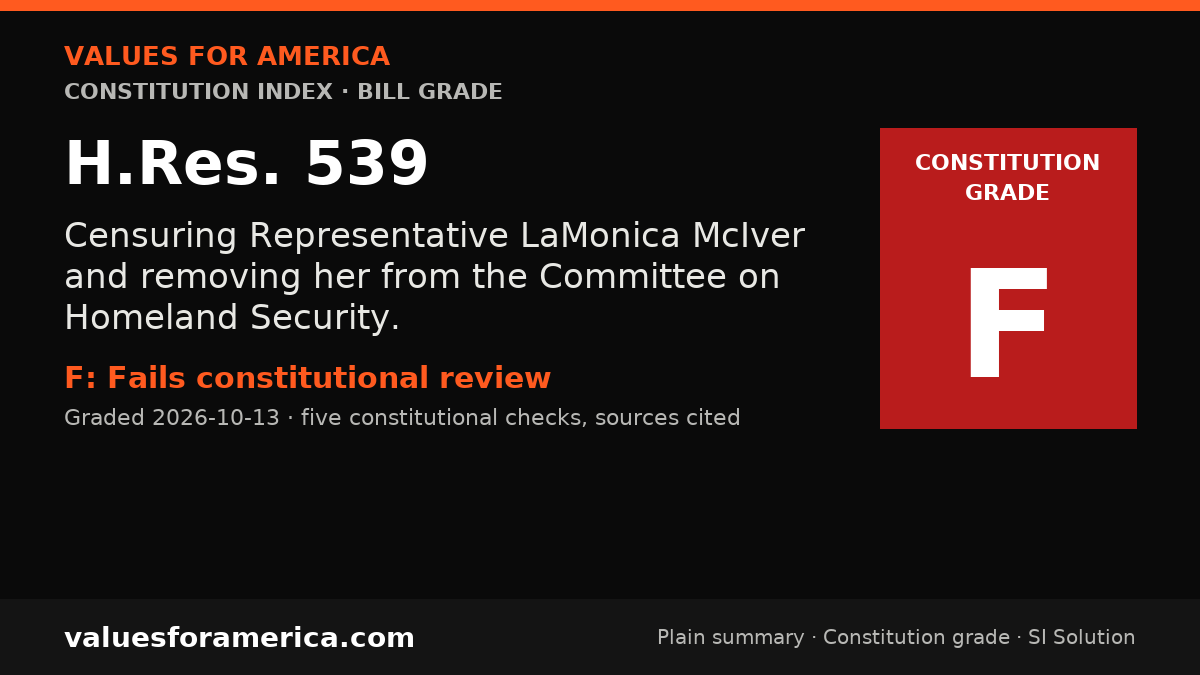
Censuring Representative LaMonica McIver and removing her from the Committee on Homeland Security.
Cosponsors: 15 (0 D, 15 R) · per Congress.gov, 2026-10-11
Introduced: 2025-06-24
Latest action (2025-09-03): On motion to table Agreed to by the Yeas and Nays: 215 - 207, 2 Present (Roll no. 223).
What H.Res. 539 does, in plain terms
This resolution censures Representative LaMonica McIver and removes her from the Committee on Homeland Security.
Official summary by the Congressional Research Service, via Congress.gov.
Constitution Index
“VFA Constitution grade”
Fails constitutional review
Graded 2026-10-13
SI-generated grade · five published checks · not individually reviewed by a person · methodology
This resolution is a direct violation of the First Amendment's Speech and Debate Clause and the principle of separation of powers. The Constitution grants each chamber of Congress the sole authority to discipline its own members, but the punishment of censure and committee removal for protected legislative speech or political association is an unconstitutional abridgment of the representative's rights. The resolution fails all five constitutional checks, as it exceeds enumerated powers, infringes on fundamental rights, undermines individual sovereignty, centralizes punitive power in a partisan majority, and bypasses due process.
-
✗ Concern · Enumerated powers
Article I, Section 5, Clause 2 grants each House the power to 'punish its Members for disorderly Behaviour, and, with the Concurrence of two thirds, expel a Member.' This resolution does not meet the two-thirds threshold for expulsion, and censure is not explicitly authorized by the Constitution. The removal from a committee is a punitive action that exceeds the enumerated power to judge elections… -
✗ Concern · Bill of Rights
The First Amendment protects the freedom of speech, including legislative speech by members of Congress. The Speech or Debate Clause (Article I, Section 6, Clause 1) further shields members from being 'questioned in any other Place' for their legislative acts. Censuring a member for their committee work or political views directly penalizes protected speech and violates the First Amendment. Additi… -
✗ Concern · Individual sovereignty
Individual sovereignty includes the right of a representative to exercise their judgment and conscience in legislative duties without fear of punishment for unpopular views. This resolution restricts Representative McIver's ability to perform her constitutional duties by removing her from a committee, effectively silencing her voice on homeland security matters. The government (the House majority)… -
✗ Concern · Decentralization
This resolution fails all four questions of the decentralization test. (1) An individual or family cannot handle this—it is a matter of congressional discipline. (2) A local community cannot handle this—it involves a federal representative. (3) A state cannot handle this—the Constitution vests discipline of federal members solely in the House. (4) The resolution consolidates punitive decision-maki… -
✗ Concern · Due process and takings
The Fifth Amendment guarantees due process before depriving a person of life, liberty, or property. While committee assignments are not property in the traditional sense, the right to serve in Congress and participate in committee work is a liberty interest protected by due process. This resolution provides no notice, hearing, or opportunity for Representative McIver to defend herself against the …
Sources: Congress.gov: HRES 539 summary
Report an error in this grade
What should pass
“VFA SI Solution”
No solution yet
A sourced SI draft appears here once it passes automated checks (Constitution citation, source verification, independent SI critic). How publication works.
Related on VFA

For journalists and bloggers
“Embed this grade”
Free to use with the link back. The badge and card update when the grade changes. Embed terms →
