H.Res. 537 explained · 119th Congress · Pending in Congress
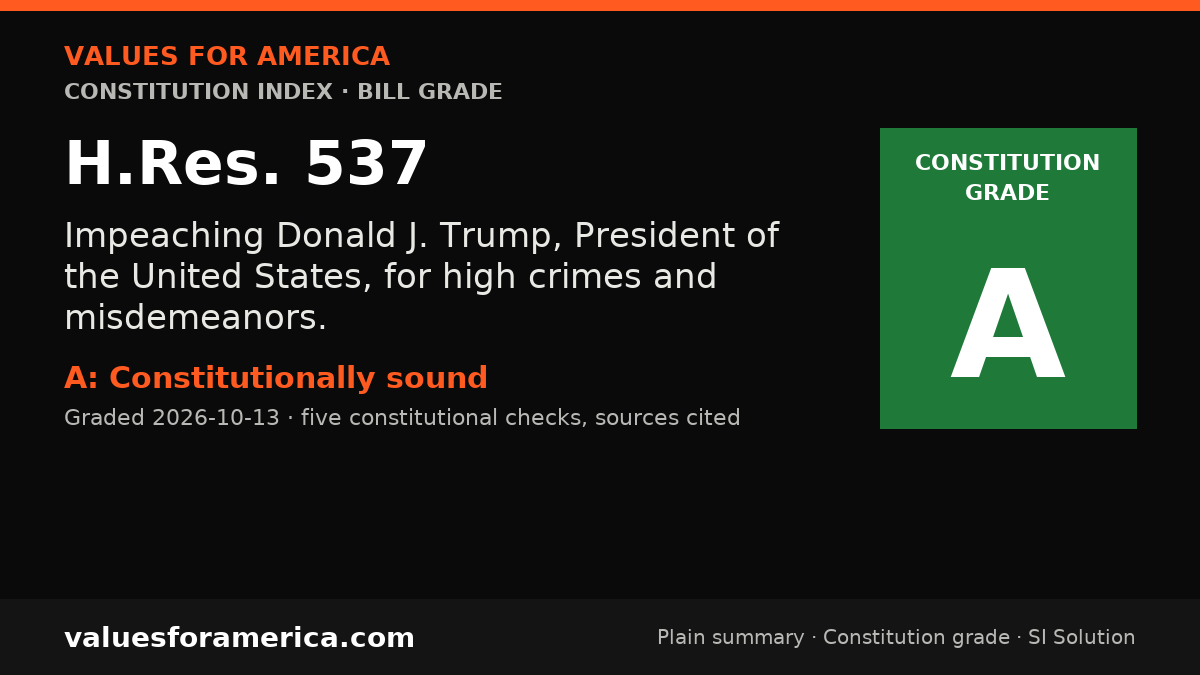
Impeaching Donald J. Trump, President of the United States, for high crimes and misdemeanors.
Cosponsors: 1 (1 D, 0 R) · per Congress.gov, 2026-10-11
Introduced: 2025-06-24
Latest action (2025-06-24): Motion to reconsider laid on the table Agreed to without objection.
What H.Res. 537 does, in plain terms
This resolution impeaches President Donald Trump for high crimes and misdemeanors. The resolution sets forth one article of impeachment concerning abuse of presidential powers by usurping Congress's power to declare war.
Official summary by the Congressional Research Service, via Congress.gov.
Constitution Index
“VFA Constitution grade”
Constitutionally sound
Graded 2026-10-13
SI-generated grade · five published checks · not individually reviewed by a person · methodology
The resolution is a constitutionally sound exercise of Congress's sole power of impeachment under Article I, Section 2, Clause 5 and Article I, Section 3, Clause 6. It does not infringe any rights, respects individual sovereignty, properly centralizes only what the Constitution requires at the federal level, and follows the due process of impeachment as outlined in the Constitution.
-
✓ Passes · Enumerated powers
Article I, Section 2, Clause 5 grants the House of Representatives the sole power of impeachment. Article I, Section 3, Clause 6 grants the Senate the sole power to try impeachments. This resolution is a direct exercise of that enumerated power. The subject matter — abuse of presidential powers by usurping Congress's war-declaring power — falls within the scope of 'high crimes and misdemeanors' as… -
✓ Passes · Bill of Rights
Impeachment proceedings do not implicate any of the first ten amendments. The resolution does not restrict speech, religion, press, assembly, petition, arms, quartering, search and seizure, self-incrimination, due process, takings, trial rights, jury rights, or cruel and unusual punishment. The Bill of Rights is not engaged by this action. -
✓ Passes · Individual sovereignty
This resolution targets the conduct of a public official in their official capacity — specifically, the President's alleged abuse of the war power. It does not restrict any individual's person, property, speech, labor, or belief. The government's action is directed at a constitutional officer, not at a private citizen's sovereign rights. -
✓ Passes · Decentralization
Impeachment of a federal officer is inherently a federal function that cannot be handled by individuals, local communities, or states. The Constitution explicitly assigns this power to Congress. The resolution does not consolidate decision-making upward beyond what the Constitution mandates; it is the minimum necessary level of government for this function. -
✓ Passes · Due process and takings
Impeachment is a political process, not a criminal one, and the Constitution provides its own procedural framework: the House impeaches, the Senate tries, and a two-thirds vote is required for conviction. The resolution does not bypass any due process protections; it initiates a process that includes notice, hearing, and a vote. No property is taken without just compensation.
Sources: Congress.gov: HRES 537 summary
Report an error in this grade
What should pass
“VFA SI Solution”
No solution yet
A sourced SI draft appears here once it passes automated checks (Constitution citation, source verification, independent SI critic). How publication works.
Related on VFA

For journalists and bloggers
“Embed this grade”
Free to use with the link back. The badge and card update when the grade changes. Embed terms →
