H.Res. 530 explained · 119th Congress · Pending in Congress
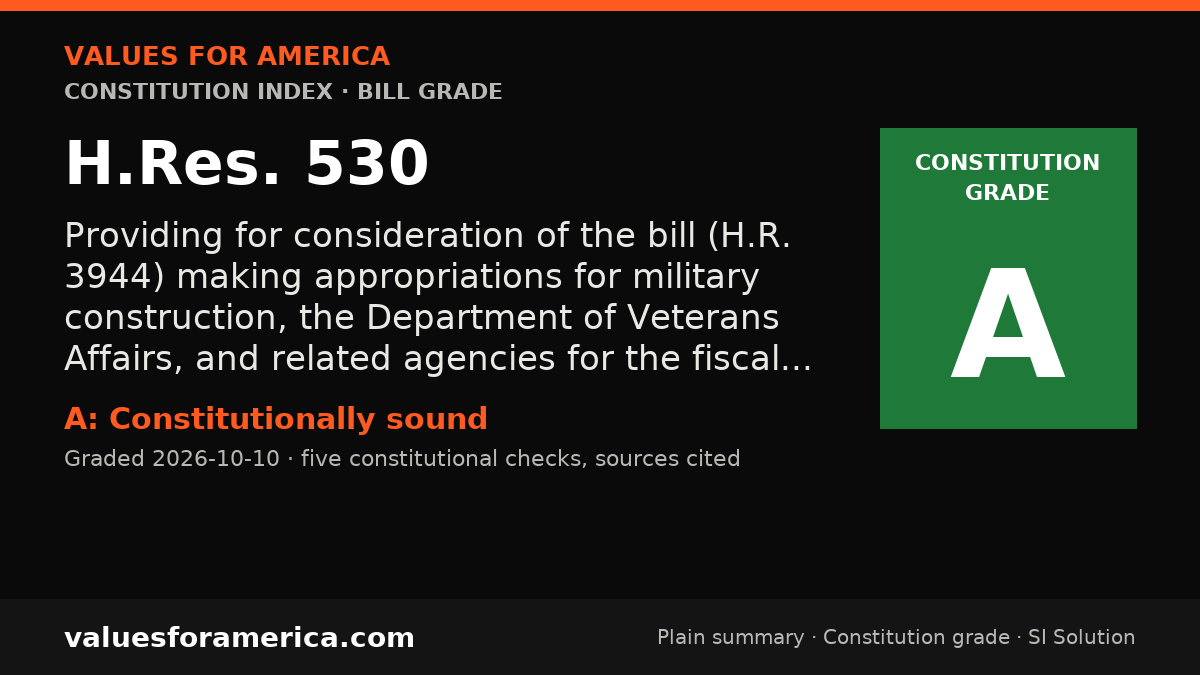
Providing for consideration of the bill (H.R. 3944) making appropriations for military construction, the Department of Veterans Affairs, and related agencies for the fiscal year ending September 30, 2026, and for other purposes; providing for consideration of the bill (H.R. 275) to require the Secretary of Homeland Security to publish on a monthly basis the number of special interest aliens encountered attempting to unlawfully enter the United States, and for other purposes; providing for consideration of the bill (H.R. 875) to amend the Immigration and Nationality Act to provide that aliens who have been convicted of or who have committed an offense for driving while intoxicated or impaired are inadmissible and deportable; and providing for consideration of the resolution (H. Res. 516) condemning the violent June 2025 riots in Los Angeles, California.
Cosponsors: none · per Congress.gov, 2026-10-11
Introduced: 2025-06-23
Latest action (2025-06-24): Motion to reconsider laid on the table Agreed to without objection.
What H.Res. 530 does, in plain terms
The Congressional Research Service has not published a summary of H.Res. 530 yet. Its official title: “Providing for consideration of the bill (H.R. 3944) making appropriations for military construction, the Department of Veterans Affairs, and related agencies for the fiscal year ending September 30, 2026, and for other purposes; providing for consideration of the bill (H.R. 275) to require the Secretary of Homeland Security to publish on a monthly basis the number of special interest aliens encountered attempting to unlawfully enter the United States, and for other purposes; providing for consideration of the bill (H.R. 875) to amend the Immigration and Nationality Act to provide that aliens who have been convicted of or who have committed an offense for driving while intoxicated or impaired are inadmissible and deportable; and providing for consideration of the resolution (H. Res. 516) condemning the violent June 2025 riots in Los Angeles, California.”.
Constitution Index
“VFA Constitution grade”
Constitutionally sound
Graded 2026-10-10
SI-generated grade · five published checks · not individually reviewed by a person · methodology
This resolution is a procedural rule governing floor debate and amendment of four separate measures in the House of Representatives. It does not enact any substantive law, authorize any executive action, or restrict any individual right. It is a routine exercise of each chamber's constitutional authority to determine its own rules of proceedings under Article I, Section 5, Clause 2. All five constitutional checks find no infringement or overreach.
-
✓ Passes · Enumerated powers
Article I, Section 5, Clause 2 of the U.S. Constitution provides that 'Each House may determine the Rules of its Proceedings.' H. Res. 530 is a pure procedural rule setting debate time, amendment order, and waiver of points of order for four bills. It does not exercise any substantive legislative power beyond the House's internal governance. No enumerated power is exceeded. -
✓ Passes · Bill of Rights
The resolution does not restrict speech, press, assembly, religion, petition, arms, quartering, search and seizure, self-incrimination, due process, takings, trial rights, or cruel and unusual punishment. It does not infringe any provision of the first ten amendments. It merely structures debate on other bills, none of which are themselves enacted by this resolution. -
✓ Passes · Individual sovereignty
The resolution imposes no restriction on any person's person, property, speech, labor, or belief. It governs only the internal legislative process of the House. No individual is commanded, prohibited, or penalized. The government bears no burden to justify a restriction because no restriction exists. -
✓ Passes · Decentralization
This resolution is a procedural rule for the House of Representatives, a federal legislative body. The four-question test is designed for substantive government actions affecting citizens, not for internal parliamentary procedure. However, applying the test: (1) an individual cannot set House rules; (2) a local community cannot; (3) a state cannot; (4) the action does not consolidate decision-maki… -
✓ Passes · Due process and takings
The resolution does not deprive any person of life, liberty, or property; it does not take private property; it does not bypass any hearing or notice requirement. It is a purely procedural measure governing legislative debate. No due process or takings issue arises.
Report an error in this grade
What should pass
“VFA SI Solution”
No solution yet
A sourced SI draft appears here once it passes automated checks (Constitution citation, source verification, independent SI critic). How publication works.
Related on VFA

For journalists and bloggers
“Embed this grade”
Free to use with the link back. The badge and card update when the grade changes. Embed terms →
