H.Res. 53 explained · 119th Congress · Pending in Congress
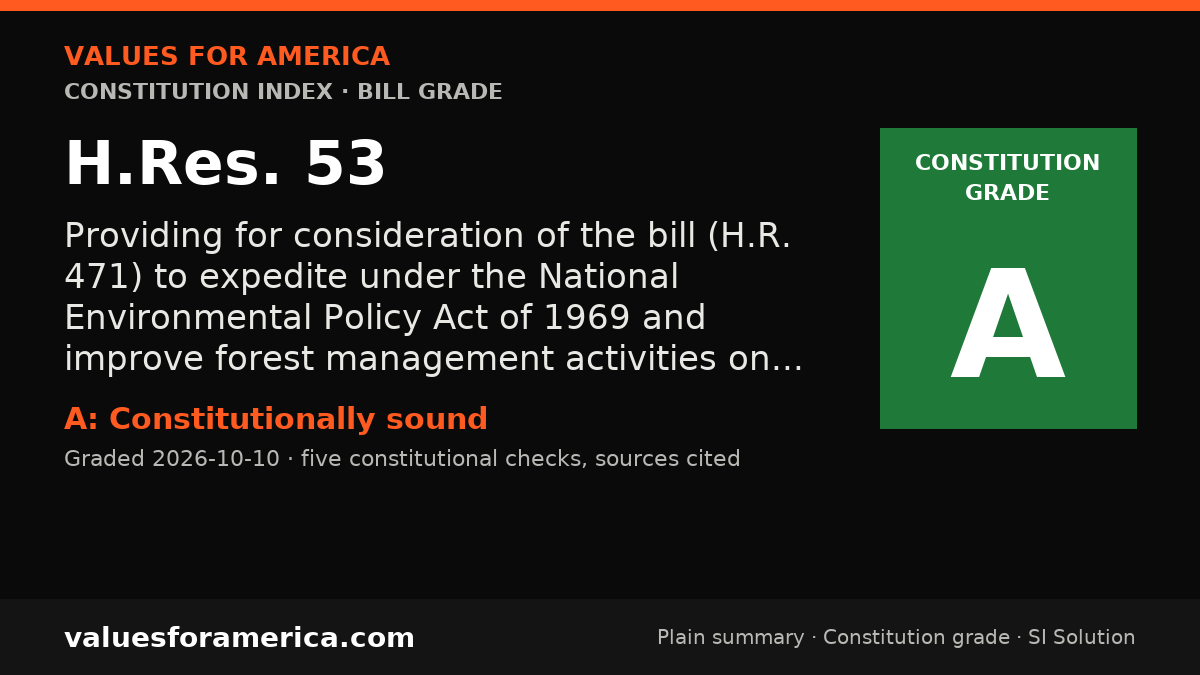
Providing for consideration of the bill (H.R. 471) to expedite under the National Environmental Policy Act of 1969 and improve forest management activities on National Forest System lands, on public lands under the jurisdiction of the Bureau of Land Management, and on Tribal lands to return resilience to overgrown, fire-prone forested lands, and for other purposes, and providing for consideration of the bill (S. 5) to require the Secretary of Homeland Security to take into custody aliens who have been charged in the United States with theft, and for other purposes.
Cosponsors: none · per Congress.gov, 2026-10-12
Introduced: 2025-01-21
Latest action (2025-01-22): Motion to reconsider laid on the table Agreed to without objection.
What H.Res. 53 does, in plain terms
The Congressional Research Service has not published a summary of H.Res. 53 yet. Its official title: “Providing for consideration of the bill (H.R. 471) to expedite under the National Environmental Policy Act of 1969 and improve forest management activities on National Forest System lands, on public lands under the jurisdiction of the Bureau of Land Management, and on Tribal lands to return resilience to overgrown, fire-prone forested lands, and for other purposes, and providing for consideration of the bill (S. 5) to require the Secretary of Homeland Security to take into custody aliens who have been charged in the United States with theft, and for other purposes.”.
Constitution Index
“VFA Constitution grade”
Constitutionally sound
Graded 2026-10-10
SI-generated grade · five published checks · not individually reviewed by a person · methodology
This resolution is a procedural rule governing floor consideration of two bills in the House of Representatives. It does not enact substantive policy, appropriate funds, or alter legal rights. It falls squarely within the House's constitutional authority to determine its own rules and proceedings under Article I, Section 5, Clause 2. No enumerated power is exceeded, no rights are infringed, and no due process or takings concerns arise. The resolution is fully constitutional.
-
✓ Passes · Enumerated powers
The resolution is a procedural measure under Article I, Section 5, Clause 2, which grants each House of Congress the power to determine the rules of its proceedings. It merely sets the terms for debate and amendment of two bills. It does not exercise any substantive legislative power beyond the House's internal rulemaking authority, which is explicitly granted by the Constitution. -
✓ Passes · Bill of Rights
The resolution does not restrict speech, religion, press, assembly, petition, the right to keep and bear arms, or any other right protected by the Bill of Rights. It is a procedural rule that applies only to the internal operations of the House of Representatives. It does not affect the rights of any person outside the legislative process. -
✓ Passes · Individual sovereignty
The resolution imposes no restrictions on individual conduct, property, speech, labor, or belief. It does not regulate private citizens or entities. It only governs how the House will consider two bills. Individual sovereignty is not implicated. -
✓ Passes · Decentralization
This resolution is a purely internal legislative procedure. It does not consolidate decision-making at any level of government; it is the House of Representatives exercising its own constitutional authority to structure its proceedings. The four-question test is not applicable to internal legislative rules, but even if applied, the resolution does not shift power from individuals, localities, or s… -
✓ Passes · Due process and takings
The resolution does not deprive any person of life, liberty, or property, nor does it take property for public use. It does not involve any adjudicative or administrative process. The waiver of points of order is a procedural mechanism within the House's constitutional authority and does not implicate due process or takings protections.
Report an error in this grade
What should pass
“VFA SI Solution”
No solution yet
A sourced SI draft appears here once it passes automated checks (Constitution citation, source verification, independent SI critic). How publication works.
Related on VFA

For journalists and bloggers
“Embed this grade”
Free to use with the link back. The badge and card update when the grade changes. Embed terms →
