H.Res. 519 explained · 119th Congress · Pending in Congress
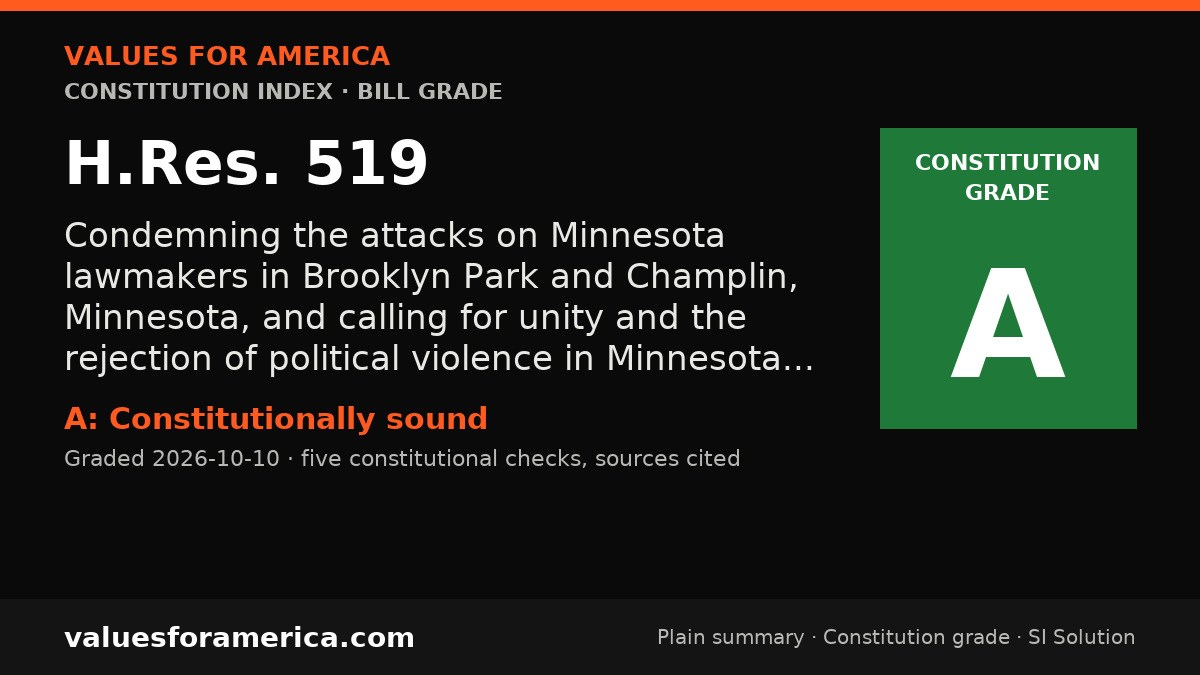
Condemning the attacks on Minnesota lawmakers in Brooklyn Park and Champlin, Minnesota, and calling for unity and the rejection of political violence in Minnesota and across the United States.
Cosponsors: 7 (3 D, 4 R) · per Congress.gov, 2026-10-11
Introduced: 2025-06-17
Latest action (2025-06-25): Motion to reconsider laid on the table Agreed to without objection.
What H.Res. 519 does, in plain terms
This resolution condemns the June 14, 2025, attacks on Minnesota state legislators and calls on all people in the United States to reaffirm our commitment to a safe, civil, and peaceful democracy. The resolution also honors (1) the lives of Speaker Emerita Melissa Hortman and her husband Mark Hortman who were killed, (2) Senator John Hoffman and his wife Yvette Hoffman who were critically injured, and (3) the law enforcement officers who rapidly responded to the attacks and apprehended the suspected perpetrator.
Official summary by the Congressional Research Service, via Congress.gov.
Constitution Index
“VFA Constitution grade”
Constitutionally sound
Graded 2026-10-10
SI-generated grade · five published checks · not individually reviewed by a person · methodology
This resolution is purely expressive and symbolic. It condemns political violence, honors victims, and calls for civic unity. It imposes no legal obligations, restricts no rights, and exercises no coercive power. It is fully consistent with the Constitution.
-
✓ Passes · Enumerated powers
The resolution is a non-binding expression of opinion by the House of Representatives. While Article I does not explicitly grant Congress the power to issue condemnations or calls for unity, such resolutions are a traditional and accepted exercise of the legislative branch's inherent authority to debate, express views, and memorialize events. No coercive or regulatory power is exercised, so no enu… -
✓ Passes · Bill of Rights
The resolution does not infringe any right protected by the Bill of Rights. It does not restrict speech, religion, assembly, press, petition, arms, quartering, search and seizure, self-incrimination, due process, takings, trial rights, or cruel and unusual punishment. It merely expresses condemnation of violence and calls for peaceful conduct, which is itself protected speech under the First Amend… -
✓ Passes · Individual sovereignty
The resolution imposes no restrictions on individual person, property, speech, labor, or belief. It is purely hortatory and does not command or prohibit any action. Individuals remain free to disagree with the resolution or ignore its call for unity without penalty. -
✓ Passes · Decentralization
The resolution is a non-binding expression of opinion by the federal legislature. It does not preempt state or local action, impose mandates, or consolidate decision-making authority. Each of the four questions is answered in the negative because no action is being taken that could be handled at a lower level. -
✓ Passes · Due process and takings
The resolution does not deprive any person of life, liberty, or property, nor does it take private property for public use. It imposes no penalties, creates no legal obligations, and bypasses no procedural protections. It is purely symbolic and carries no legal effect.
Sources: Congress.gov: HRES 519 summary
Report an error in this grade
What should pass
“VFA SI Solution”
No solution yet
A sourced SI draft appears here once it passes automated checks (Constitution citation, source verification, independent SI critic). How publication works.
Related on VFA

For journalists and bloggers
“Embed this grade”
Free to use with the link back. The badge and card update when the grade changes. Embed terms →
