H.Res. 5 explained · 119th Congress · Pending in Congress
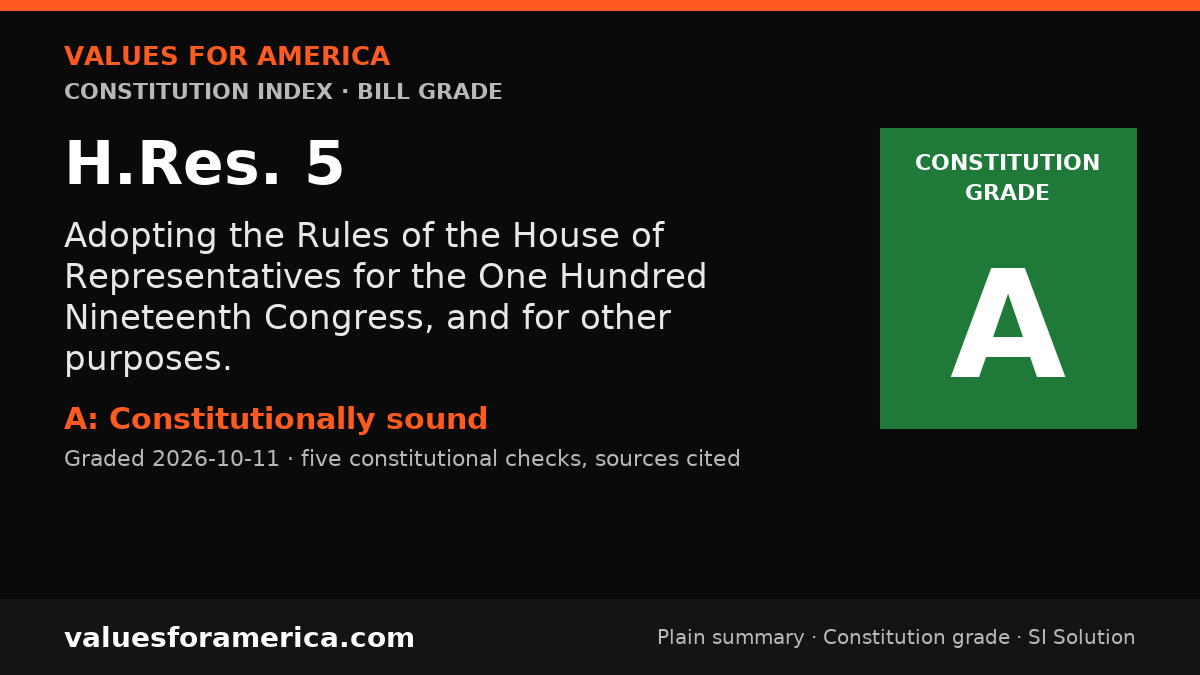
Adopting the Rules of the House of Representatives for the One Hundred Nineteenth Congress, and for other purposes.
Cosponsors: none · per Congress.gov, 2026-10-12
Introduced: 2025-01-03
Latest action (2025-01-03): Motion to reconsider laid on the table Agreed to without objection.
What H.Res. 5 does, in plain terms
This resolution establishes rules for the House of Representatives for the 119th Congress. The resolution adopts the rules from the 118th Congress with specified changes, including providing that a resolution vacating the Office of Speaker is only privileged (takes precedence over all matters other than motions to adjourn) if it is offered by a sponsor of the majority party joined by eight cosponsors from the majority party; providing that the Speaker may only entertain a motion to suspend the rules on Mondays, Tuesdays, and Wednesdays; prohibiting waiver (by rule or by order) of the germaneness rule (which requires amendments to be of the same subject matter as the measure under consideration); and prohibiting consideration of measures that exceed a specified long-term budget impact according to the Congressional Budget Office. Additional changes include authorizing the use of electronic voting within a committee; authorizing remote appearances by non-executive branch witnesses and their counsel in committee proceedings; eliminating the House Office of Diversity and Inclusion; eliminating certain collective bargaining rights for employees of the House of Representatives; reauthorizing the House Select Committee on the Strategic Competition Between the United States and the Chinese Communist Party; reauthorizing the Tom Lantos Human Rights Commission; and reauthorizing the House Democracy Assistance Commission (an entity that advises democratic parliaments in other countries) and renaming it the House Democracy Partnership. The resolution provides for the consideration of H.R. 21, H.R. 22, H.R. 23, H.R. 26, H.R. 27, H.R. 28, H.R. 29, H.R. 30, H.R. 31, H.R. 32, H.R. 33, and H.R. 35.
Official summary by the Congressional Research Service, via Congress.gov.
Constitution Index
“VFA Constitution grade”
Constitutionally sound
Graded 2026-10-11
SI-generated grade · five published checks · not individually reviewed by a person · methodology
The resolution is an internal rulemaking measure for the House of Representatives, squarely within the constitutional authority granted to each chamber to determine its own rules. It does not infringe on individual rights, does not consolidate power beyond the House itself, and does not implicate due process or takings concerns. The provisions, including those affecting House employees, are internal governance matters subject to the House's plenary authority.
-
✓ Passes · Enumerated powers
Article I, Section 5, Clause 2 of the U.S. Constitution provides that 'Each House may determine the Rules of its Proceedings.' This resolution is a rules package for the House of Representatives, thus it is directly authorized by an explicit constitutional grant. The provisions regarding committees, employee relations, and the consideration of specific bills are all internal matters within the Hou… -
✓ Passes · Bill of Rights
The resolution does not implicate any of the first ten amendments. It does not restrict speech, religion, assembly, press, or petition; it does not affect the right to bear arms; it does not involve quartering of soldiers; it does not authorize searches or seizures; it does not affect criminal proceedings, self-incrimination, due process, or takings; it does not affect trial by jury or cruel and u… -
✓ Passes · Individual sovereignty
The resolution does not restrict the personal liberty, property, speech, labor, or belief of any individual outside the internal operations of the House. It governs the conduct of House proceedings and the employment conditions of House staff, which are subject to the House's constitutional authority to manage its own affairs. No compelling constitutional justification is needed because no individ… -
✓ Passes · Decentralization
This is a matter of federal legislative procedure, which cannot be handled by individuals, local communities, or states. The Constitution explicitly assigns the power to make such rules to each house of Congress. The resolution does not consolidate decision-making at a higher level than necessary; it is the House exercising its own constitutional authority. -
✓ Passes · Due process and takings
The resolution does not deprive any person of life, liberty, or property without due process, nor does it take private property for public use without just compensation. The changes to House employee collective bargaining rights are internal employment matters, not deprivations of constitutional rights. The House has the authority to set its own employment terms, and no procedural due process viol…
Sources: Congress.gov: HRES 5 summary
Report an error in this grade
What should pass
“VFA SI Solution”
No solution yet
A sourced SI draft appears here once it passes automated checks (Constitution citation, source verification, independent SI critic). How publication works.
Related on VFA

For journalists and bloggers
“Embed this grade”
Free to use with the link back. The badge and card update when the grade changes. Embed terms →
