H.Res. 405 explained · 119th Congress · Pending in Congress
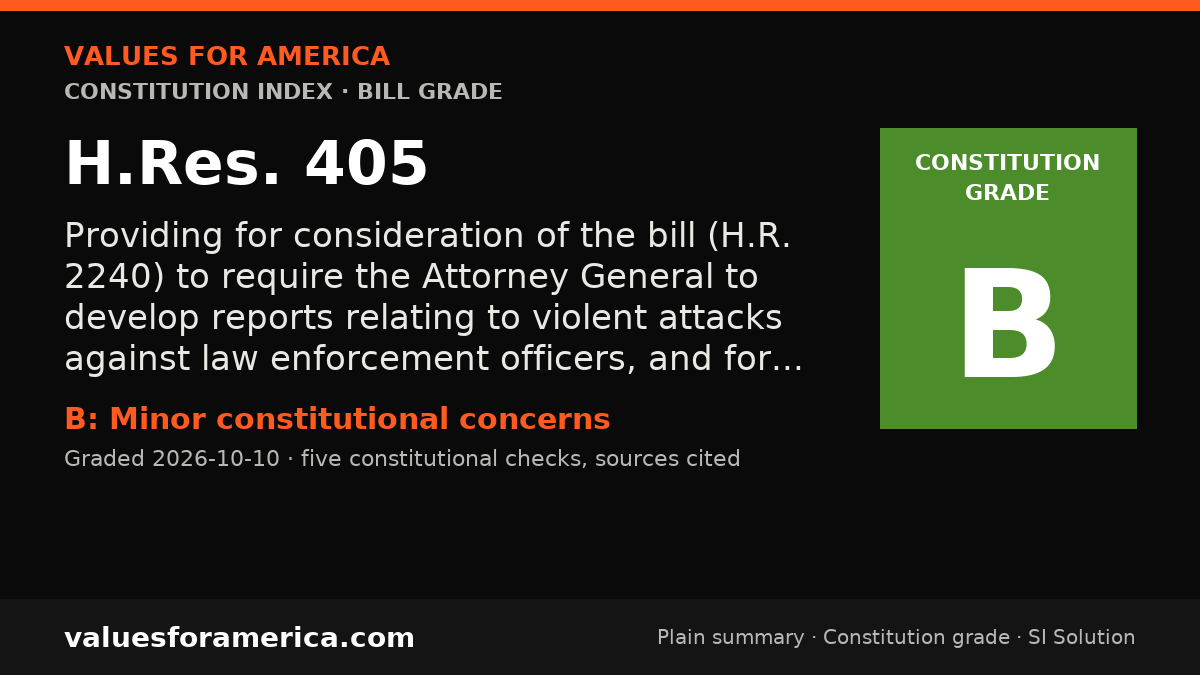
Providing for consideration of the bill (H.R. 2240) to require the Attorney General to develop reports relating to violent attacks against law enforcement officers, and for other purposes; providing for consideration of the bill (H.R. 2243) to amend title 18, United States Code, to improve the Law Enforcement Officer Safety Act and provisions relating to the carrying of concealed weapons by law enforcement officers, and for other purposes; and providing for consideration of the bill (H.R. 2255) to allow Federal law enforcement officers to purchase retired service weapons, and for other purposes.
Cosponsors: none · per Congress.gov, 2026-10-11
Introduced: 2025-05-13
Latest action (2025-05-14): Motion to reconsider laid on the table Agreed to without objection.
What H.Res. 405 does, in plain terms
The Congressional Research Service has not published a summary of H.Res. 405 yet. Its official title: “Providing for consideration of the bill (H.R. 2240) to require the Attorney General to develop reports relating to violent attacks against law enforcement officers, and for other purposes; providing for consideration of the bill (H.R. 2243) to amend title 18, United States Code, to improve the Law Enforcement Officer Safety Act and provisions relating to the carrying of concealed weapons by law enforcement officers, and for other purposes; and providing for consideration of the bill (H.R. 2255) to allow Federal law enforcement officers to purchase retired service weapons, and for other purposes.”.
Constitution Index
“VFA Constitution grade”
Minor constitutional concerns
Graded 2026-10-10
SI-generated grade · five published checks · not individually reviewed by a person · methodology
This resolution is a procedural rule governing floor consideration of three bills. It does not itself enact substantive law, but it waives points of order and limits debate, which raises minor concerns about deliberative process. The underlying bills appear to fall within Congress's enumerated powers, and none of the provisions clearly infringe constitutional rights. The rule's restrictions on amendment and debate are typical House procedures and do not rise to a constitutional violation, though they do consolidate decision-making in the House leadership.
-
✓ Passes · Enumerated powers
The resolution is a procedural measure for the House of Representatives, which has the constitutional authority to determine the rules of its proceedings under Article I, Section 5, Clause 2. The underlying bills relate to federal law enforcement, which falls under Congress's enumerated powers to regulate interstate commerce (Article I, Section 8, Clause 3) and to provide for the common defense an… -
✓ Passes · Bill of Rights
The resolution itself does not infringe any of the first ten amendments. It merely sets the terms for debate and amendment of three bills. The underlying bills concern law enforcement reporting, concealed carry by law enforcement officers, and purchase of retired service weapons. These touch on the Second Amendment, but the bills appear to expand or facilitate rights (e.g., allowing law enforcemen… -
✓ Passes · Individual sovereignty
The resolution does not directly restrict individual liberty. It is a procedural rule for the House. The underlying bills do not impose new restrictions on individuals; they relate to law enforcement officers' ability to carry weapons and purchase retired service weapons, which are permissive in nature. The reporting requirement on violent attacks against officers is a data collection measure that… -
✗ Concern · Decentralization
The resolution is a federal procedural rule, which by nature consolidates decision-making at the federal level. However, the underlying bills concern federal law enforcement officers and federal crimes, which are inherently federal matters. The four-question test: (1) individuals cannot handle federal law enforcement reporting or officer weapons policies; (2) local communities cannot regulate fede… -
✓ Passes · Due process and takings
The resolution does not bypass due process or take property. It is a procedural rule that waives points of order and limits debate, which is a standard legislative practice. The underlying bills do not deprive anyone of life, liberty, or property without due process. The purchase of retired service weapons is a voluntary transaction, not a taking. No due process or takings issues are present.
Report an error in this grade
What should pass
“VFA SI Solution”
No solution yet
A sourced SI draft appears here once it passes automated checks (Constitution citation, source verification, independent SI critic). How publication works.
Related on VFA

For journalists and bloggers
“Embed this grade”
Free to use with the link back. The badge and card update when the grade changes. Embed terms →
