H.Res. 242 explained · 119th Congress · Pending in Congress
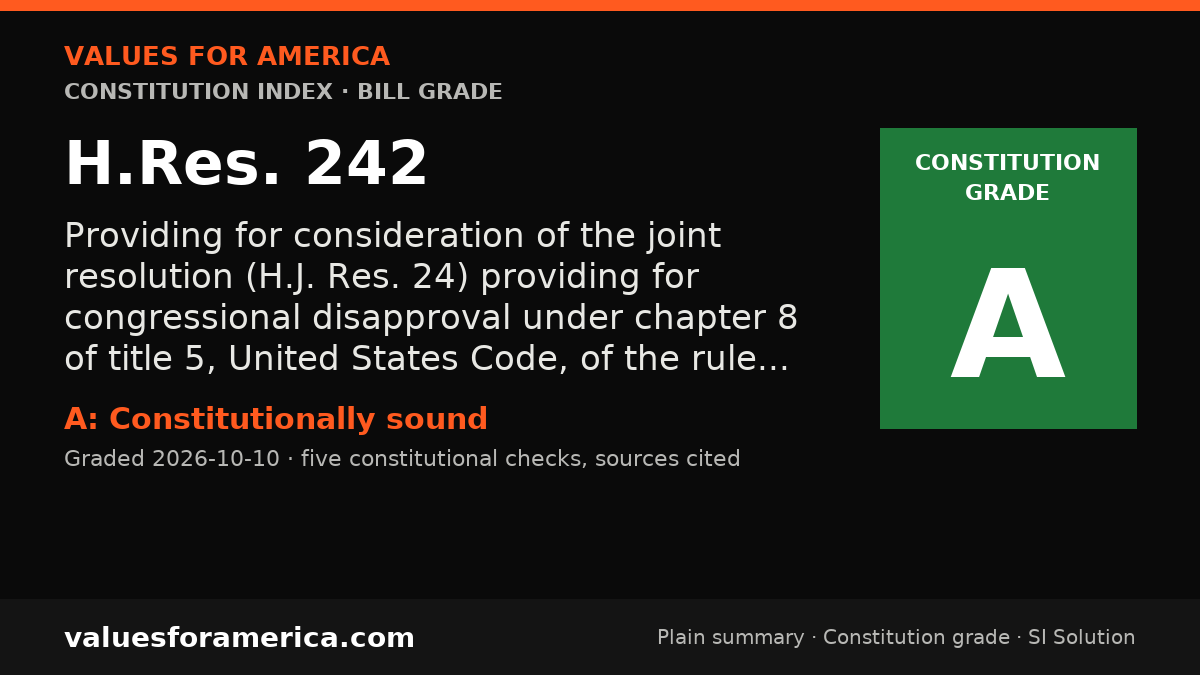
Providing for consideration of the joint resolution (H.J. Res. 24) providing for congressional disapproval under chapter 8 of title 5, United States Code, of the rule submitted by the Department of Energy relating to "Energy Conservation Program: Energy Conservation Standards for Walk-In Coolers and Walk-In Freezers"; providing for consideration of the joint resolution (H.J. Res. 75) providing for congressional disapproval under chapter 8 of title 5, United States Code, of the rule submitted by the Office of Energy Efficiency and Renewable Energy, Department of Energy relating to "Energy Conservation Program: Energy Conservation Standards for Commercial Refrigerators, Freezers, and Refrigerator-Freezers"; and providing for consideration of the bill (H.R. 1048) to amend the Higher Education Act of 1965 to strengthen disclosure requirements relating to foreign gifts and contracts, to prohibit contracts between institutions of higher education and certain foreign entities and countries of concern, and for other purposes.
Cosponsors: none · per Congress.gov, 2026-10-12
Introduced: 2025-03-24
Latest action (2025-03-25): Motion to reconsider laid on the table Agreed to without objection.
What H.Res. 242 does, in plain terms
The Congressional Research Service has not published a summary of H.Res. 242 yet. Its official title: “Providing for consideration of the joint resolution (H.J. Res. 24) providing for congressional disapproval under chapter 8 of title 5, United States Code, of the rule submitted by the Department of Energy relating to "Energy Conservation Program: Energy Conservation Standards for Walk-In Coolers and Walk-In Freezers"; providing for consideration of the joint resolution (H.J. Res. 75) providing for congressional disapproval under chapter 8 of title 5, United States Code, of the rule submitted by the Office of Energy Efficiency and Renewable Energy, Department of Energy relating to "Energy Conservation Program: Energy Conservation Standards for Commercial Refrigerators, Freezers, and Refrigerator-Freezers"; and providing for consideration of the bill (H.R. 1048) to amend the Higher Education Act of 1965 to strengthen disclosure requirements relating to foreign gifts and contracts, to prohibit contracts between institutions of higher education and certain foreign entities and countries of concern, and for other purposes.”.
Constitution Index
“VFA Constitution grade”
Constitutionally sound
Graded 2026-10-10
SI-generated grade · five published checks · not individually reviewed by a person · methodology
This resolution is a procedural rule governing floor consideration of three measures in the House of Representatives. It does not enact substantive policy, but rather sets the terms for debate and amendment. The Constitution grants each house of Congress the authority to determine the rules of its proceedings (Article I, Section 5, Clause 2), and this resolution is a textbook exercise of that authority. It does not infringe on any constitutional rights, does not expand federal power beyond enumerated authority, and does not implicate due process or takings concerns. The resolution is fully constitutional.
-
✓ Passes · Enumerated powers
The Constitution explicitly grants each house of Congress the power to determine the rules of its proceedings (Article I, Section 5, Clause 2). This resolution is a rule for the House of Representatives governing the consideration of specific legislation. It is a direct exercise of that enumerated power and does not exceed it. -
✓ Passes · Bill of Rights
The resolution does not implicate any of the first ten amendments. It does not restrict speech, religion, assembly, press, petition, arms, quartering, search and seizure, self-incrimination, due process, takings, fair trial, jury, cruel and unusual punishment, unenumerated rights, or reserved powers. It is purely procedural and does not affect individual rights. -
✓ Passes · Individual sovereignty
The resolution imposes no restrictions on individuals' person, property, speech, labor, or belief. It merely sets the terms for legislative debate and amendment. There is no government action that burdens individual freedom, and no compelling constitutional justification is needed because no restriction exists. -
✓ Passes · Decentralization
This resolution concerns the internal procedures of the House of Representatives, a matter that cannot be handled by individuals, local communities, or states. It is inherently a federal legislative function. The resolution does not consolidate decision-making upward; it is the exercise of the House's own constitutional authority over its proceedings. All four questions are answered in a way that … -
✓ Passes · Due process and takings
The resolution does not affect any person's life, liberty, or property. It does not involve any adjudicative process, does not deprive anyone of due process, and does not take any property. The Fifth Amendment's Due Process and Takings Clauses are not implicated.
Report an error in this grade
What should pass
“VFA SI Solution”
No solution yet
A sourced SI draft appears here once it passes automated checks (Constitution citation, source verification, independent SI critic). How publication works.
Related on VFA

For journalists and bloggers
“Embed this grade”
Free to use with the link back. The badge and card update when the grade changes. Embed terms →
