H.Res. 211 explained · 119th Congress · Pending in Congress
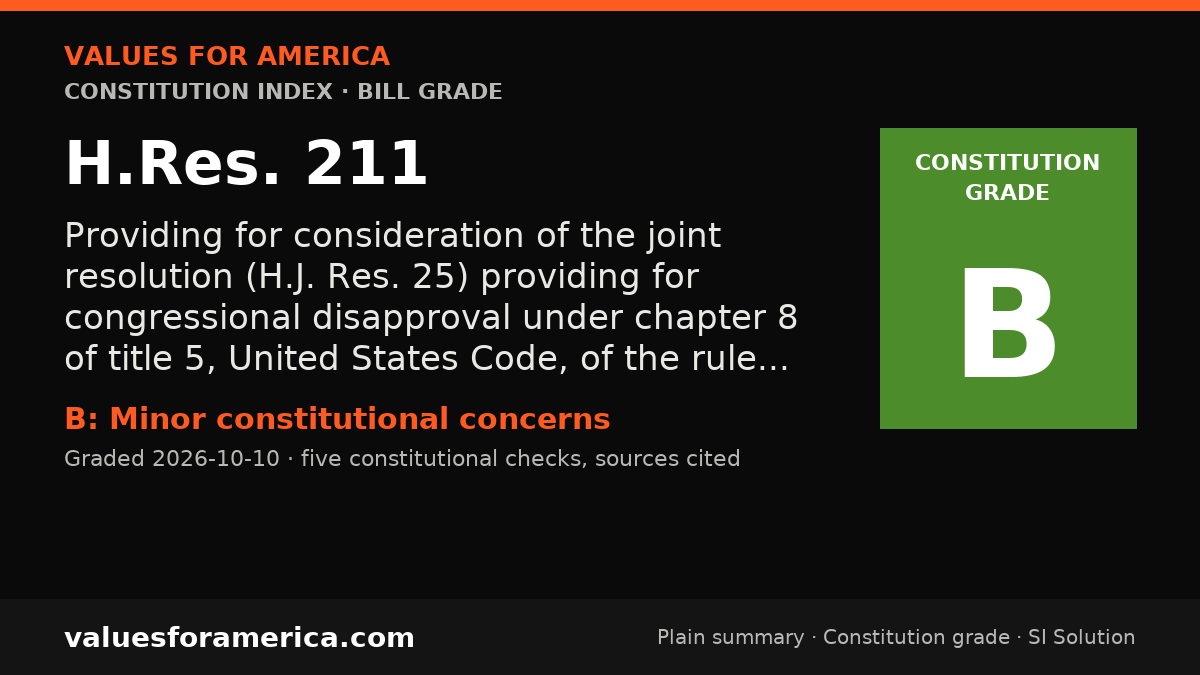
Providing for consideration of the joint resolution (H.J. Res. 25) providing for congressional disapproval under chapter 8 of title 5, United States Code, of the rule submitted by the Internal Revenue Service relating to ‘‘Gross Proceeds Reporting by Brokers That Regularly Provide Services Effectuating Digital Asset Sales’’; providing for consideration of the bill (H.R. 1156) to amend the CARES Act to extend the statute of limitations for fraud under certain unemployment programs, and for other purposes; providing for consideration of the bill (H.R. 1968) making further continuing appropriations and other extensions for the fiscal year ending September 30, 2025, and for other purposes; and for other purposes.
Cosponsors: none · per Congress.gov, 2026-10-10
Introduced: 2025-03-11
Latest action (2025-09-16): Pursuant to the provisions of H.Res. 707, H.Res. 211 is amended.
What H.Res. 211 does, in plain terms
The Congressional Research Service has not published a summary of H.Res. 211 yet. Its official title: “Providing for consideration of the joint resolution (H.J. Res. 25) providing for congressional disapproval under chapter 8 of title 5, United States Code, of the rule submitted by the Internal Revenue Service relating to ‘‘Gross Proceeds Reporting by Brokers That Regularly Provide Services Effectuating Digital Asset Sales’’; providing for consideration of the bill (H.R. 1156) to amend the CARES Act to extend the statute of limitations for fraud under certain unemployment programs, and for other purposes; providing for consideration of the bill (H.R. 1968) making further continuing appropriations and other extensions for the fiscal year ending September 30, 2025, and for other purposes; and for other purposes.”.
Constitution Index
“VFA Constitution grade”
Minor constitutional concerns
Graded 2026-10-10
SI-generated grade · five published checks · not individually reviewed by a person · methodology
This resolution is a procedural rule governing floor consideration of several bills. It does not itself enact substantive law, but it waives points of order and restricts amendments, which raises minor concerns about deliberative process. The resolution also includes a provision affecting the National Emergencies Act calendar, which is within Congress's constitutional authority. Overall, the resolution is within Congress's enumerated powers and does not infringe on individual rights, but the waiver of points of order and limitation on amendments present minor due process concerns.
-
✓ Passes · Enumerated powers
The resolution is a procedural measure under Article I, Section 5, Clause 2, which grants each House the power to determine the rules of its proceedings. It also facilitates Congress's exercise of its legislative powers under Article I, Section 8, including the power to tax (for the IRS rule disapproval), to appropriate funds (for the continuing appropriations bill), and to address fraud in unempl… -
✓ Passes · Bill of Rights
The resolution does not directly infringe on any of the first ten amendments. It is a procedural rule for floor debate and does not restrict speech, religion, assembly, press, petition, arms, quartering, search and seizure, self-incrimination, due process, takings, trial rights, jury rights, cruel and unusual punishment, unenumerated rights, or reserved powers. The waiver of points of order is a p… -
✓ Passes · Individual sovereignty
The resolution does not restrict individual liberty or property. It merely sets the terms for congressional consideration of other bills. The underlying bills may affect individuals, but this resolution itself does not impose any direct restriction on personal freedom, property, speech, labor, or belief. -
✓ Passes · Decentralization
This is a federal legislative procedure, so the decentralization test is not directly applicable. However, the resolution does not consolidate decision-making at the federal level beyond what is necessary for Congress to perform its constitutional functions. The underlying bills involve federal powers (taxation, spending, and emergency powers) that are properly exercised at the federal level. The … -
✗ Concern · Due process and takings
The resolution waives all points of order against the considered bills, which limits the ability of members to raise procedural objections. This is a minor due process concern because it restricts the deliberative process, but it does not affect the rights of individuals outside Congress. The waiver is a common practice in the House and does not violate the Fifth Amendment's Due Process Clause, as…
Report an error in this grade
What should pass
“VFA SI Solution”
No solution yet
A sourced SI draft appears here once it passes automated checks (Constitution citation, source verification, independent SI critic). How publication works.
Related on VFA

For journalists and bloggers
“Embed this grade”
Free to use with the link back. The badge and card update when the grade changes. Embed terms →
