H.Res. 189 explained · 119th Congress · Pending in Congress
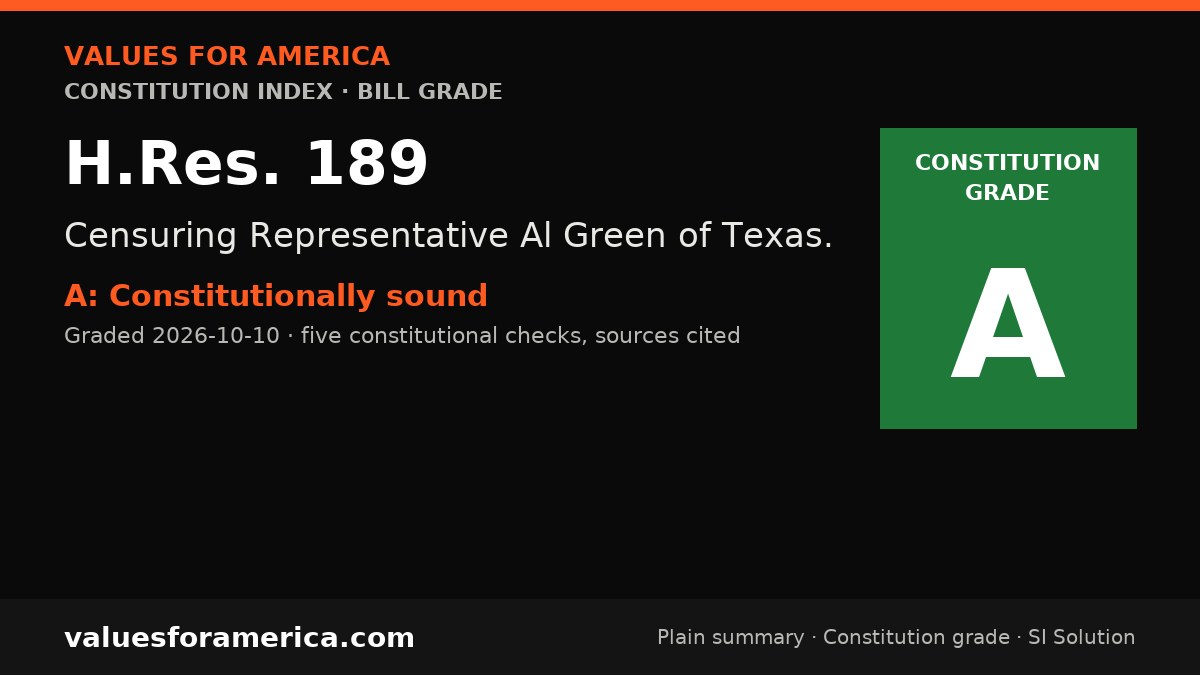
Censuring Representative Al Green of Texas.
Cosponsors: 34 (0 D, 34 R) · per Congress.gov, 2026-10-12
Introduced: 2025-03-05
Latest action (2025-03-06): Motion to reconsider laid on the table Agreed to without objection.
What H.Res. 189 does, in plain terms
This resolution censures Representative Al Green.
Official summary by the Congressional Research Service, via Congress.gov.
Constitution Index
“VFA Constitution grade”
Constitutionally sound
Graded 2026-10-10
SI-generated grade · five published checks · not individually reviewed by a person · methodology
This resolution is a routine exercise of the House of Representatives' constitutional power to discipline its own Members for disorderly conduct. It does not exceed federal authority, infringe any constitutional right, or violate due process. The censure is a purely internal legislative action with no effect on individual liberties outside the chamber.
-
✓ Passes · Enumerated powers
Article I, Section 5, Clause 2 of the Constitution expressly grants each House of Congress the power to 'punish its Members for disorderly Behaviour, and, with the Concurrence of two thirds, expel a Member.' Censure is a lesser form of discipline than expulsion and falls squarely within this enumerated power. The House is acting on its own internal proceedings, not regulating any external matter. -
✓ Passes · Bill of Rights
The First Amendment protects the right to petition the government and freedom of speech, but the Supreme Court has long held that Congress may regulate the conduct of its own proceedings, including disciplining Members for disruptive behavior during a joint session. This is not a restriction on a citizen's speech but an internal rule of order. No other Bill of Rights provision is implicated. -
✓ Passes · Individual sovereignty
This resolution applies only to a Member of Congress in their official capacity during a legislative proceeding. It does not restrict any person's control over their own person, property, speech, labor, or belief outside the chamber. The government's compelling interest in maintaining order during a joint session of Congress justifies this minimal internal restriction. -
✓ Passes · Decentralization
This action concerns the internal discipline of a federal legislative body. The four-question test is designed for policy actions affecting the general public, not internal parliamentary procedure. However, applying the test: (1) an individual cannot handle discipline of a Member of Congress; (2) a local community cannot; (3) a state cannot; (4) the action does not consolidate decision-making upwa… -
✓ Passes · Due process and takings
The House is following its own established procedures for censure. The resolution provides notice of the specific conduct (disrupting a joint session) and the specific punishment (censure with public reading). The Member is given the opportunity to present himself in the well. This satisfies procedural due process for internal legislative discipline. No property is taken, and no criminal penalty i…
Report an error in this grade
What should pass
“VFA SI Solution”
No solution yet
A sourced SI draft appears here once it passes automated checks (Constitution citation, source verification, independent SI critic). How publication works.
Related on VFA

For journalists and bloggers
“Embed this grade”
Free to use with the link back. The badge and card update when the grade changes. Embed terms →
