H.Res. 1530 explained · 119th Congress · Pending in Congress
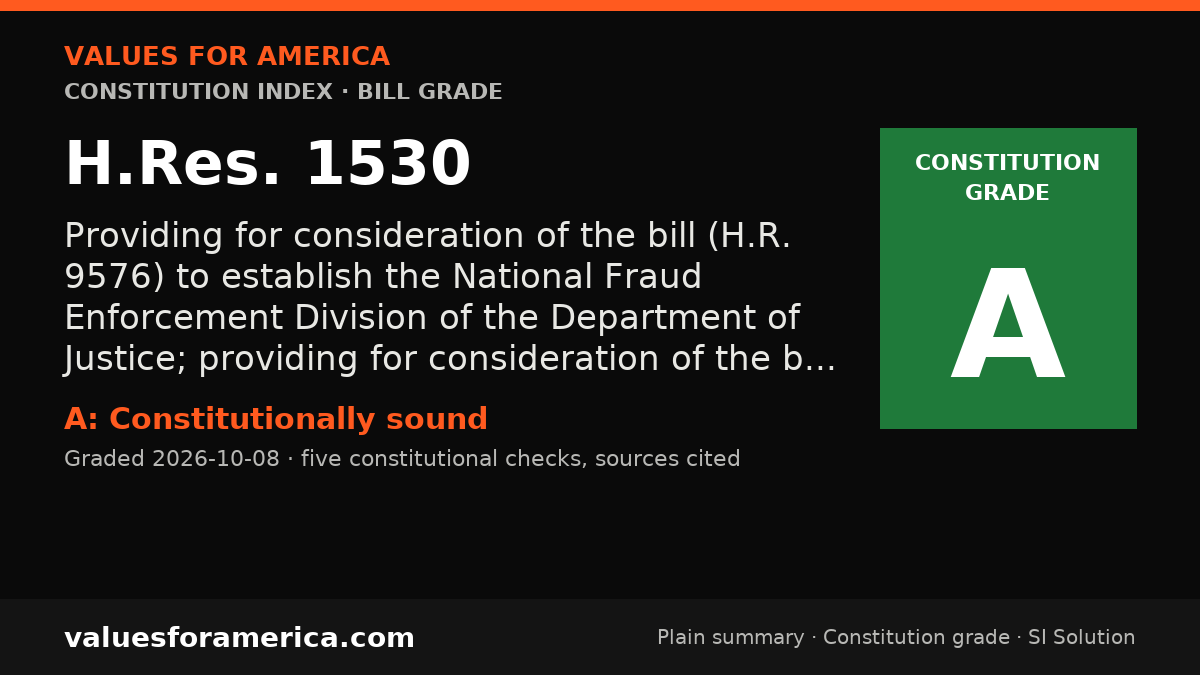
Providing for consideration of the bill (H.R. 9576) to establish the National Fraud Enforcement Division of the Department of Justice; providing for consideration of the bill (H.R. 10326) to enhance information-sharing capabilities between Federal law enforcement and State agencies to detect, investigate, and prosecute fraud in certain Federal programs, and to protect individual privacy; providing for consideration of the joint resolution (H.J. Res. 210) providing for congressional disapproval under chapter 8 of title 5, United States Code, of the rule submitted by the Environmental Protection Agency relating to ‘‘California State Nonroad Engine Pollution Control Standards; Ocean-Going Vessels At-Berth; Notice of Decision''; providing for consideration of the joint resolution (H.J. Res. 213) providing for congressional disapproval under chapter 8 of title 5, United States Code, of the rule issued by the Environmental Protection Agency relating to the ‘‘California State Nonroad Engine Pollution Control Standards; Commercial Harbor Craft Regulations; Notice of Decision''; and providing for consideration of the Senate amendments to the bill (H.R. 5334) to amend the Internal Revenue Code of 1986 to allow early childhood educators to take the educator expense deduction, and for other purposes.
Cosponsors: none · per Congress.gov, 2026-10-14
Introduced: 2026-09-14
Latest action (2026-09-15): Motion to reconsider laid on the table Agreed to without objection.
What H.Res. 1530 does, in plain terms
This resolution provides for the consideration of the bill (H.R. 9576) to establish the National Fraud Enforcement Division of the Department of Justice; providing for consideration of the bill (H.R. 10326) to enhance information-sharing capabilities between Federal law enforcement and State agencies to detect, investigate, and prosecute fraud in certain Federal programs, and to protect individual privacy; providing for consideration of the joint resolution (H.J. Res. 210) providing for congressional disapproval under chapter 8 of title 5, United States Code, of the rule submitted by the Environmental Protection Agency relating to ''California State Nonroad Engine Pollution Control Standards; Ocean-Going Vessels At-Berth; Notice of Decision''; providing for consideration of the joint resolution (H.J. Res. 213) providing for congressional disapproval under chapter 8 of title 5, United States Code, of the rule issued by the Environmental Protection Agency relating to the ''California State Nonroad Engine Pollution Control Standards; Commercial Harbor Craft Regulations; Notice of Decision''; and providing for consideration of the Senate amendments to the bill (H.R. 5334) to amend the Internal Revenue Code of 1986 to allow early childhood educators to take the educator expense deduction, and for other purposes.
Official summary by the Congressional Research Service, via Congress.gov.
Constitution Index
“VFA Constitution grade”
Constitutionally sound
Graded 2026-10-08
SI-generated grade · five published checks · not individually reviewed by a person · methodology
HRES 1530 is an internal House procedural rule authorized expressly by Article I, Section 5, Clause 2. It enacts no substantive law, restricts no rights, takes no property, and consolidates no power. It is fully constitutional.
-
✓ Passes · Enumerated powers
The House has explicit authority to set its own proceedings under Article I, Section 5, Clause 2, which provides each House may determine the Rules of its Proceedings. A special rule providing for consideration of specified bills and joint resolutions is the core exercise of that power. No authority under Article I, Section 8 is exceeded because no substantive federal program is created by this re… -
✓ Passes · Bill of Rights
HRES 1530 regulates only House floor procedure — which bills and resolutions may be debated and under what terms. It restricts no speech, religion, press, assembly, arms, privacy, trial, or other right protected by the First through Tenth Amendments. No citizen is searched, silenced, disarmed, or compelled to testify. The underlying bills referenced (fraud enforcement, information-sharing with pri… -
✓ Passes · Individual sovereignty
This resolution restricts no individual conduct regarding person, property, speech, labor, or belief. It governs only Members of the House in their official capacity during floor debate. The burden test is satisfied because no burden is placed on any private person, and no justification is therefore required under the Ninth Amendment or general liberty principles. -
✓ Passes · Decentralization
The four-question test applies to substantive governance, not internal legislative procedure. (1) Individuals cannot set House debate rules. (2) Local communities cannot manage congressional floor procedure. (3) States cannot regulate House internal proceedings. (4) This resolution does not consolidate decision-making upward — it exercises only the House's own internal authority and actually enabl… -
✓ Passes · Due process and takings
No person is deprived of life, liberty, or property. No criminal penalty, civil forfeiture, seizure, or taking occurs. The Fifth Amendment Due Process and Takings Clauses and Article III trial guarantees are untouched — this resolution provides orderly legislative notice and debate procedures, which is itself a form of procedural regularity, not a bypass of it. Any future enforcement actions under…
Sources: Congress.gov: HRES 1530 summary
Report an error in this grade
What should pass
“VFA SI Solution”
No solution yet
A sourced SI draft appears here once it passes automated checks (Constitution citation, source verification, independent SI critic). How publication works.
Related on VFA

For journalists and bloggers
“Embed this grade”
Free to use with the link back. The badge and card update when the grade changes. Embed terms →
