H.Res. 1498 explained · 119th Congress · Pending in Congress
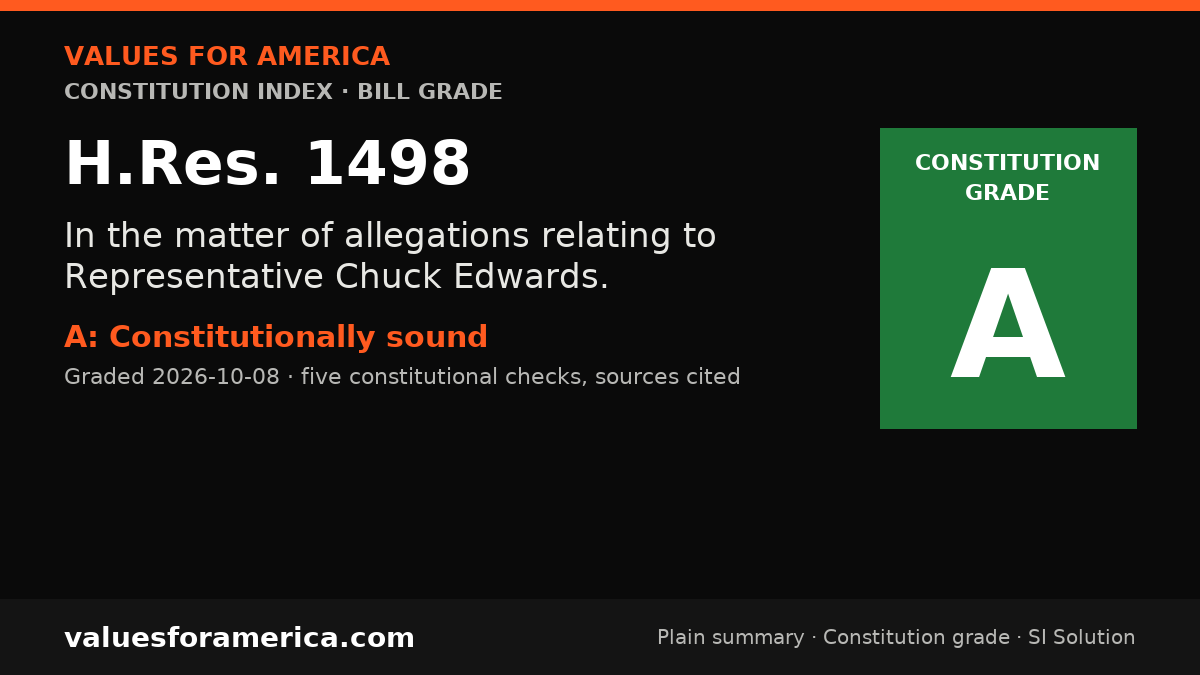
In the matter of allegations relating to Representative Chuck Edwards.
Cosponsors: none · per Congress.gov, 2026-10-14
Introduced: 2026-08-03
Latest action (2026-09-01): Motion to reconsider laid on the table Agreed to without objection.
What H.Res. 1498 does, in plain terms
This resolution censures Representative Chuck Edwards of North Carolina.
Official summary by the Congressional Research Service, via Congress.gov.
Constitution Index
“VFA Constitution grade”
Constitutionally sound
Graded 2026-10-08
SI-generated grade · five published checks · not individually reviewed by a person · methodology
House censure of its own Member is expressly authorized by Article I, Section 5, Clause 2. It infringes no Bill of Rights protection, restricts no private sovereignty, stays at the correct level of government, and follows Ethics Committee process with a House vote. Fully constitutional.
-
✓ Passes · Enumerated powers
The House has explicit authority to discipline its own Members. Article I, Section 5, Clause 2 provides that 'Each House may determine the Rules of its Proceedings, punish its Members for disorderly Behaviour.' Censure with presentment in the well and public reading is a classic exercise of that punishment power, not an exercise of unenumerated federal police power. -
✓ Passes · Bill of Rights
No First through Tenth Amendment right is infringed. Censure is a reputational and institutional reprimand, not a criminal punishment, seizure, or speech prohibition. It does not restrict Representative Edwards' protected speech under the First Amendment, does not search or seize under the Fourth Amendment, and does not impose criminal jeopardy under the Fifth, Sixth, or Eighth Amendments. -
✓ Passes · Individual sovereignty
Censure restricts no private person, property, labor, belief, or speech outside the House. It imposes no fine, imprisonment, disarmament, or occupational ban on a private citizen. Any burden falls solely on a sitting officeholder as a condition of continued membership under Article I, Section 5, Clause 2, with full constitutional justification. -
✓ Passes · Decentralization
Discipline of a sitting federal House Member cannot be handled at a lower level. (1) An individual or family cannot censure a Member of Congress. (2) A local community or county has no authority over House membership. (3) A state cannot discipline a federal officer under Article I, Section 5. (4) The action does not consolidate power upward to the Executive or to a new federal bureaucracy; it exer… -
✓ Passes · Due process and takings
Procedural due process satisfied: investigation by the Committee on Ethics with a dated Report of July 22, 2026, followed by House adoption and vote on September 1, 2026. Substantive action is non-arbitrary and proportionate. No property taken under the Fifth Amendment Takings Clause, no deprivation of life or liberty, and no presumption of innocence violation because censure is not a criminal con…
Report an error in this grade
What should pass
“VFA SI Solution”
No solution yet
A sourced SI draft appears here once it passes automated checks (Constitution citation, source verification, independent SI critic). How publication works.
Related on VFA

For journalists and bloggers
“Embed this grade”
Free to use with the link back. The badge and card update when the grade changes. Embed terms →
