H.Res. 1490 explained · 119th Congress · Pending in Congress
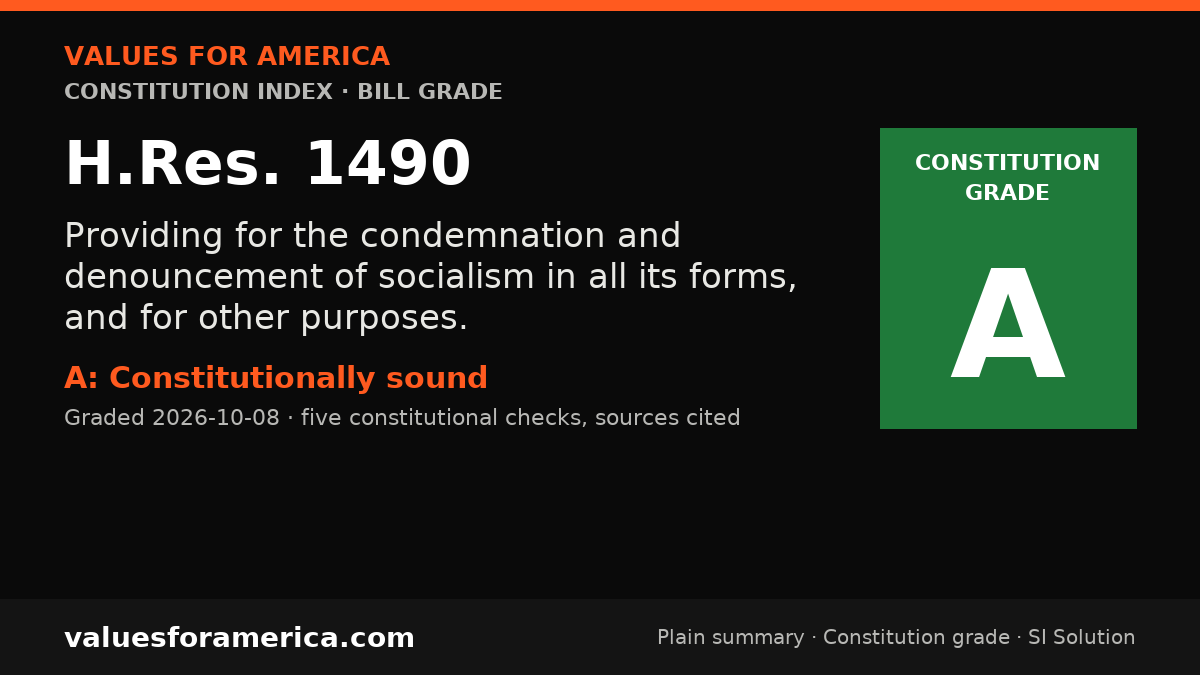
Providing for the condemnation and denouncement of socialism in all its forms, and for other purposes.
Cosponsors: 25 (0 D, 25 R) · per Congress.gov, 2026-10-14
Introduced: 2026-08-27
Latest action (2026-09-01): Motion to reconsider laid on the table Agreed to without objection.
What H.Res. 1490 does, in plain terms
This resolution states that the House of Representatives condemns and denounces socialism in all its forms, including the Democratic Socialists of America, and opposes the implementation of socialist policies in the United States; reaffirms its support for free, fair, and secure elections and calls for enactment of the SAVE America Act; reiterates that American elections are for American citizens only; and recommits itself to upholding the U.S. Constitution.
Official summary by the Congressional Research Service, via Congress.gov.
Constitution Index
“VFA Constitution grade”
Constitutionally sound
Graded 2026-10-08
SI-generated grade · five published checks · not individually reviewed by a person · methodology
HRES 1490 is non-binding House speech condemning socialism and affirming election principles. It creates no law, penalty, mandate, surveillance, or taking, and leaves individual rights and state powers intact under the First, Ninth, and Tenth Amendments. Minor rhetorical tension around a named association does not become a constitutional violation without enforcement.
-
✓ Passes · Enumerated powers
A simple House resolution denouncing an ideology and affirming support for the Constitution is not legislation and exercises no coercive regulatory power. Under Article I, Section 5, Clauses 2-3, each House may determine its own proceedings and express its sense. Protected further by the Speech or Debate Clause in Article I, Section 6, Clause 1, it does not invoke or exceed the enumerated legislat… -
✓ Passes · Bill of Rights
This is a non-binding House resolution expressing opinion. It imposes no criminal penalty, civil liability, prohibition on speech, press, assembly, or petition, and no search, seizure, or arms restriction. Under the First Amendment, mere government speech condemning an ideology, without compulsion or sanction, does not infringe private speech or association rights, though hostile rhetoric toward a… -
✓ Passes · Individual sovereignty
No individual conduct is restricted. Persons remain free to believe, speak, assemble, vote, labor, and hold property as before, consistent with the First Amendment and the Ninth Amendment retention of unenumerated rights. The burden test is satisfied because the government imposes no burden requiring justification; condemnation without coercion is government speech, not government control. -
✓ Passes · Decentralization
The Four-Question Test applies to regulatory power, not to non-binding expression. (1) Individuals can hold political views without government help, but this resolution does not regulate them. (2) Local communities do not need federal permission to debate ideology. (3) States retain full authority under the Tenth Amendment to hold different views. (4) The resolution consolidates no decision-making… -
✓ Passes · Due process and takings
No person is deprived of life, liberty, or property under the Fifth Amendment Due Process Clause, and no property is taken under the Fifth Amendment Takings Clause. There is no notice-and-hearing obligation because there is no adjudication, no presumption of innocence issue, and no fine, forfeiture, or seizure. The election-integrity statements are aspirational and create no enforcement mechanism.
Sources: Congress.gov: HRES 1490 summary
Report an error in this grade
What should pass
“VFA SI Solution”
No solution yet
A sourced SI draft appears here once it passes automated checks (Constitution citation, source verification, independent SI critic). How publication works.
Related on VFA

For journalists and bloggers
“Embed this grade”
Free to use with the link back. The badge and card update when the grade changes. Embed terms →
