H.Res. 1486 explained · 119th Congress · Pending in Congress
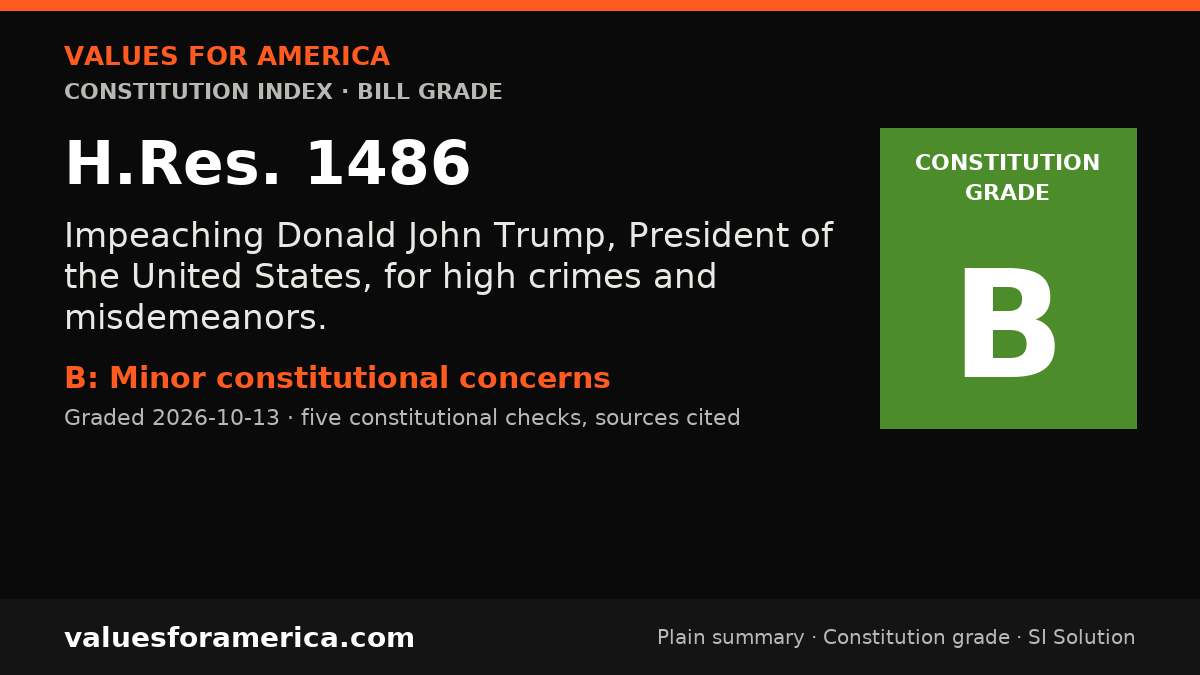
Impeaching Donald John Trump, President of the United States, for high crimes and misdemeanors.
Cosponsors: none · per Congress.gov, 2026-10-14
Introduced: 2026-08-24
Latest action (2026-09-15): Motion to reconsider laid on the table Agreed to without objection.
What H.Res. 1486 does, in plain terms
This resolution impeaches President Donald Trump for high crimes and misdemeanors. Specifically, the resolution sets forth one article of impeachment concerning abuse of presidential powers by allowing U.S. Immigration and Customs Enforcement (ICE) and U.S. Customs and Border Protection (CBP) to operate in violation of the First, Fourth, and Fifth Amendments to the U.S. Constitution while undermining judicial oversight.
Official summary by the Congressional Research Service, via Congress.gov.
Constitution Index
“VFA Constitution grade”
Minor constitutional concerns
Graded 2026-10-13
SI-generated grade · five published checks · not individually reviewed by a person · methodology
The resolution is a constitutional exercise of the House's impeachment power, but it raises significant concerns about the underlying conduct it alleges and the potential for abuse of the impeachment process. The resolution itself does not violate the Constitution, but the allegations of executive overreach and rights violations are serious and warrant scrutiny.
-
✓ Passes · Enumerated powers
The House of Representatives has the sole power of impeachment under Article I, Section 2, Clause 5. This resolution is a direct exercise of that enumerated power. The subject matter—abuse of presidential powers—is within the scope of 'high crimes and misdemeanors' as historically understood. The resolution does not exceed the House's authority. -
✓ Passes · Bill of Rights
The resolution itself does not infringe upon any rights protected by the Bill of Rights. However, it alleges that the President allowed ICE and CBP to violate the First, Fourth, and Fifth Amendments. If true, those actions would be unconstitutional, but the resolution is a remedy, not a violation. The resolution's allegations are consistent with the Bill of Rights, as it seeks to hold the Presiden… -
✓ Passes · Individual sovereignty
The resolution does not restrict individual sovereignty. It is a governmental action aimed at checking executive power. The allegations of rights violations, if true, would have restricted individual sovereignty, but the resolution itself is a protective measure. The burden is on the government to justify any restriction, and here the resolution is not restricting rights but rather addressing alle… -
✓ Passes · Decentralization
Impeachment is a federal function explicitly assigned to the House of Representatives by the Constitution. It cannot be handled by individuals, local communities, or states. The resolution does not consolidate power upward; it is a check on the executive branch by the legislative branch, which is a constitutional design to prevent consolidation of power. The four-question test is not applicable to… -
✓ Passes · Due process and takings
The resolution does not bypass due process or take property. Impeachment is a political process, not a criminal trial, and the Constitution provides for the Senate to conduct a trial with the Chief Justice presiding. The resolution itself does not deprive any person of life, liberty, or property without due process. The allegations of Fifth Amendment violations by ICE and CBP, if true, would be a …
Sources: Congress.gov: HRES 1486 summary
Report an error in this grade
The Framers
“Founders’ Verdict”
Confidence 1.00
Archived SI output (machine-generated)No editorial review recorded. This historical SI verdict was machine-generated by software and predates the review desk; check it against the official bill text.
Synthesis
Unanimous among all four voices: the impeachment power itself is squarely constitutional — Article I, Section 2, Clause 5 vests the sole Power of Impeachment in the House, and Article II, Section 4 makes the President removable upon Impeachment for, and Conviction of, Treason, Bribery, or other high Crimes and Misdemeanors. However, resolution hres-119-1486 is constitutionally deficient in its present form: it recites only the general constitutional formula without annexing specific articles charging particular acts. The House may constitutionally proceed only upon articles alleging specific facts constituting treason, bribery, or genuine high crimes and misdemeanors — offenses against the constitutional order and public trust, not mere policy disagreement or maladministration (which the Convention expressly rejected). Removal cannot occur absent trial before the Senate and conviction by two-thirds of members present (Article I, Section 3, Clauses 6-7); judgment is confined to removal and disqualification, with the party remaining amenable to ordinary criminal process.
The power here invoked is among the most solemn confided to the national legislature, and its existence admits of no doubt. Article II, Section 4 declares the President removable from office upon Impeachment for, and Conviction of, Treason, Bribery, or other high Crimes and Misdemeanors; Article I, Section 2, Clause 5 vests in the House the sole Power of Impeachment; and Article I, Section 3, Clause 6 commits the trial thereof to the Senate. Unlike the British monarch, whom no tribunal may touch, the Chief Magistrate under our Constitution is amenable to justice in his official conduct and may…
The power of impeachment is lodged in our Constitution deliberately, as the last resort of a free people against a magistrate who betrays his sacred trust. Article I, Section 2 vests in the House of Representatives the sole power of impeachment; Article II, Section 4 confines its just objects to treason, bribery, or other high crimes and misdemeanors — that is, offenses against the Constitution itself, not differences of policy, opinion, or administration between the branches. A resolution declaring an intention to impeach the Chief Magistrate 'for high crimes and misdemeanors,' while enumerat…
The power here exercised is constitutional in its kind. The Constitution vests in the House of Representatives 'the sole Power of Impeachment' (Article I, Section 2, Clause 5), and Article II, Section 4 declares the President removable 'on Impeachment for, and Conviction of, Treason, Bribery, or other high Crimes and Misdemeanors.' The Framers at Philadelphia deliberately lodged this check in the popular branch while requiring concurrence of two-thirds of the Senators present for conviction (Article I, Section 3, Clauses 6-7), so that no single department might dominate the removal of an offic…
The instrument before me exercises a power expressly granted, and thus its form offends no provision of the supreme law. Article I, Section 2, Clause 5 vests in the House of Representatives 'the sole Power of Impeachment,' and Article II, Section 4 declares that the President 'shall be removed from Office on Impeachment for, and Conviction of, Treason, Bribery, or other high Crimes and Misdemeanors.' An impeachment resolution is therefore constitutional in its inception. Yet the Constitution does not make removal a matter of legislative will alone. Article I, Section 3, Clause 6 commits the tr…
Report an error in this Founders' Verdict
What should pass
“VFA SI Solution”
No solution yet
A sourced SI draft appears here once it passes automated checks (Constitution citation, source verification, independent SI critic). How publication works.
Related on VFA

For journalists and bloggers
“Embed this grade”
Free to use with the link back. The badge and card update when the grade changes. Embed terms →
