H.Res. 1438 explained · 119th Congress · Pending in Congress
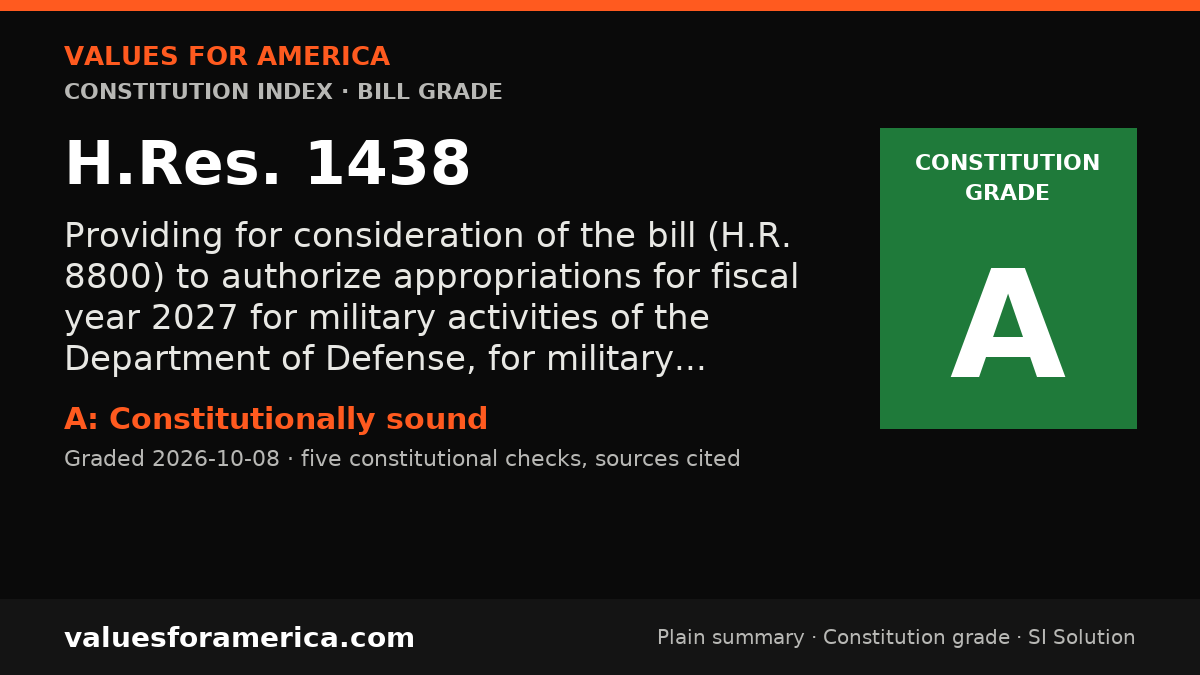
Providing for consideration of the bill (H.R. 8800) to authorize appropriations for fiscal year 2027 for military activities of the Department of Defense, for military construction, and for defense activities of the Department of Energy, to prescribe military personnel strengths for such fiscal year, and for other purposes; providing for consideration of the bill (H.R. 8884) to amend title II of the Social Security Act to reauthorize demonstration authority for the disability insurance program; providing for consideration of the concurrent resolution (H. Con. Res. 113) establishing the congressional budget for the United States Government for fiscal year 2027 and setting forth the appropriate budgetary levels for fiscal years 2028 through 2036; providing for consideration of the bill (H.R. 7008) to amend chapter 131 of title 5 to require certain restrictions on stocks for Members of Congress and their spouses and dependents, and for other purposes; providing for consideration of the bill (H.R. 6955) to make improvements to the Federal banking laws, and for other purposes; providing for consideration of the bill (H.R. 9770) making continuing appropriations for fiscal year 2027, and for other purposes; and for other purposes.
Cosponsors: none · per Congress.gov, 2026-10-15
Introduced: 2026-07-20
Latest action (2026-07-21): Motion to reconsider laid on the table Agreed to without objection.
What H.Res. 1438 does, in plain terms
This resolution provides for the consideration of the bill (H.R. 8800) to authorize appropriations for fiscal year 2027 for military activities of the Department of Defense, for military construction, and for defense activities of the Department of Energy, to prescribe military personnel strengths for such fiscal year, and for other purposes; providing for consideration of the bill (H.R. 8884) to amend title II of the Social Security Act to reauthorize demonstration authority for the disability insurance program; providing for consideration of the concurrent resolution (H. Con. Res. 113) establishing the congressional budget for the United States Government for fiscal year 2027 and setting forth the appropriate budgetary levels for fiscal years 2028 through 2036; providing for consideration of the bill (H.R. 7008) to amend chapter 131 of title 5 to require certain restrictions on stocks for Members of Congress and their spouses and dependents, and for other purposes; providing for consideration of the bill (H.R. 6955) to make improvements to the Federal banking laws, and for other purposes; providing for consideration of the bill (H.R. 9770) making continuing appropriations for fiscal year 2027, and for other purposes; and for other purposes.
Official summary by the Congressional Research Service, via Congress.gov.
Constitution Index
“VFA Constitution grade”
Constitutionally sound
Graded 2026-10-08
SI-generated grade · five published checks · not individually reviewed by a person · methodology
HRES 1438 is an internal House rules measure authorized by Article I, Section 5, Clause 2. It authorizes no surveillance, imposes no mandate on private persons, takes no property, and restricts no Bill of Rights freedom. Substantive constitutional questions belong to the underlying bills, not to this procedural vehicle.
-
✓ Passes · Enumerated powers
The House has explicit authority to adopt this resolution under Article I, Section 5, Clause 2, which provides that each House may determine the rules of its proceedings. A House resolution governing consideration, debate structure, and ordering of bills is squarely within that grant. It does not itself exercise Article I, Section 8 powers beyond Congress, such as Clause 12 to raise armies or Clau… -
✓ Passes · Bill of Rights
This resolution creates no substantive restriction on speech, religion, press, assembly, arms, search and seizure, self-incrimination, trial rights, or other protections under Amendments 1-10. It is a House procedures measure under Article I, Section 5, Clause 2, setting terms for debate and consideration of listed bills. No First Amendment, Second Amendment, or Fourth Amendment interest is burden… -
✓ Passes · Individual sovereignty
The resolution restricts no private conduct involving person, property, speech, labor, or belief. It governs only internal legislative procedure for Members of the House under Article I, Section 5. The burden analysis under the Ninth Amendment and the liberty protected by the Fifth Amendment is therefore satisfied, as no individual freedom requires justification here. -
✓ Passes · Decentralization
The four-question test must be applied to the nature of the action: regulation of internal House floor procedure. Under Article I, Section 5, Clause 2, each House determines the rules of its proceedings. Individuals, counties, and states cannot set House debate rules, so the first three questions are answered no without indicating improper centralization. It does not transfer any general governing… -
✓ Passes · Due process and takings
No liberty or property interest is deprived and no taking occurs under the Fifth Amendment. The resolution provides procedural notice to Members and the public of how specified measures will be considered, which supports orderly process rather than bypassing it. No presumption of innocence, hearing right, or just compensation issue is implicated.
Sources: Congress.gov: HRES 1438 summary
Report an error in this grade
What should pass
“VFA SI Solution”
No solution yet
A sourced SI draft appears here once it passes automated checks (Constitution citation, source verification, independent SI critic). How publication works.
Related on VFA

For journalists and bloggers
“Embed this grade”
Free to use with the link back. The badge and card update when the grade changes. Embed terms →
