H.Res. 1423 explained · 119th Congress · Pending in Congress
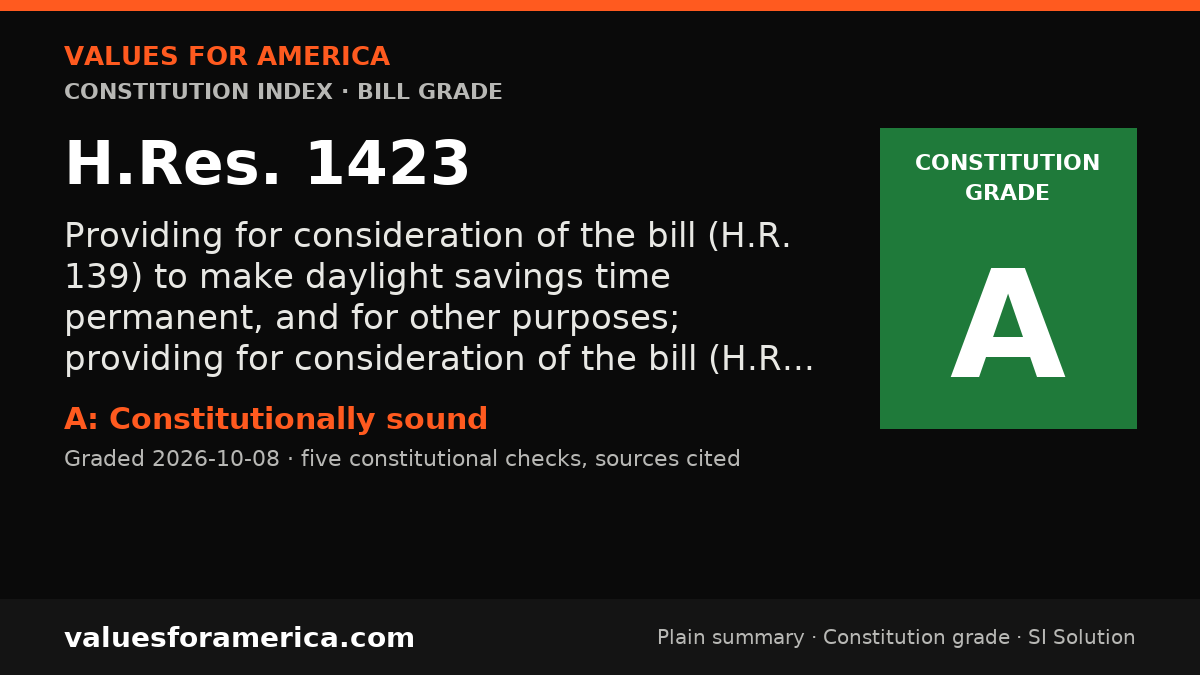
Providing for consideration of the bill (H.R. 139) to make daylight savings time permanent, and for other purposes; providing for consideration of the bill (H.R. 8595) making appropriations for national security, Department of State, and related programs for the fiscal year ending September 30, 2027, and for other purposes; providing for consideration of the bill (H.R. 9237) to amend titles 10 and 38, United States Code, and other Federal laws, to improve benefits for veterans and the administration of the Department of Veterans Affairs; providing for consideration of the bill (H.R. 1181) to prohibit payment card networks and covered entities from requiring the use of or assigning merchant category codes that distinguish a firearms retailer from general-merchandise retailer or sporting-goods retailer, and for other purposes; and for other purposes.
Cosponsors: none · per Congress.gov, 2026-10-14
Introduced: 2026-07-13
Latest action (2026-07-14): Motion to reconsider laid on the table Agreed to without objection.
What H.Res. 1423 does, in plain terms
This resolution provides for the consideration of the bill (H.R. 139) to make daylight savings time permanent, and for other purposes; providing for consideration of the bill (H.R. 8595) making appropriations for national security, Department of State, and related programs for the fiscal year ending September 30, 2027, and for other purposes; providing for consideration of the bill (H.R. 9237) to amend titles 10 and 38, United States Code, and other Federal laws, to improve benefits for veterans and the administration of the Department of Veterans Affairs; providing for consideration of the bill (H.R. 1181) to prohibit payment card networks and covered entities from requiring the use of or assigning merchant category codes that distinguish a firearms retailer from general-merchandise retailer or sporting-goods retailer, and for other purposes; and for other purposes.
Official summary by the Congressional Research Service, via Congress.gov.
Constitution Index
“VFA Constitution grade”
Constitutionally sound
Graded 2026-10-08
SI-generated grade · five published checks · not individually reviewed by a person · methodology
HRES 1423 is an internal House procedural rule authorized by Article I, Section 5. It takes no property, imposes no mandate, and infringes no rights; it only schedules debate on four bills.
-
✓ Passes · Enumerated powers
The House has explicit authority to adopt its own procedural rules under Article I, Section 5, Clause 2, which provides Each House may determine the Rules of its Proceedings. A special rule providing for consideration of H.R. 139, H.R. 8595, H.R. 9237, and H.R. 1181 is a core exercise of that power, not an assertion of unenumerated federal authority under Article I, Section 8. -
✓ Passes · Bill of Rights
This resolution imposes no restriction on speech, religion, press, assembly, arms, search, trial rights, or other protections in Amendments 1-10. It only schedules House debate on four bills. One underlying bill, H.R. 1181, would bar payment networks from tagging firearms retailers with distinct merchant codes, which supports Second Amendment privacy and First Amendment associational interests by … -
✓ Passes · Individual sovereignty
The resolution restricts no personal conduct, property use, labor, belief, or expression. It governs only legislative scheduling and debate terms. No individual must justify a freedom, and the government bears no burden here because no liberty is burdened under the Ninth Amendment and the liberty protected by the Fifth Amendment. -
✓ Passes · Decentralization
House floor procedure cannot be handled by individuals, localities, or states; Article I, Section 5 vests rulemaking in each House. This resolution does not consolidate substantive power upward; it merely structures debate. The underlying bills vary on subsidiarity, but the rule itself keeps decision-making at the proper level for internal congressional operations under the Tenth Amendment. -
✓ Passes · Due process and takings
No person is deprived of life, liberty, or property, and no property is taken. The resolution provides orderly notice and debate procedures, consistent with procedural due process under the Fifth Amendment and Due Process Clause of the Fourteenth Amendment. No fines, seizures, or transfers of property occur, so the Takings Clause of the Fifth Amendment is not implicated.
Sources: Congress.gov: HRES 1423 summary
Report an error in this grade
The Framers
“Founders’ Verdict”
Confidence 1.00
Archived SI output (machine-generated)No editorial review recorded. This historical SI verdict was machine-generated by software and predates the review desk; check it against the official bill text.
Synthesis
The resolution is a procedural rule for considering multiple bills, which is a valid exercise of the House's power under Article I, Section 5, Clause 2 to determine its own proceedings. It does not enact substantive law and falls within the legislative branch's discretion.
This resolution is a procedural rule providing for the consideration of multiple bills. The Constitution grants each House the power to determine the rules of its proceedings (Article I, Section 5, Clause 2). This power is essential for the orderly conduct of legislative business and is a core attribute of the legislative branch's independence. The resolution does not itself enact substantive law but merely sets the terms for debate and amendment on the specified bills. As such, it falls squarely within the constitutional authority of the House of Representatives. The Federalist Papers, partic…
The House of Representatives, by the authority granted in Article I, Section 5, Clause 2 of the Constitution, possesses the sole power to determine the rules of its proceedings. This resolution is a procedural measure that establishes the order and manner for considering several bills. It does not itself enact any substantive law, nor does it infringe upon any right secured by the Bill of Rights. The Tenth Amendment reserves to the States or the people powers not delegated to the United States, but the power to set legislative rules is expressly delegated to Congress. Therefore, this resolutio…
This resolution is a procedural rule providing for consideration of multiple bills. The Constitution grants each House the power to determine the rules of its proceedings (Article I, Section 5, Clause 2). Such a resolution does not itself enact substantive law but merely sets the terms for debate and amendment. It is a necessary instrument for the orderly conduct of legislative business, consistent with the separation of powers and the principle that each House may govern its own internal processes. The resolution does not exceed any enumerated power, nor does it infringe upon the rights of th…
This resolution is a procedural rule by which the House of Representatives orders its own business. The Constitution expressly grants each House the authority to 'determine the Rules of its Proceedings' (Article I, Section 5, Clause 2). Such internal governance is essential to the legislative function and does not exceed the powers delegated to Congress. The resolution does not itself enact any substantive law, nor does it infringe upon any provision of the Constitution. It is a proper exercise of the power vested in the House to manage its own agenda, consistent with the principles of separat…
Report an error in this Founders' Verdict
What should pass
“VFA SI Solution”
Archived SI output (machine-generated) · No editorial review recorded
This historical draft has no editorial review time on record. Check its claims against the original bill and current law.
Constitutional Consideration Rule for H.R. 139, H.R. 8595, H.R. 9237, and H.R. 1181
Generated by VFA SI Solutions
To set the terms for floor debate and voting on four substantive bills: making daylight saving time permanent, national security appropriations, veterans benefits improvements, and prohibiting firearm-specific merchant category codes.
Bipartisan rationale: Democratic priorities: fiscal responsibility through spending caps and offsets (H.R. 8595, H.R. 9237), and protecting consumer privacy from government-mandated tracking (H.R. 1181 amendment). Republican priorities: limiting federal overreach (H.R. 139 sunset and study, H.R. 1181 amendment protecting private commerce), and ensuring veterans benefits are fully funded without adding to deficit.
Article I, Section 8, Clause 1 Article I, Section 8, Clause 5 Article I, Section 8, Clause 14 Amendment I Amendment X Amendment V
Report an error in this Solution
Citizen Consensus
“Do you support this VFA SI Solution?”
One vote per verified account; you can change it any time. Only verified accounts count, results publish once 30 verified people have voted, and state and district results count only people who attested a home ZIP code. How this works.
Email verification is not switched on yet, so no vote counts toward results yet. Votes cast now are saved and count once the voter verifies their email address.
Sign in or create a free account to vote.
Add a short reason (optional)
/280 · no links or contact details · reasons are reviewed before anyone sees them, and many never are shown.
Your vote is saved but held out of published results by an automated integrity check (for example, several accounts voting from one browser).
Your vote is saved. It will count once you verify your email address. Verify on your account page.
Your vote counts nationally. Add your home ZIP code to count in your state and district too.
Your vote counts nationally and in .
Reason saved privately; it is shown only if it passes review.
Verified participants nationwide · n =
Self-selected participants, not a random sample; ± is the 95% sampling margin.
Not enough verified votes yet. Results publish at verified votes.
A sudden surge of votes on this item was flagged and is under review; votes from new accounts in that surge are held out until it is resolved.
Related on VFA

For journalists and bloggers
“Embed this grade”
Free to use with the link back. The badge and card update when the grade changes. Embed terms →
