H.Res. 1399 explained · 119th Congress · Pending in Congress
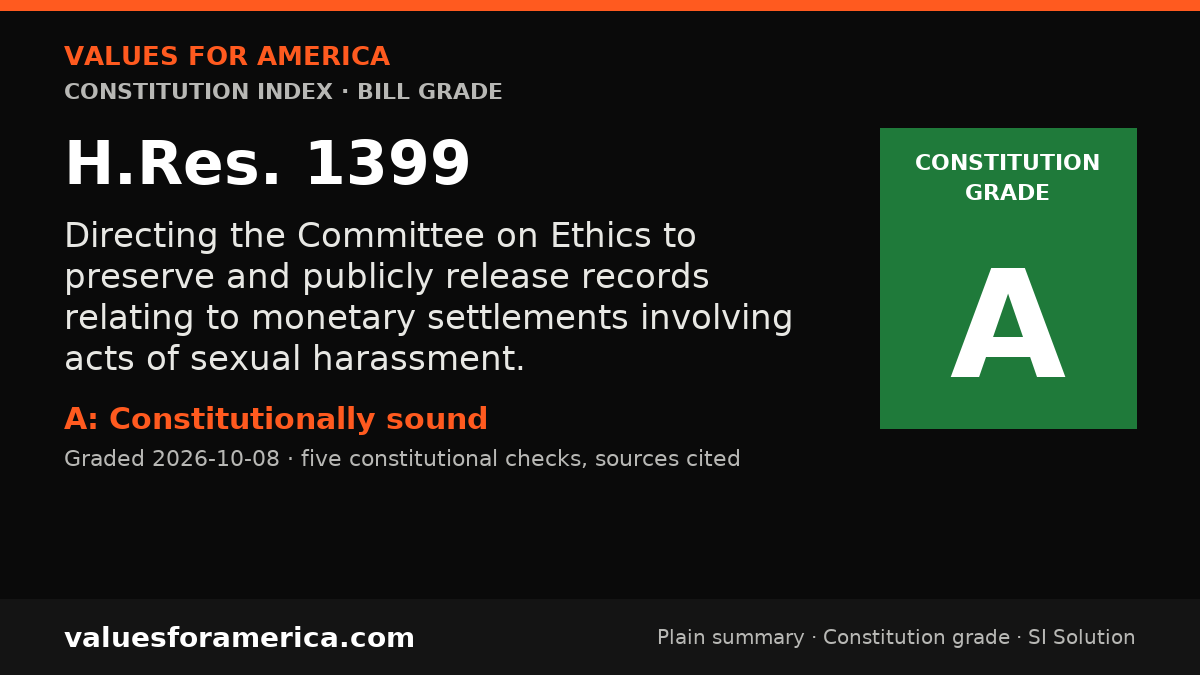
Directing the Committee on Ethics to preserve and publicly release records relating to monetary settlements involving acts of sexual harassment.
Cosponsors: none · per Congress.gov, 2026-10-08
Introduced: 2026-06-30
Latest action (2026-06-30): Motion to reconsider laid on the table Agreed to without objection.
What H.Res. 1399 does, in plain terms
The Congressional Research Service has not published a summary of H.Res. 1399 yet. Its official title: “Directing the Committee on Ethics to preserve and publicly release records relating to monetary settlements involving acts of sexual harassment.”.
Constitution Index
“VFA Constitution grade”
Constitutionally sound
Graded 2026-10-08
SI-generated grade · five published checks · not individually reviewed by a person · methodology
House internal transparency rule squarely authorized by Article I, Section 5, Clauses 2-3. It spends no new private regulation, restricts no citizen liberty, centralizes no power, and takes no property. Any fairness concern about naming Members is mitigated because listing is limited to matters resulting in taxpayer-funded payments.
-
✓ Passes · Enumerated powers
The House has explicit authority over its own proceedings and discipline. Article I, Section 5, Clause 2 provides each House may determine the Rules of its Proceedings and punish its Members for disorderly Behaviour. Directing the Committee on Ethics and the Office of Congressional Workplace Rights to inventory and publish settlement records tied to Rule XXIII clauses 9 and 18 is a direct exercise… -
✓ Passes · Bill of Rights
No provision compels speech, restricts press, assembly, religion or petition under the First Amendment, disarms under the Second Amendment, or authorizes searches under the Fourth Amendment. The resolution discloses House records about use of taxpayer funds for settlements, which furthers First Amendment petition and press oversight values. Naming Members linked to taxpayer-paid settlements touche… -
✓ Passes · Individual sovereignty
The resolution restricts no private person in their body, property, speech, labor, or belief. It imposes a transparency duty on House institutions regarding taxpayer funds, not a mandate, prohibition, or license on citizens. Members voluntarily holding federal office accept heightened public accountability for use of public funds under Article I, Section 5, so disclosure of names only where a revi… -
✓ Passes · Decentralization
This is internal House self-governance, the lowest possible level for this function. (1) Individuals or families cannot audit and release House Ethics and Office of Congressional Workplace Rights settlement records. (2) Local or county government cannot manage House disciplinary records. (3) States cannot regulate House proceedings. (4) It does not consolidate power upward to the executive, judici… -
✓ Passes · Due process and takings
Under the Fifth Amendment Due Process and Takings Clauses, there is no deprivation of life, liberty, or property without notice and hearing, and no physical or regulatory taking requiring just compensation. The resolution orders disclosure of amounts already paid and a consolidated list where taxpayer funds were used; it imposes no fine, forfeiture, imprisonment, or property seizure, and creates n…
Report an error in this grade
What should pass
“VFA SI Solution”
No solution yet
A sourced SI draft appears here once it passes automated checks (Constitution citation, source verification, independent SI critic). How publication works.
Related on VFA

For journalists and bloggers
“Embed this grade”
Free to use with the link back. The badge and card update when the grade changes. Embed terms →
