H.Res. 1345 explained · 119th Congress · Pending in Congress
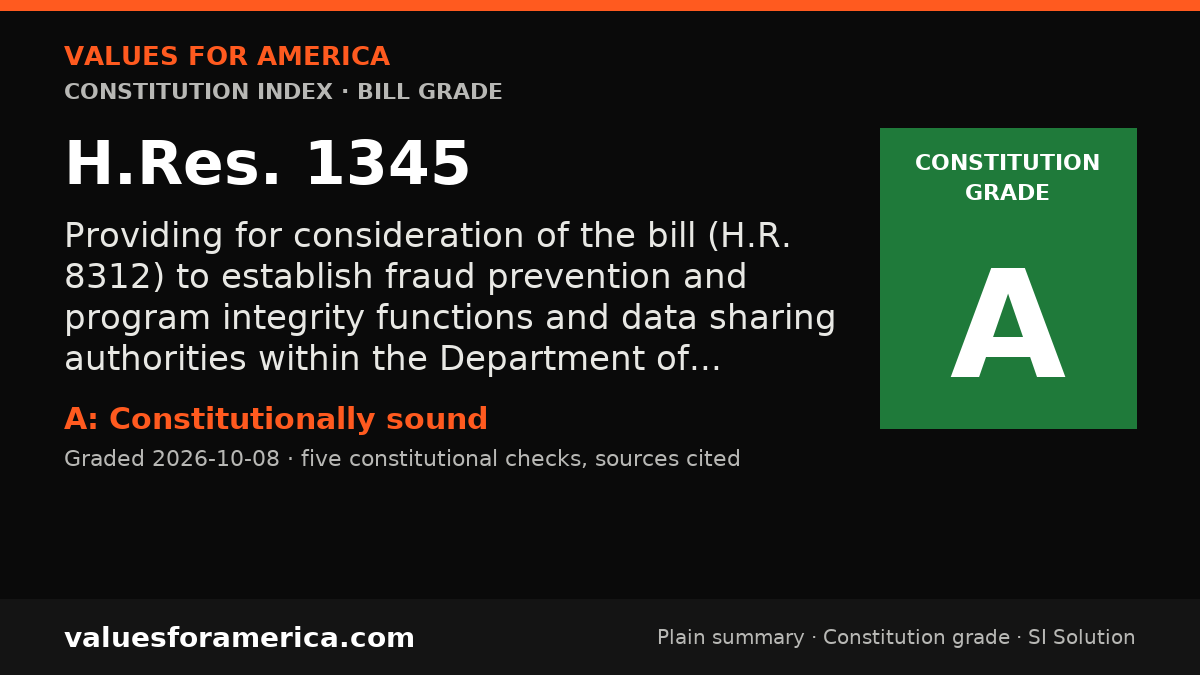
Providing for consideration of the bill (H.R. 8312) to establish fraud prevention and program integrity functions and data sharing authorities within the Department of Treasury and a permanent governmentwide Inspector General for Fraud, Accountability, and Recovery, and for other purposes; providing for consideration of the bill (H.R. 8464) to amend title 31, United States Code, to authorize pausing and segmenting payments, and for other purposes; providing for consideration of the resolution (H. Res. 1335) condemning actors seeking to defraud the United States Government, and expressing the sense of the House of Representatives that governmentwide fraud and improper payment prevention reforms will meaningfully improve the financial prosperity of the United States, and that Federal program eligibility should be verified before payment; and providing for consideration of the bill (S. 2) to provide for reconciliation pursuant to title II of S. Con. Res. 33.
Cosponsors: none · per Congress.gov, 2026-10-08
Introduced: 2026-06-08
Latest action (2026-06-09): Motion to reconsider laid on the table Agreed to without objection.
What H.Res. 1345 does, in plain terms
This resolution provides for the consideration of the bill (H.R. 8312) to establish fraud prevention and program integrity functions and data sharing authorities within the Department of Treasury and a permanent governmentwide Inspector General for Fraud, Accountability, and Recovery, and for other purposes; providing for consideration of the bill (H.R. 8464) to amend title 31, United States Code, to authorize pausing and segmenting payments, and for other purposes; providing for consideration of the resolution (H. Res. 1335) condemning actors seeking to defraud the United States Government, and expressing the sense of the House of Representatives that governmentwide fraud and improper payment prevention reforms will meaningfully improve the financial prosperity of the United States, and that Federal program eligibility should be verified before payment; and providing for consideration of the bill (S. 2) to provide for reconciliation pursuant to title II of S. Con. Res. 33.
Official summary by the Congressional Research Service, via Congress.gov.
Constitution Index
“VFA Constitution grade”
Constitutionally sound
Graded 2026-10-08
SI-generated grade · five published checks · not individually reviewed by a person · methodology
HRES 1345 is an internal House special rule setting terms for considering fraud-prevention and reconciliation measures. The House has explicit Article I, Section 5 authority to do so, and the rule itself restricts no rights, takes no property, and creates no substantive surveillance or enforcement power. Substantive constitutional questions belong to the underlying bills.
-
✓ Passes · Enumerated powers
The House has explicit authority to set its own proceedings under Article I, Section 5, Clause 2, which provides each House may determine the Rules of its Proceedings. A special rule providing for consideration of H.R. 8312, H.R. 8464, H. Res. 1335, and S. 2 is a core exercise of that power, supported by Article I, Section 1 vesting of legislative power in Congress. -
✓ Passes · Bill of Rights
This is a House procedural rule governing debate and consideration of four measures. It restricts no speech, religion, press, assembly, arms, privacy, trial or other protected right. First Amendment activity is not abridged; Fourth Amendment search authority is not created here. Any data-sharing or payment-pause authority in the underlying bills would be graded when those bills are graded, not in … -
✓ Passes · Individual sovereignty
The rule restricts no personal conduct, property use, speech, labor, or belief. It governs only how Representatives debate and vote. No individual liberty interest requires government justification under the Ninth Amendment or the liberty component of the Fifth Amendment. -
✓ Passes · Decentralization
Internal House procedure cannot be handled by individuals, localities, or states; Article I, Section 5, Clause 2 reserves to each House the power to determine its own rules. It does not consolidate substantive regulatory power upward to the federal executive or remove state authority, so no upward consolidation occurs. -
✓ Passes · Due process and takings
No deprivation of life, liberty, or property and no taking occurs under Fifth Amendment Due Process and Takings Clauses. The resolution provides notice and orderly House process, which supports rather than bypasses procedural due process. Payment-pause authority is in H.R. 8464, not effected by this rule.
Sources: Congress.gov: HRES 1345 summary
Report an error in this grade
What should pass
“VFA SI Solution”
No solution yet
A sourced SI draft appears here once it passes automated checks (Constitution citation, source verification, independent SI critic). How publication works.
Related on VFA

For journalists and bloggers
“Embed this grade”
Free to use with the link back. The badge and card update when the grade changes. Embed terms →
