H.Res. 1340 explained · 119th Congress · Pending in Congress
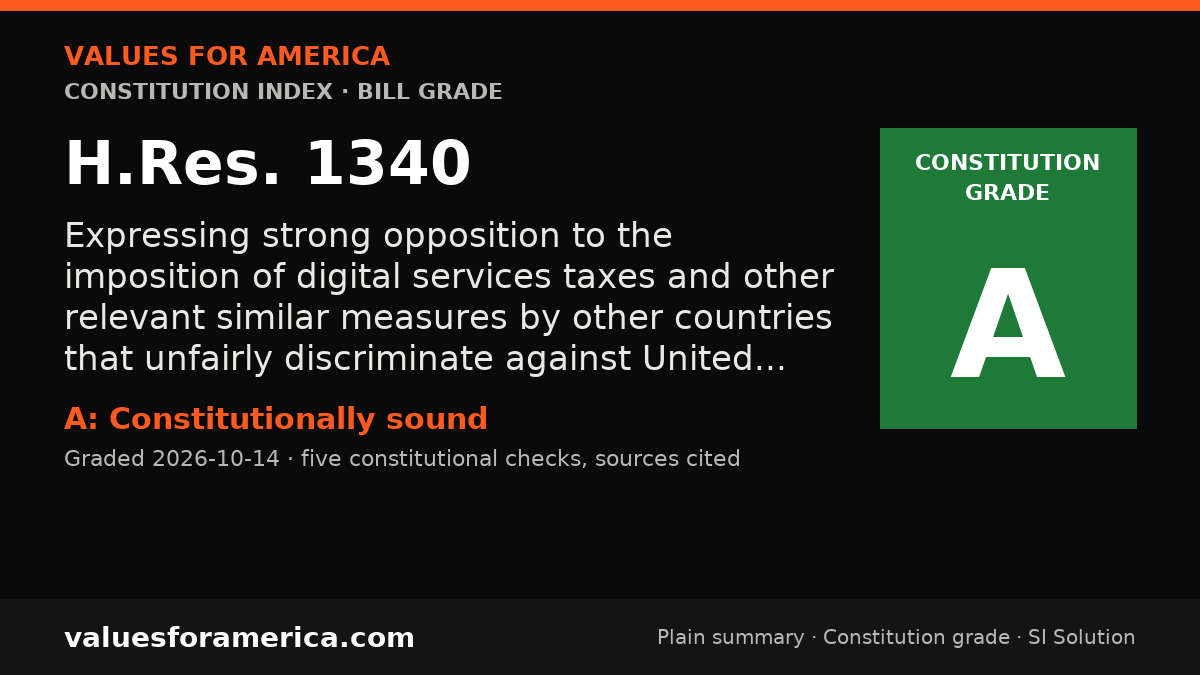
Expressing strong opposition to the imposition of digital services taxes and other relevant similar measures by other countries that unfairly discriminate against United States companies.
Cosponsors: 5 (3 D, 2 R) · per Congress.gov, 2026-10-14
Introduced: 2026-06-04
Latest action (2026-06-04): Referred to the Committee on Ways and Means, and in addition to the Committee on Foreign Affairs, for a period to be subsequently determined by the Speaker, in each case for consideration of such provisions as fall within the jurisdiction of the committee concerned.
What H.Res. 1340 does, in plain terms
This resolution calls on (1) all other countries to cease and desist from implementing any digital services tax (DST) or similar measure, repeal existing DSTs, and immediately stop unfairly targeting U.S. companies; and (2) U.S. government agencies to use all available methods and resources to protect U.S. companies from the discriminatory effects of DSTs. It also supports appropriate tax and trade tools, including Section 301 investigations into the implementation or proposal of DSTs by any nation. (Section 301 of the Trade Act of 1974 authorizes the Office of the U.S. Trade Representative to investigate and take action to enforce U.S. rights under trade agreements and respond to certain foreign trade practices.)
Official summary by the Congressional Research Service, via Congress.gov.
Constitution Index
“VFA Constitution grade”
Constitutionally sound
Graded 2026-10-14
SI-generated grade · five published checks · not individually reviewed by a person · methodology
This resolution is a non-binding expression of congressional opinion and a directive to executive agencies to use existing legal tools to respond to foreign digital services taxes that discriminate against U.S. companies. It does not enact new law, impose domestic obligations, or restrict individual rights. It falls within Congress's enumerated powers over foreign commerce and foreign affairs, and it does not infringe on any constitutional protections. The resolution appropriately supports the use of existing trade remedies, such as Section 301 investigations, which are consistent with U.S. treaty obligations and statutory authority.
-
✓ Passes · Enumerated powers
Congress has explicit authority to regulate foreign commerce under Article I, Section 8, Clause 3, and to enact laws necessary and proper to execute its foreign commerce powers under Article I, Section 8, Clause 18. The resolution addresses foreign digital services taxes that discriminate against U.S. companies, which directly implicates foreign commerce and international trade. The resolution is … -
✓ Passes · Bill of Rights
The resolution does not infringe on any of the first ten amendments. It does not restrict speech, religion, assembly, press, petition, arms, quartering, search and seizure, self-incrimination, due process, takings, fair trial, jury, cruel and unusual punishment, unenumerated rights, or reserved powers. It is a statement of policy and a directive to use existing trade remedies, which do not implica… -
✓ Passes · Individual sovereignty
The resolution does not restrict what individuals can do with their person, property, speech, labor, or belief. It addresses foreign government taxation of U.S. companies, which is a matter of international trade policy, not individual conduct. The resolution imposes no new obligations on individuals and does not require any individual to act or refrain from acting. Therefore, it does not infringe… -
✓ Passes · Decentralization
The resolution concerns foreign trade policy, which is inherently a federal matter. The Constitution grants the federal government exclusive authority over foreign commerce (Article I, Section 8, Clause 3), and the Tenth Amendment reserves to the states only those powers not delegated to the federal government. Foreign trade cannot be handled by individuals, local communities, or states because it… -
✓ Passes · Due process and takings
The resolution does not bypass due process or take property without just compensation. It is a non-binding resolution that does not enact any law or regulation. It does not affect any individual's procedural or substantive due process rights, nor does it involve any taking of private property. The resolution merely supports the use of existing trade remedies, which are subject to statutory and int…
Sources: Congress.gov: HRES 1340 summary
Report an error in this grade
What should pass
“VFA SI Solution”
Archived SI output (machine-generated) · No editorial review recorded
This historical draft has no editorial review time on record. Check its claims against the original bill and current law.
Digital Services Tax Fairness and Retaliation Authorization Act
Generated by VFA SI Solutions
To express Congress's strong opposition to foreign digital services taxes that discriminate against U.S. companies, and to signal potential retaliatory measures.
Bipartisan rationale: Democratic priorities honored: protects U.S. workers and companies from unfair foreign taxes, includes relief for affected companies, and requires transparent investigations. Republican priorities honored: uses targeted tariffs rather than broad tax increases, respects executive authority in trade, and includes a sunset to limit government overreach.
Article I, Section 8, Clause 3 Article I, Section 8, Clause 1 Amendment V
Report an error in this Solution
Citizen Consensus
“Do you support this VFA SI Solution?”
One vote per verified account; you can change it any time. Only verified accounts count, results publish once 30 verified people have voted, and state and district results count only people who attested a home ZIP code. How this works.
Email verification is not switched on yet, so no vote counts toward results yet. Votes cast now are saved and count once the voter verifies their email address.
Sign in or create a free account to vote.
Add a short reason (optional)
/280 · no links or contact details · reasons are reviewed before anyone sees them, and many never are shown.
Your vote is saved but held out of published results by an automated integrity check (for example, several accounts voting from one browser).
Your vote is saved. It will count once you verify your email address. Verify on your account page.
Your vote counts nationally. Add your home ZIP code to count in your state and district too.
Your vote counts nationally and in .
Reason saved privately; it is shown only if it passes review.
Verified participants nationwide · n =
Self-selected participants, not a random sample; ± is the 95% sampling margin.
Not enough verified votes yet. Results publish at verified votes.
A sudden surge of votes on this item was flagged and is under review; votes from new accounts in that surge are held out until it is resolved.
Related on VFA

For journalists and bloggers
“Embed this grade”
Free to use with the link back. The badge and card update when the grade changes. Embed terms →
