H.Res. 1275 explained · 119th Congress · Pending in Congress
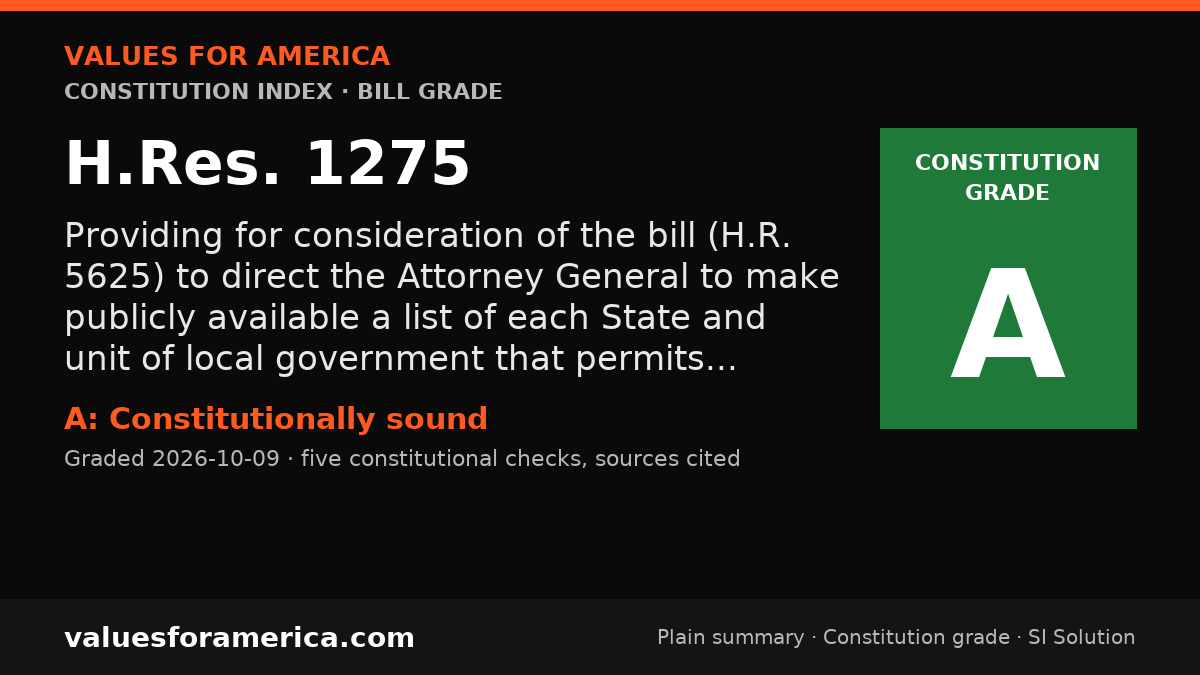
Providing for consideration of the bill (H.R. 5625) to direct the Attorney General to make publicly available a list of each State and unit of local government that permits cashless bail, and for other purposes; providing for consideration of the bill (H.R. 6260) to amend title 18, United States Code, to prohibit fraud in connection with posting bail; providing for consideration of the bill (H.R. 8365) to provide for conditions on the appointment of monitors by courts, and for other purposes; providing for consideration of the concurrent resolution (H. Con. Res. 96) expressing support for law enforcement officers; and providing for consideration of the bill (H.R. 8469) making appropriations for military construction, the Department of Veterans Affairs, and related agencies for the fiscal year ending September 30, 2027, and for other purposes.
Cosponsors: none · per Congress.gov, 2026-10-08
Introduced: 2026-05-12
Latest action (2026-05-13): Motion to reconsider laid on the table Agreed to without objection.
What H.Res. 1275 does, in plain terms
This resolution provides for the consideration of the bill (H.R. 5625) to direct the Attorney General to make publicly available a list of each State and unit of local government that permits cashless bail, and for other purposes; providing for consideration of the bill (H.R. 6260) to amend title 18, United States Code, to prohibit fraud in connection with posting bail; providing for consideration of the bill (H.R. 8365) to provide for conditions on the appointment of monitors by courts, and for other purposes; providing for consideration of the concurrent resolution (H. Con. Res. 96) expressing support for law enforcement officers; and providing for consideration of the bill (H.R. 8469) making appropriations for military construction, the Department of Veterans Affairs, and related agencies for the fiscal year ending September 30, 2027, and for other purposes.
Official summary by the Congressional Research Service, via Congress.gov.
Constitution Index
“VFA Constitution grade”
Constitutionally sound
Graded 2026-10-09
SI-generated grade · five published checks · not individually reviewed by a person · methodology
HRES 1275 is a procedural rule establishing the terms for floor consideration of several listed measures. The House of Representatives has express constitutional authority under Article I, Section 5, Clause 2 to determine the rules of its proceedings. The resolution itself imposes no substantive restriction on rights, does not consolidate governmental power, and does not affect due process or takings protections. Any constitutional questions about the underlying bills would require separate analysis, but this resolution is constitutional.
-
✓ Passes · Enumerated powers
The Constitution grants each house of Congress authority to determine the rules of its proceedings under Article I, Section 5, Clause 2. A resolution providing for consideration of bills is a direct exercise of that procedural authority and is not an attempt to exercise power outside the legislative grants of Article I, Section 8. -
✓ Passes · Bill of Rights
The resolution merely sets the terms for floor debate and votes; it does not abridge speech, religion, assembly, press, petition, arms, search protections, trial rights, or any other provision of the first ten amendments. No Bill of Rights interest is implicated. -
✓ Passes · Individual sovereignty
This is an internal legislative procedure, not a government restriction on the person, property, speech, labor, or belief of any individual. It does not require or prohibit any private conduct and therefore does not infringe individual sovereignty. -
✓ Passes · Decentralization
The resolution operates at the level of the House of Representatives, which is the appropriate body to set its own floor procedure. It does not consolidate substantive decision-making into a higher level of government; it concerns only how the House will consider certain measures. The individual/local/state handling questions do not apply to internal legislative rules, but the action does not viol… -
✓ Passes · Due process and takings
The resolution does not adjudicate rights, impose penalties, deprive any person of life, liberty, or property, or take property without just compensation. It does not prejudice any person's right to notice, hearing, or fair procedure; it is a procedural rule for congressional consideration only.
Sources: Congress.gov: HRES 1275 summary
Report an error in this grade
What should pass
“VFA SI Solution”
No solution yet
A sourced SI draft appears here once it passes automated checks (Constitution citation, source verification, independent SI critic). How publication works.
Related on VFA

For journalists and bloggers
“Embed this grade”
Free to use with the link back. The badge and card update when the grade changes. Embed terms →
