H.Res. 1274 explained · 119th Congress · Pending in Congress
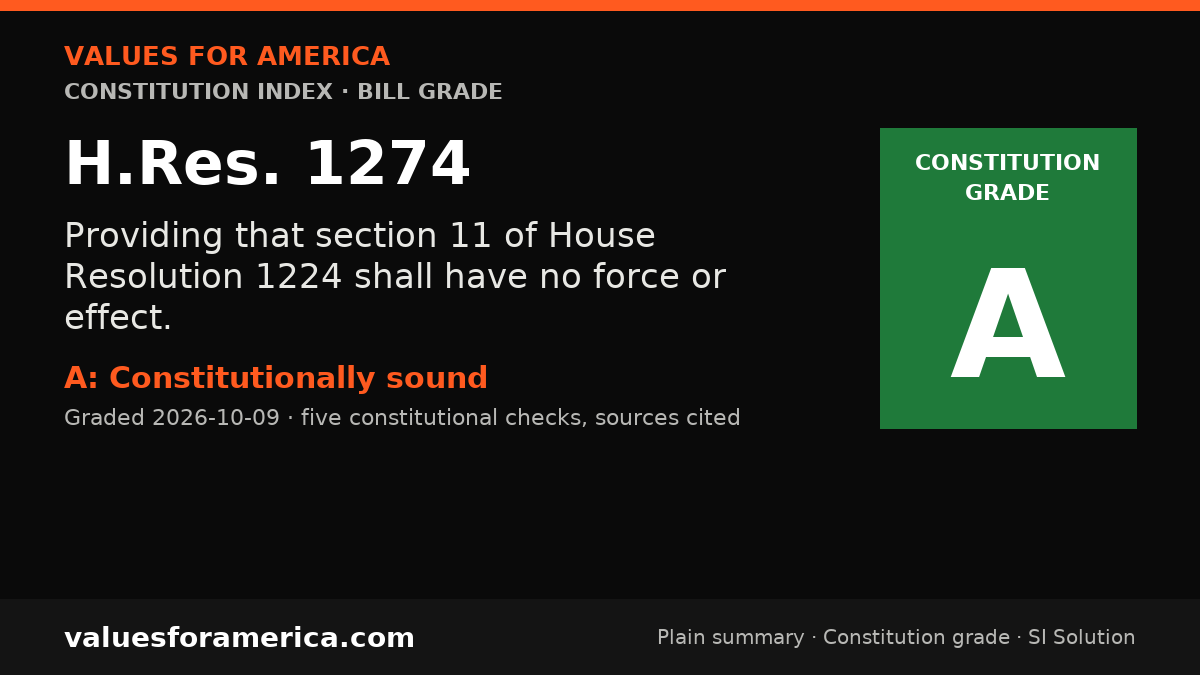
Providing that section 11 of House Resolution 1224 shall have no force or effect.
Cosponsors: none · per Congress.gov, 2026-10-08
Introduced: 2026-05-12
Latest action (2026-05-13): Motion to reconsider laid on the table Agreed to without objection.
What H.Res. 1274 does, in plain terms
This resolution eliminates a requirement to include the text of H.R. 1346, the Nationwide Consumer and Fuel Retailer Choice Act of 2025, as passed by the House of Representatives, in H.R. 7567, the Farm, Food, and National Security Act of 2026 (commonly known as the farm bill). The requirement is contained in H.Res. 1224, which also provides for the consideration of both H.R. 7567 and H.R. 1346. (H.Res. 1224 was agreed to in the House on April 29, 2026.)
Official summary by the Congressional Research Service, via Congress.gov.
Constitution Index
“VFA Constitution grade”
Constitutionally sound
Graded 2026-10-09
SI-generated grade · five published checks · not individually reviewed by a person · methodology
This resolution is a purely procedural measure concerning the internal rules of the House of Representatives. It removes a requirement from a previous resolution that mandated the inclusion of a specific bill's text into another bill. The Constitution explicitly grants each chamber the authority to determine its own rules (Article I, Section 5, Clause 2). The resolution does not infringe any constitutional rights, restrict individual sovereignty, centralize power beyond the necessary legislative process, or implicate due process or takings. It is fully constitutional.
-
✓ Passes · Enumerated powers
Article I, Section 5, Clause 2 of the Constitution provides that 'Each House may determine the Rules of its Proceedings.' HRES 1274 is a rule change within the House's exclusive authority to manage its own legislative process. No external enumerated power is needed; this is an inherent power of the legislative branch. -
✓ Passes · Bill of Rights
The resolution does not regulate speech, religion, press, assembly, petition, arms, quartering, search and seizure, self-incrimination, due process, takings, trial rights, cruel punishment, or any other right protected by the Bill of Rights. It is a purely internal procedural action with no effect on individual liberties. -
✓ Passes · Individual sovereignty
The resolution imposes no restriction on any person's person, property, speech, labor, or belief. It does not command or forbid any conduct by individuals. It only alters the legislative packaging of two bills within the House. Individual sovereignty is untouched. -
✓ Passes · Decentralization
This resolution concerns only the internal procedure of the House of Representatives. It does not involve any action that could be handled by individuals, local communities, or states. The four-question test is not applicable to internal legislative rules, but if applied: (1) individuals cannot set House rules; (2) local communities cannot; (3) states cannot; (4) the action does not consolidate de… -
✓ Passes · Due process and takings
The resolution does not deprive any person of life, liberty, or property; it does not involve a hearing, notice, or adjudication. It does not take private property for public use. The Fifth Amendment's Due Process and Takings Clauses are not engaged.
Sources: Congress.gov: HRES 1274 summary
Report an error in this grade
What should pass
“VFA SI Solution”
No solution yet
A sourced SI draft appears here once it passes automated checks (Constitution citation, source verification, independent SI critic). How publication works.
Related on VFA

For journalists and bloggers
“Embed this grade”
Free to use with the link back. The badge and card update when the grade changes. Embed terms →
