H.Res. 1259 explained · 119th Congress · Pending in Congress
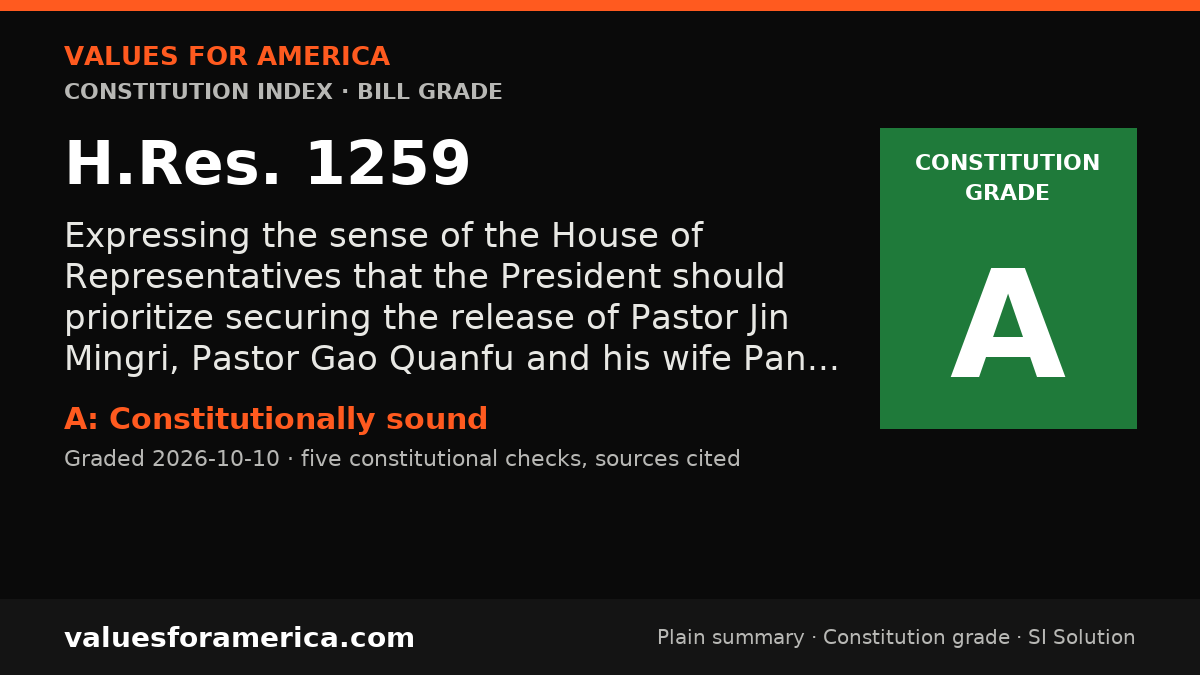
Expressing the sense of the House of Representatives that the President should prioritize securing the release of Pastor Jin Mingri, Pastor Gao Quanfu and his wife Pang Yu, Dr. Gulshan Abbas, and Jimmy Lai detained by the People’s Republic of China during future engagements with Chinese President Xi Jinping.
Cosponsors: 3 (1 D, 2 R) · per Congress.gov, 2026-10-08
Introduced: 2026-05-07
Latest action (2026-05-13): Motion to reconsider laid on the table Agreed to without objection.
What H.Res. 1259 does, in plain terms
This resolution calls upon the President to prioritize the humanitarian release of five specified individuals (Pastor Jin Mingri, Pastor Gao Quanfu and his wife Pang Yu, Dr. Gulshan Abbas, and Jimmy Lai) and others unjustly detained by China during future engagements with China's President Xi Jinping. The resolution also (1) urges the President to seek verifiable proof of life, access to independent legal counsel, family communication, and medical care for these detainees; and (2) reaffirms the U.S. commitment to defending political and religious freedom and advocating for the release of those unjustly detained for exercising such fundamental freedoms.
Official summary by the Congressional Research Service, via Congress.gov.
Constitution Index
“VFA Constitution grade”
Constitutionally sound
Graded 2026-10-10
SI-generated grade · five published checks · not individually reviewed by a person · methodology
This resolution is a non-binding expression of the sense of the House of Representatives. It does not create law, authorize spending, or compel executive action. It merely urges the President to prioritize humanitarian diplomacy during foreign engagements. As such, it falls squarely within Congress's enumerated power to advise on foreign affairs and express its views, infringes no constitutional rights, respects individual sovereignty, does not centralize power beyond the minimum necessary, and imposes no deprivation of due process or property.
-
✓ Passes · Enumerated powers
The resolution is a non-binding sense-of-Congress measure. Article I, Section 8 does not enumerate a power to pass binding laws on foreign affairs beyond those listed, but the Constitution implicitly grants Congress the power to debate, advise, and express its views on matters of national concern, including foreign policy. The Supreme Court has long recognized Congress's authority to issue non-bin… -
✓ Passes · Bill of Rights
The resolution does not restrict any right protected by the Bill of Rights. It advocates for the release of individuals detained abroad and reaffirms commitment to political and religious freedom. It does not abridge speech, religion, assembly, press, petition, arms, quartering, search and seizure, self-incrimination, due process, trial rights, jury rights, cruel and unusual punishment, unenumerat… -
✓ Passes · Individual sovereignty
The resolution imposes no restriction on any individual's person, property, speech, labor, or belief. It does not command, prohibit, or penalize any action by any person. It merely expresses a preference for diplomatic action. Individual sovereignty is fully preserved. -
✓ Passes · Decentralization
This resolution addresses a matter of international diplomacy, which by its nature cannot be handled by individuals, families, local communities, or states alone. Foreign relations are constitutionally committed to the federal government. The resolution does not consolidate decision-making upward beyond the minimum necessary because foreign policy inherently requires federal action. All four quest… -
✓ Passes · Due process and takings
The resolution does not deprive any person of life, liberty, or property, nor does it take property without just compensation. It imposes no penalty, no forfeiture, and no legal obligation. Due process is not implicated because no adverse government action is taken against any person. The resolution merely urges diplomatic action abroad.
Sources: Congress.gov: HRES 1259 summary
Report an error in this grade
What should pass
“VFA SI Solution”
No solution yet
A sourced SI draft appears here once it passes automated checks (Constitution citation, source verification, independent SI critic). How publication works.
Related on VFA

For journalists and bloggers
“Embed this grade”
Free to use with the link back. The badge and card update when the grade changes. Embed terms →
