H.Res. 1251 explained · 119th Congress · Pending in Congress
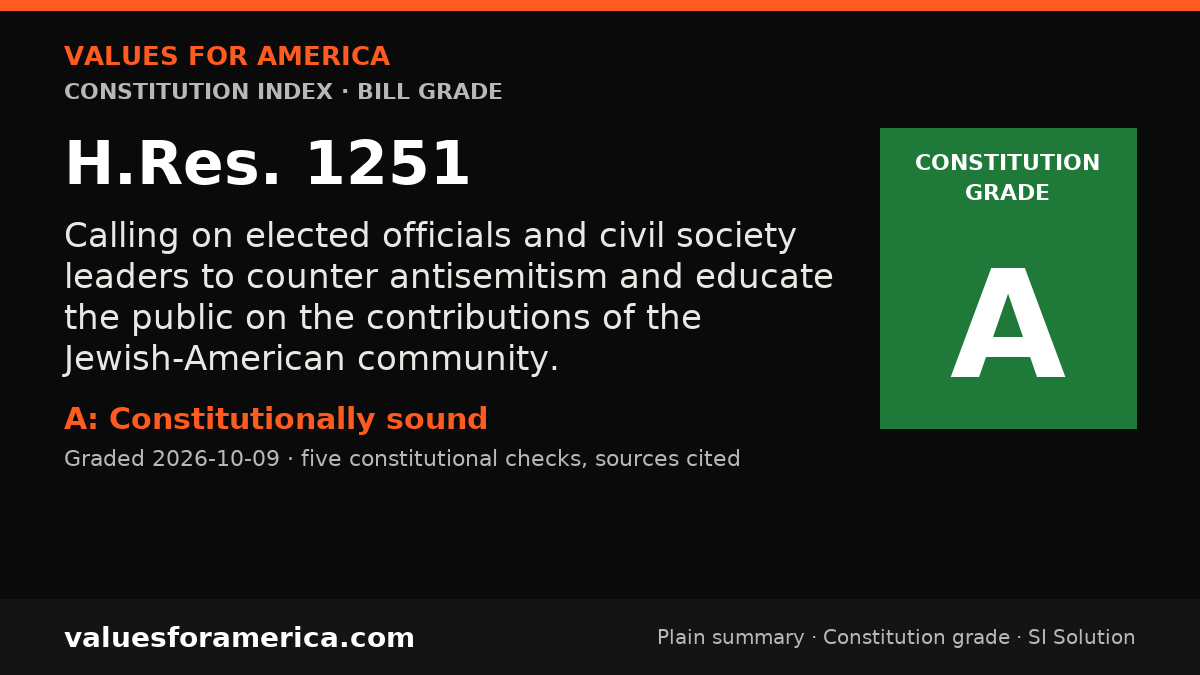
Calling on elected officials and civil society leaders to counter antisemitism and educate the public on the contributions of the Jewish-American community.
Cosponsors: 11 (8 D, 3 R) · per Congress.gov, 2026-10-08
Introduced: 2026-04-30
Latest action (2026-05-13): Motion to reconsider laid on the table Agreed to without objection.
What H.Res. 1251 does, in plain terms
This resolution calls on elected officials, faith leaders, and civil society leaders to condemn and counter acts of anti-Semitism. The resolution also honors the contributions of Jewish-American servicemembers and commits to ensuring all Americans, including Jewish Americans, can worship without fear of violence or persecution.
Official summary by the Congressional Research Service, via Congress.gov.
Constitution Index
“VFA Constitution grade”
Constitutionally sound
Graded 2026-10-09
SI-generated grade · five published checks · not individually reviewed by a person · methodology
HRES 1251 is a non-binding resolution that expresses the sense of Congress and calls on elected officials, faith leaders, and civil society leaders to counter antisemitism and educate the public. It does not impose any legal requirements, restrictions, or penalties. Therefore, it falls within Congress's inherent authority to debate and issue resolutions, does not infringe any constitutional rights, respects individual sovereignty, does not consolidate power upward, and raises no due process or takings concerns. The resolution is fully constitutional.
-
✓ Passes · Enumerated powers
Congress has the inherent authority to pass non-binding resolutions expressing its views. This resolution does not exercise any legislative power under Article I, Section 8, but rather constitutes a formal statement of opinion. No enumerated power is exceeded because no law is enacted. -
✓ Passes · Bill of Rights
The resolution calls for countering antisemitism and educating the public. It does not restrict speech, religion, assembly, press, or any other right protected by the First Amendment or any other amendment. Encouraging condemnation of discrimination is consistent with constitutional values. No infringement occurs. -
✓ Passes · Individual sovereignty
The resolution imposes no restrictions on any individual's person, property, speech, labor, or belief. It merely urges action by leaders and does not compel any private citizen to do anything. The burden on government to justify a restriction is not triggered because no restriction exists. -
✓ Passes · Decentralization
The resolution passes all four questions of the decentralization test. (1) Individuals and families can address antisemitism education without government involvement, but the resolution does not prevent that. (2) Local communities and counties can handle this without state involvement. (3) States can handle this without federal involvement. (4) The resolution does not consolidate decision-making a… -
✓ Passes · Due process and takings
The resolution does not deprive any person of life, liberty, or property, nor does it take private property for public use. It does not bypass any procedural or substantive due process protections. No hearing, notice, or compensation issues arise.
Sources: Congress.gov: HRES 1251 summary
Report an error in this grade
What should pass
“VFA SI Solution”
No solution yet
A sourced SI draft appears here once it passes automated checks (Constitution citation, source verification, independent SI critic). How publication works.
Related on VFA

For journalists and bloggers
“Embed this grade”
Free to use with the link back. The badge and card update when the grade changes. Embed terms →
