H.Res. 1189 explained · 119th Congress · Pending in Congress
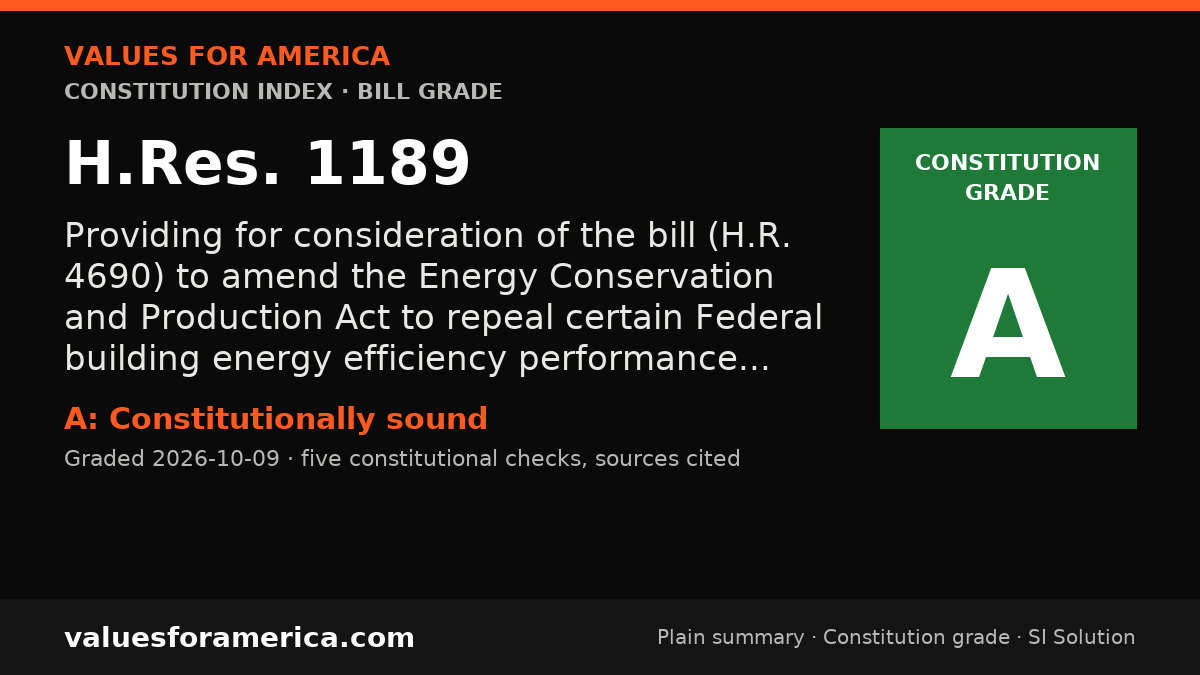
Providing for consideration of the bill (H.R. 4690) to amend the Energy Conservation and Production Act to repeal certain Federal building energy efficiency performance standards, and for other purposes; providing for consideration of the resolution (H. Res. 1182) expressing support for rural communities across the United States as stewards of the environment, major suppliers of United States energy resources, critical providers of food production and manufacturing capacity, and drivers of national economic stability, and recognizing the work of the House of Representatives in the 119th Congress in support of those vital communities; providing for consideration of the bill (H.R. 1897) to amend the Endangered Species Act of 1973 to optimize conservation through resource prioritization, incentivize wildlife conservation on private lands, provide for greater incentives to recover listed species, create greater transparency and accountability in recovering listed species, streamline the permitting process, eliminate barriers to conservation, and restore congressional intent; and providing for consideration of the bill (H.R. 5587) to amend the Geothermal Steam Act of 1970 to waive the requirement for a Federal drilling permit for certain activities, to exempt certain activities from the requirements of the National Environmental Policy Act of 1969, and for other purposes.
Cosponsors: none · per Congress.gov, 2026-10-08
Introduced: 2026-04-20
Latest action (2026-04-22): Motion to reconsider laid on the table Agreed to without objection.
What H.Res. 1189 does, in plain terms
This resolution provides for the consideration of the bill (H.R. 4690) to amend the Energy Conservation and Production Act to repeal certain Federal building energy efficiency performance standards, and for other purposes; providing for consideration of the resolution (H. Res. 1182) expressing support for rural communities across the United States as stewards of the environment, major suppliers of United States energy resources, critical providers of food production and manufacturing capacity, and drivers of national economic stability, and recognizing the work of the House of Representatives in the 119th Congress in support of those vital communities; providing for consideration of the bill (H.R. 1897) to amend the Endangered Species Act of 1973 to optimize conservation through resource prioritization, incentivize wildlife conservation on private lands, provide for greater incentives to recover listed species, create greater transparency and accountability in recovering listed species, streamline the permitting process, eliminate barriers to conservation, and restore congressional intent; and providing for consideration of the bill (H.R. 5587) to amend the Geothermal Steam Act of 1970 to waive the requirement for a Federal drilling permit for certain activities, to exempt certain activities from the requirements of the National Environmental Policy Act of 1969, and for other purposes.
Official summary by the Congressional Research Service, via Congress.gov.
Constitution Index
“VFA Constitution grade”
Constitutionally sound
Graded 2026-10-09
SI-generated grade · five published checks · not individually reviewed by a person · methodology
This resolution is a procedural rule of the House of Representatives, setting terms for consideration of several substantive bills. Under Article I, Section 5, Clause 2, each chamber of Congress is expressly empowered to determine the rules of its own proceedings. The resolution itself does not enact any substantive law, restrict any individual right, or reassign governmental authority. It is therefore fully constitutional.
-
✓ Passes · Enumerated powers
The Constitution vests all legislative powers in Congress (Article I, Section 1) and specifically grants each House authority to determine its own rules of proceedings (Article I, Section 5, Clause 2). A resolution providing for consideration of bills is a quintessential exercise of that internal rulemaking power. Nothing in the resolution exceeds these enumerated powers; it is a procedural vehicl… -
✓ Passes · Bill of Rights
The resolution does not restrict speech, religion, assembly, press, petition, arms, quartering, search and seizure, self-incrimination, due process, trial rights, jury rights, cruel and unusual punishment, or any other protection of the first ten amendments. It merely sets debate parameters for the House. No Bill of Rights interest is affected by this rule. -
✓ Passes · Individual sovereignty
The resolution imposes no restriction on the person, property, speech, labor, or belief of any individual. It governs only the internal procedure of the House of Representatives. The burden on individual sovereignty is zero; the rule does not command, prohibit, or regulate any private conduct. -
✓ Passes · Decentralization
The four-question test asks whether an action could be handled at a lower level of government. A House rule governing consideration of legislation cannot be handled by an individual, family, local community, or state; it is inherently a federal legislative procedural matter. The resolution does not consolidate any substantive decision-making authority upward because it creates no new policy author… -
✓ Passes · Due process and takings
The resolution does not deprive anyone of life, liberty, or property, does not bypass any hearing or notice requirement, and does not take private property. It has no effect on any person's procedural or substantive due process rights. The Takings Clause of the Fifth Amendment is not implicated.
Sources: Congress.gov: HRES 1189 summary
Report an error in this grade
What should pass
“VFA SI Solution”
No solution yet
A sourced SI draft appears here once it passes automated checks (Constitution citation, source verification, independent SI critic). How publication works.
Related on VFA

For journalists and bloggers
“Embed this grade”
Free to use with the link back. The badge and card update when the grade changes. Embed terms →
