H.Res. 1174 explained · 119th Congress · Pending in Congress
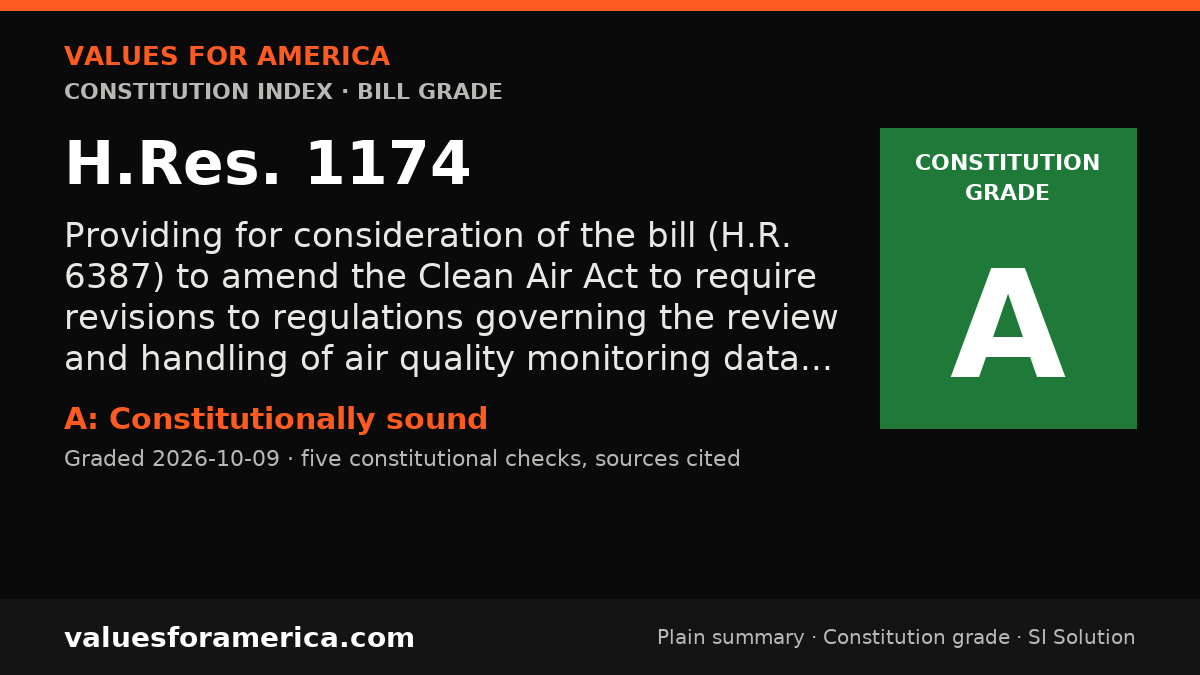
Providing for consideration of the bill (H.R. 6387) to amend the Clean Air Act to require revisions to regulations governing the review and handling of air quality monitoring data influenced by exceptional events or actions to mitigate wildfire risk; providing for consideration of the bill (H.R. 6398) to amend the Clean Air Act relating to review by the Environmental Protection Agency of proposed legislation; providing for consideration of the bill (H.R. 6409) to amend the Clean Air Act to clarify standards for emissions emanating from outside of the United States, and for other purposes; and providing for consideration of the resolution (H. Res. 1156) expressing support for tax policies that support working families.
Cosponsors: none · per Congress.gov, 2026-10-09
Introduced: 2026-04-15
Latest action (2026-04-15): Motion to reconsider laid on the table Agreed to without objection.
What H.Res. 1174 does, in plain terms
This resolution provides for the consideration of the bill (H.R. 6387) to amend the Clean Air Act to require revisions to regulations governing the review and handling of air quality monitoring data influenced by exceptional events or actions to mitigate wildfire risk; providing for consideration of the bill (H.R. 6398) to amend the Clean Air Act relating to review by the Environmental Protection Agency of proposed legislation; providing for consideration of the bill (H.R. 6409) to amend the Clean Air Act to clarify standards for emissions emanating from outside of the United States, and for other purposes; and providing for consideration of the resolution (H. Res. 1156) expressing support for tax policies that support working families.
Official summary by the Congressional Research Service, via Congress.gov.
Constitution Index
“VFA Constitution grade”
Constitutionally sound
Graded 2026-10-09
SI-generated grade · five published checks · not individually reviewed by a person · methodology
HRES 1174 is a procedural resolution that sets the terms for debating and voting on several bills. It does not enact any substantive law, impose any restrictions on rights, or expand federal power beyond the House's explicit constitutional authority to determine its own rules of proceedings under Article I, Section 5, Clause 2. The resolution itself infringes no constitutional provisions and raises no rights or sovereignty concerns.
-
✓ Passes · Enumerated powers
The House of Representatives has explicit constitutional authority under Article I, Section 5, Clause 2 to 'determine the Rules of its Proceedings.' HRES 1174 is a rule providing for consideration of specific bills and a resolution, which falls squarely within that enumerated power. No federal power overreach occurs. -
✓ Passes · Bill of Rights
The resolution does not restrict speech, religion, assembly, press, petition, arms, quartering, search and seizure, self-incrimination, due process, takings, fair trial, jury, cruel and unusual punishment, or any other right protected by the first ten amendments. It is a purely procedural measure with no impact on individual liberties. -
✓ Passes · Individual sovereignty
HRES 1174 does not restrict any person's control over their own person, property, speech, labor, or belief. It merely governs the internal legislative process of the House. No government justification is needed because no restriction is imposed. -
✓ Passes · Decentralization
The resolution is an internal procedural rule of the House of Representatives. It does not affect the ability of individuals, families, local communities, or states to handle their own affairs. It does not consolidate decision-making upward beyond the minimum necessary; rather, it is a routine exercise of the House's own rulemaking power. All four decentralization questions are satisfied. -
✓ Passes · Due process and takings
The resolution does not bypass any procedural due process, does not presume guilt, and does not take any private property. It is a legislative rule that provides notice and an orderly process for considering bills. No due process or takings clause issue arises.
Sources: Congress.gov: HRES 1174 summary
Report an error in this grade
What should pass
“VFA SI Solution”
No solution yet
A sourced SI draft appears here once it passes automated checks (Constitution citation, source verification, independent SI critic). How publication works.
Related on VFA

For journalists and bloggers
“Embed this grade”
Free to use with the link back. The badge and card update when the grade changes. Embed terms →
