H.Res. 1131 explained · 119th Congress · Pending in Congress
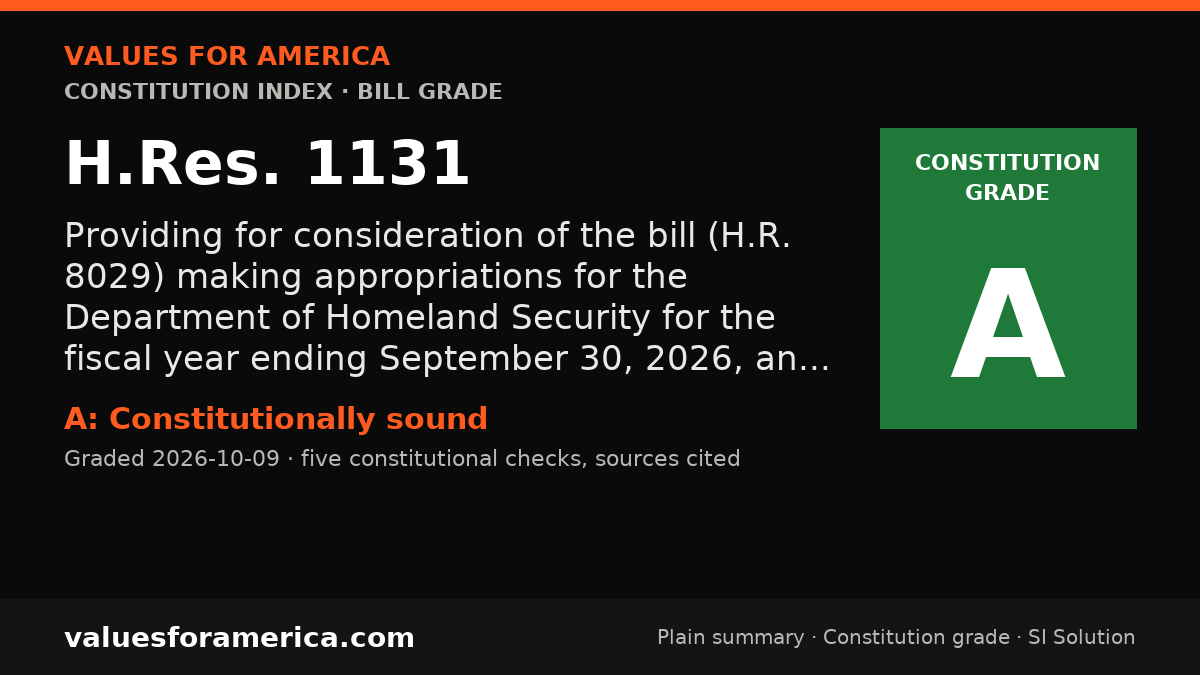
Providing for consideration of the bill (H.R. 8029) making appropriations for the Department of Homeland Security for the fiscal year ending September 30, 2026, and for other purposes; providing for consideration of the resolution (H. Res. 1128) expressing the support of the House of Representatives for the Department of Homeland Security; providing for consideration of the bill (H.R. 5103) to establish a program to Beautify the District of Columbia and establish the District of Columbia Safe and Beautiful Commission; providing for consideration of the bill (H.R. 7084) to amend title 46, United States Code, with respect to the types of vessels that may enter or operate in navigable waters of the United States or transfer cargo in any port or place under the jurisdiction of the United States, and for other purposes; and for other purposes.
Cosponsors: none · per Congress.gov, 2026-10-09
Introduced: 2026-03-24
Latest action (2026-03-25): Motion to reconsider laid on the table Agreed to without objection.
What H.Res. 1131 does, in plain terms
This resolution provides for the consideration of the bill (H.R. 8029) making appropriations for the Department of Homeland Security for the fiscal year ending September 30, 2026, and for other purposes; providing for consideration of the resolution (H. Res. 1128) expressing the support of the House of Representatives for the Department of Homeland Security; providing for consideration of the bill (H.R. 5103) to establish a program to Beautify the District of Columbia and establish the District of Columbia Safe and Beautiful Commission; providing for consideration of the bill (H.R. 7084) to amend title 46, United States Code, with respect to the types of vessels that may enter or operate in navigable waters of the United States or transfer cargo in any port or place under the jurisdiction of the United States, and for other purposes; and for other purposes.
Official summary by the Congressional Research Service, via Congress.gov.
Constitution Index
“VFA Constitution grade”
Constitutionally sound
Graded 2026-10-09
SI-generated grade · five published checks · not individually reviewed by a person · methodology
H.Res. 1131 is a procedural rule setting the terms for floor consideration of several bills. It is a valid exercise of the House's constitutional power to determine its own proceedings under Article I, Section 5, Clause 2. The resolution itself does not enact substantive policy, appropriate money, or regulate private conduct, so it does not run afoul of enumerated-powers limits or the Bill of Rights. Nothing in the resolution takes property, deprives anyone of due process, or restricts individual sovereignty. It is a routine internal legislative action, consistent with the Constitution.
-
✓ Passes · Enumerated powers
The House has explicit constitutional authority to determine the rules of its own proceedings under Article I, Section 5, Clause 2. A resolution providing for consideration of bills is precisely that. The underlying bills concern DHS appropriations, support for DHS, beautification of the District of Columbia, and vessel operations in navigable waters, all of which fall within Congress's enumerated… -
✓ Passes · Bill of Rights
The resolution is purely procedural and does not restrict speech, religion, press, assembly, petition, the right to keep and bear arms, or any other provision of the first ten amendments. It does not authorize searches, seizures, or quartering, and it creates no criminal or civil penalties. No rights under the Bill of Rights are implicated. -
✓ Passes · Individual sovereignty
The resolution imposes no restriction on what individuals may do with their persons, property, speech, labor, or beliefs. The burden of justification for a rights restriction is not triggered because the resolution does not restrict anyone's liberty. It merely schedules and structures House debate and votes. -
✓ Passes · Decentralization
Setting the rules for floor consideration of bills is an inherently federal legislative function that cannot be performed by an individual, a family, a local community, or a state. The House of Representatives is the minimum necessary body to determine its own proceedings. This action does not consolidate decision-making above the required level; it is the House acting on its own internal rules. -
✓ Passes · Due process and takings
The resolution does not deprive any person of life, liberty, or property, nor does it take property for public use without just compensation. It is not an adjudicative proceeding and does not implicate procedural or substantive due process. The resolution is a legislative rule about consideration, not an action against any individual.
Sources: Congress.gov: HRES 1131 summary
Report an error in this grade
What should pass
“VFA SI Solution”
No solution yet
A sourced SI draft appears here once it passes automated checks (Constitution citation, source verification, independent SI critic). How publication works.
Related on VFA

For journalists and bloggers
“Embed this grade”
Free to use with the link back. The badge and card update when the grade changes. Embed terms →
