H.Res. 1100 explained · 119th Congress · Pending in Congress
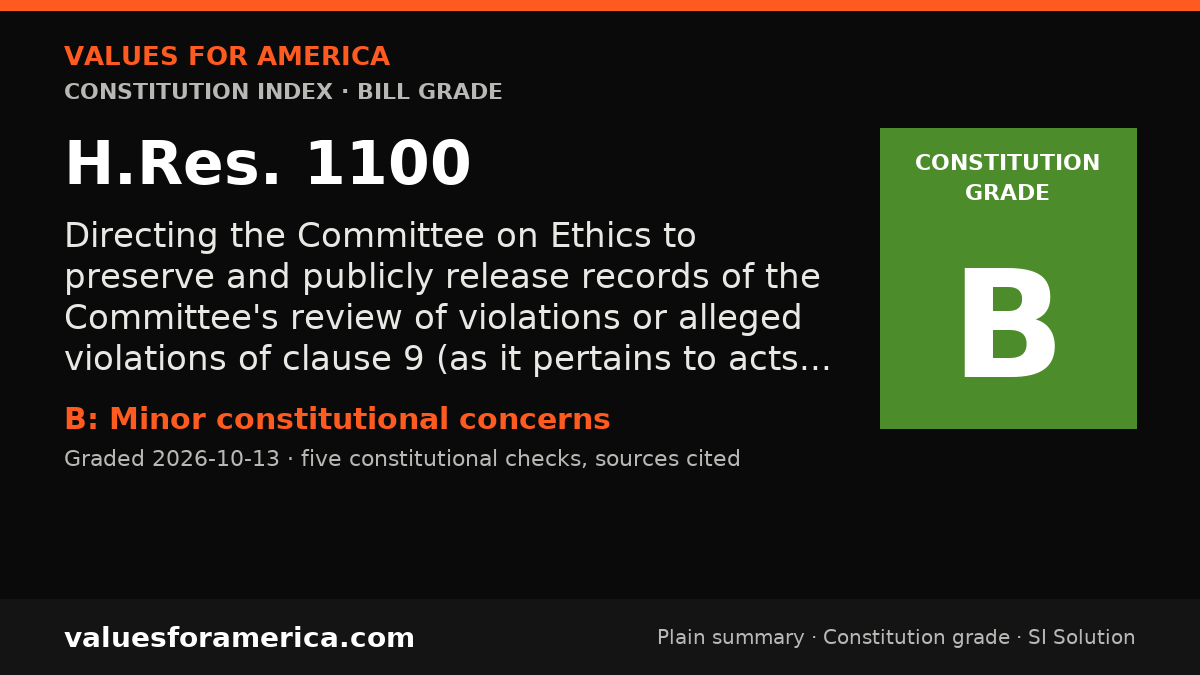
Directing the Committee on Ethics to preserve and publicly release records of the Committee's review of violations or alleged violations of clause 9 (as it pertains to acts of sexual harassment) and clause 18 of rule XXIII of the Rules of the House of Representatives.
Cosponsors: none · per Congress.gov, 2026-10-09
Introduced: 2026-03-04
Latest action (2026-03-04): Motion to reconsider laid on the table Agreed to without objection.
What H.Res. 1100 does, in plain terms
This resolution directs the House Committee on Ethics to preserve and publicly disclose records related to violations or alleged violations of the Code of Official Conduct involving acts of sexual harassment, unwelcome sexual advance, or sexual assault by a Member, Delegate, or Resident Commissioner. (The Code of Official Conduct is Rule XXIII of the Rules of the House of Representatives.) Under the resolution, the committee must preserve all records (including investigative materials) of such a violation or alleged violation. Further, within 60 days after the resolution is adopted, the committee must publicly release available reports, conclusions, recommendations, exhibits, and attachments related to such investigations. The personally identifiable information of victims, alleged victims, and witnesses must be redacted.
Official summary by the Congressional Research Service, via Congress.gov.
Constitution Index
“VFA Constitution grade”
Minor constitutional concerns
Graded 2026-10-13
SI-generated grade · five published checks · not individually reviewed by a person · methodology
This resolution directs the House Committee on Ethics to preserve and publicly release records of investigations into sexual harassment or assault by Members. It is a procedural measure within the House's constitutional authority to discipline its own Members. The primary constitutional concern is the potential infringement on the due process rights of the accused Members, as public release of investigative materials before a final adjudication could prejudice their reputation and fair hearing. However, the resolution's requirement to redact personally identifiable information of victims and witnesses mitigates some privacy concerns. The measure does not exceed federal enumerated powers, as it pertains to the internal governance of Congress, and it does not implicate the Bill of Rights in a way that would render it unconstitutional. The decentralization test is not applicable to internal congressional procedures, but the resolution does not consolidate power beyond the necessary level. Overall, the resolution is mostly sound but requires careful implementation to ensure due process protections for accused Members.
-
✓ Passes · Enumerated powers
The resolution is an exercise of the House's constitutional authority to discipline its own Members and to determine the rules of its proceedings. Article I, Section 5, Clause 2 grants each House the power to punish its Members for disorderly behavior and, with the concurrence of two-thirds, to expel a Member. Additionally, Article I, Section 5, Clause 2 allows each House to determine the rules of… -
✓ Passes · Bill of Rights
The resolution does not directly infringe upon the rights protected by the Bill of Rights. It does not restrict speech, religion, assembly, press, petition, arms, quartering, search and seizure, self-incrimination, due process, takings, fair trial, jury, cruel and unusual punishment, or unenumerated rights. The public release of records could implicate the due process rights of accused Members und… -
✓ Passes · Individual sovereignty
The resolution restricts the privacy of accused Members by requiring public release of investigative records. However, the government has a compelling interest in maintaining the integrity of the House and addressing sexual harassment and assault. The restriction is narrowly tailored: it applies only to records of violations or alleged violations of specific rules, and it requires redaction of per… -
✓ Passes · Decentralization
This resolution concerns the internal procedures of the House of Representatives, a federal institution. The decentralization test is not directly applicable to internal congressional governance, as it is not a matter that could be handled by individuals, local communities, or states. The resolution does not consolidate decision-making at a higher level than necessary; it is a decision made by the… -
✗ Concern · Due process and takings
The resolution raises due process concerns for accused Members. The public release of investigative records, including reports, conclusions, and recommendations, could occur before the accused has had a full and fair hearing. This could prejudice the accused's reputation and potentially affect their ability to receive a fair proceeding. The Fifth Amendment's Due Process Clause requires that govern…
Sources: Congress.gov: HRES 1100 summary
Report an error in this grade
What should pass
“VFA SI Solution”
No solution yet
A sourced SI draft appears here once it passes automated checks (Constitution citation, source verification, independent SI critic). How publication works.
Related on VFA

For journalists and bloggers
“Embed this grade”
Free to use with the link back. The badge and card update when the grade changes. Embed terms →
