H.Res. 1075 explained · 119th Congress · Pending in Congress
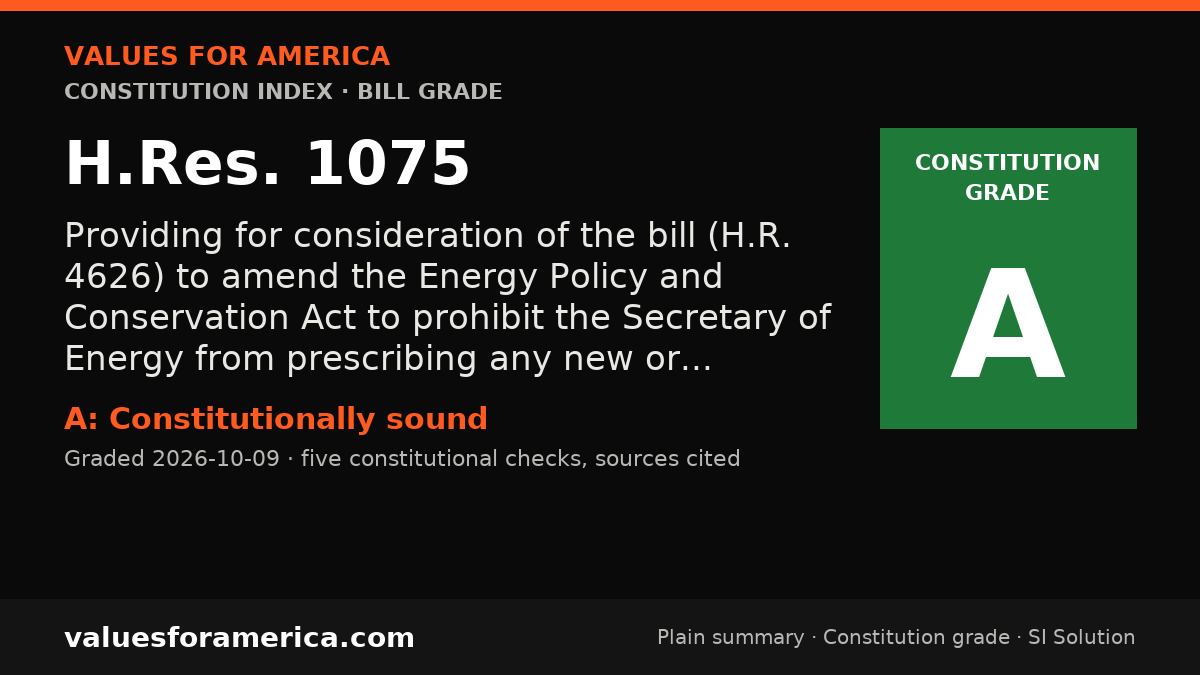
Providing for consideration of the bill (H.R. 4626) to amend the Energy Policy and Conservation Act to prohibit the Secretary of Energy from prescribing any new or amended energy conservation standard for a product that is not technologically feasible and economically justified, and for other purposes, and providing for consideration of the bill (H.R. 4758) to repeal provisions of Public Law 117–169 relating to taxpayer subsidies for home electrification, and for other purposes.
Cosponsors: none · per Congress.gov, 2026-10-09
Introduced: 2026-02-24
Latest action (2026-02-24): Motion to reconsider laid on the table Agreed to without objection.
What H.Res. 1075 does, in plain terms
This resolution provides for the consideration of the bill (H.R. 4626) to amend the Energy Policy and Conservation Act to prohibit the Secretary of Energy from prescribing any new or amended energy conservation standard for a product that is not technologically feasible and economically justified, and for other purposes, and providing for consideration of the bill (H.R. 4758) to repeal provisions of Public Law 117-169 relating to taxpayer subsidies for home electrification, and for other purposes.
Official summary by the Congressional Research Service, via Congress.gov.
Constitution Index
“VFA Constitution grade”
Constitutionally sound
Graded 2026-10-09
SI-generated grade · five published checks · not individually reviewed by a person · methodology
HRES 1075 is a procedural resolution that sets the terms for considering two bills. Congress has explicit constitutional authority under Article I, Section 5, Clause 2 to determine the rules of its proceedings. The underlying bills—limiting executive energy‑conservation standards and repealing certain home‑electrification subsidies—fall within Congress’s enumerated powers under the Commerce Clause (Article I, Section 8, Clause 3) and the Taxing and Spending Clause (Article I, Section 8, Clause 1). No rights are infringed, individual sovereignty is preserved or enhanced, the action does not consolidate power upward, and no due‑process or takings issues arise. The resolution is fully constitutional.
-
✓ Passes · Enumerated powers
Congress has explicit constitutional authority to set its own procedural rules (Article I, Section 5, Clause 2). The bills being considered—H.R. 4626 (amending the Energy Policy and Conservation Act) and H.R. 4758 (repealing taxpayer subsidies for home electrification)—are within Congress’s enumerated powers under the Commerce Clause (Article I, Section 8, Clause 3) and the Taxing and Spending Cla… -
✓ Passes · Bill of Rights
The resolution and the underlying bills do not restrict speech, religion, assembly, press, petition, the right to keep and bear arms, protection against unreasonable searches, self‑incrimination, due process, takings, fair trial, jury trial, cruel and unusual punishment, or any other right enumerated in the first ten amendments. No infringement of the Bill of Rights occurs. -
✓ Passes · Individual sovereignty
The resolution does not restrict what individuals may do with their person, property, speech, labor, or belief. The underlying bills limit federal executive power (by requiring energy standards to be technologically feasible and economically justified) and remove federal subsidies (repealing home‑electrification incentives). Both actions reduce government involvement in individual choices, thereby… -
✓ Passes · Decentralization
The resolution is a procedural rule for Congress, which is the appropriate level for such decisions. The underlying bills reduce federal authority: H.R. 4626 restricts the Secretary of Energy from imposing standards that are not feasible or justified, leaving more room for state and local regulation; H.R. 4758 eliminates federal subsidies, returning decisions about home electrification to individu… -
✓ Passes · Due process and takings
The resolution is a legislative procedural action that does not deprive any person of life, liberty, or property without due process. The underlying bills are prospective legislative changes: limiting future executive rulemaking does not deprive anyone of vested rights, and repealing a subsidy does not constitute a taking of property (subsidies are gratuities, not property rights). No procedural o…
Sources: Congress.gov: HRES 1075 summary
Report an error in this grade
What should pass
“VFA SI Solution”
No solution yet
A sourced SI draft appears here once it passes automated checks (Constitution citation, source verification, independent SI critic). How publication works.
Related on VFA

For journalists and bloggers
“Embed this grade”
Free to use with the link back. The badge and card update when the grade changes. Embed terms →
