H.Res. 1042 explained · 119th Congress · Pending in Congress
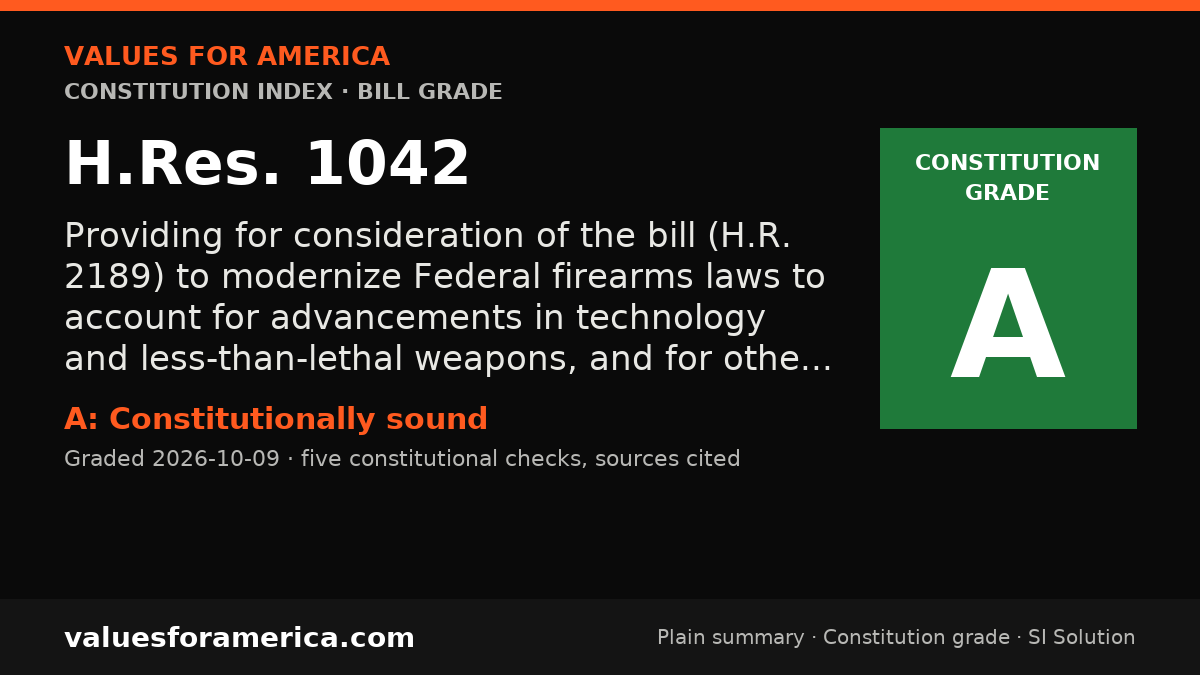
Providing for consideration of the bill (H.R. 2189) to modernize Federal firearms laws to account for advancements in technology and less-than-lethal weapons, and for other purposes; providing for consideration of the bill (H.R. 261) to amend the National Marine Sanctuaries Act to prohibit requiring an authorization for the installation, continued presence, operation, maintenance, repair, or recovery of undersea fiber optic cables in a national marine sanctuary if such activities have previously been authorized by a Federal or State agency; providing for consideration of the bill (H.R. 3617) to amend the Department of Energy Organization Act to secure the supply of critical energy resources, including critical minerals and other materials, and for other purposes; and for other purposes.
Cosponsors: none · per Congress.gov, 2026-10-09
Introduced: 2026-02-09
Latest action (2026-02-10): Motion to reconsider laid on the table Agreed to without objection.
What H.Res. 1042 does, in plain terms
This resolution provides for the consideration of the bill (H.R. 2189) to modernize Federal firearms laws to account for advancements in technology and less-than-lethal weapons, and for other purposes; providing for consideration of the bill (H.R. 261) to amend the National Marine Sanctuaries Act to prohibit requiring an authorization for the installation, continued presence, operation, maintenance, repair, or recovery of undersea fiber optic cables in a national marine sanctuary if such activities have previously been authorized by a Federal or State agency; providing for consideration of the bill (H.R. 3617) to amend the Department of Energy Organization Act to secure the supply of critical energy resources, including critical minerals and other materials, and for other purposes; and for other purposes.
Official summary by the Congressional Research Service, via Congress.gov.
Constitution Index
“VFA Constitution grade”
Constitutionally sound
Graded 2026-10-09
SI-generated grade · five published checks · not individually reviewed by a person · methodology
H.Res. 1042 is a special rule of the House of Representatives. The Constitution expressly gives each House the power to determine the rules of its proceedings, and a rule merely sets the terms for debating and voting on three underlying bills. It does not enact the substantive provisions of H.R. 2189, H.R. 261, or H.R. 3617 and imposes no restriction on private rights. Any constitutional concerns in the underlying bills would be assessed when those bills are considered on their merits.
-
✓ Passes · Enumerated powers
Article I, Section 5, Clause 2 expressly authorizes each House to determine the rules of its proceedings. A resolution providing for consideration of bills is a direct exercise of that authority. The enumerated-powers question for the underlying bills is separate; this rule itself is within Congress's express procedural power. -
✓ Passes · Bill of Rights
The resolution does not regulate speech, religion, assembly, the press, petition, arms, quartering, searches, criminal procedure, takings, or any other right protected by the Bill of Rights. It only arranges floor consideration. Even limitations on debate time are internal legislative rules authorized by Article I, Section 5 and do not infringe the First Amendment rights of Members beyond the proc… -
✓ Passes · Individual sovereignty
This measure is directed at the internal legislative process and does not restrict what any person may do with their own person, property, speech, labor, or belief. It places no burden on any individual; the burden of justification would apply only to the substantive provisions of the underlying bills if they are enacted. -
✓ Passes · Decentralization
The House's floor procedure cannot be conducted by individuals, localities, or states; the Constitution assigns it to the House of Representatives itself. The resolution does not consolidate private, local, or state decision-making upward because the power over House proceedings is already vested at the federal legislative level by Article I, Section 5, Clause 2. Therefore there is no Tenth Amendm… -
✓ Passes · Due process and takings
The resolution takes no private property, deprives no person of life, liberty, or property, and creates no new administrative or judicial procedure. Because it is a procedural rule governing House consideration, the Fifth Amendment's Due Process and Takings Clauses are not implicated.
Sources: Congress.gov: HRES 1042 summary
Report an error in this grade
What should pass
“VFA SI Solution”
No solution yet
A sourced SI draft appears here once it passes automated checks (Constitution citation, source verification, independent SI critic). How publication works.
Related on VFA

For journalists and bloggers
“Embed this grade”
Free to use with the link back. The badge and card update when the grade changes. Embed terms →
