H.Res. 102 explained · 119th Congress · Pending in Congress
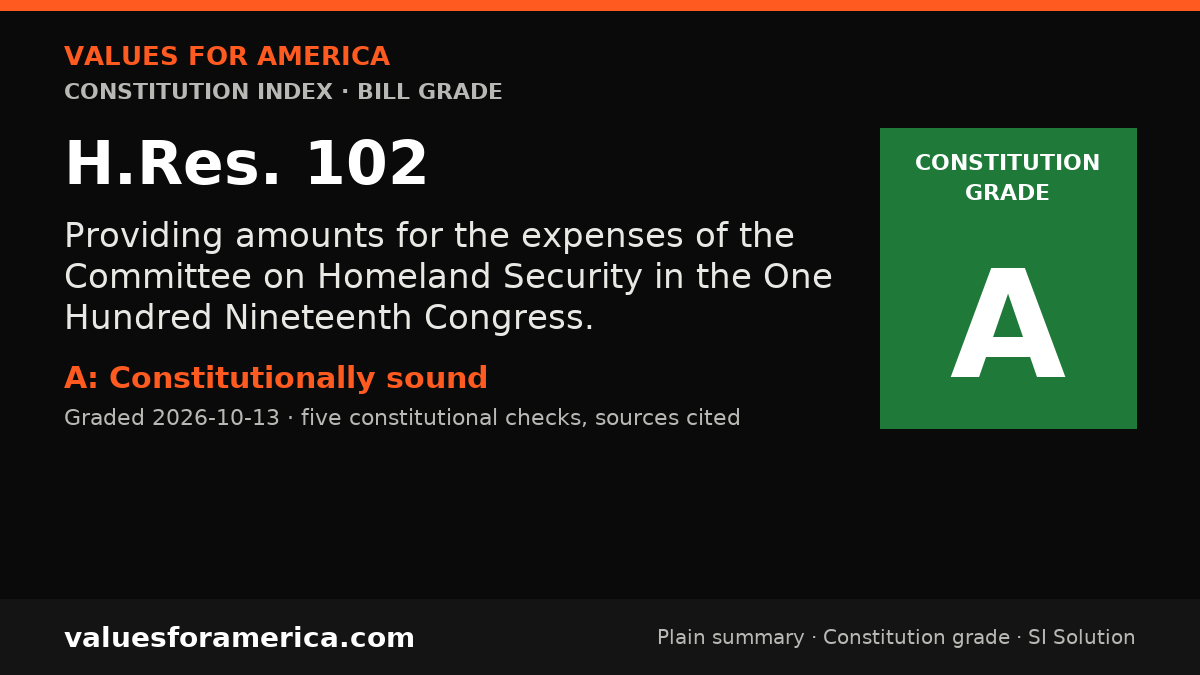
Providing amounts for the expenses of the Committee on Homeland Security in the One Hundred Nineteenth Congress.
Cosponsors: 1 (1 D, 0 R) · per Congress.gov, 2026-10-12
Introduced: 2025-02-04
Latest action (2025-02-04): Referred to the House Committee on House Administration.
What H.Res. 102 does, in plain terms
This resolution provides amounts for the expenses of the House Committee on Homeland Security for the 119th Congress.
Official summary by the Congressional Research Service, via Congress.gov.
Constitution Index
“VFA Constitution grade”
Constitutionally sound
Graded 2026-10-13
SI-generated grade · five published checks · not individually reviewed by a person · methodology
This resolution merely funds the internal operations of a House committee, an action squarely within Congress's constitutional authority to organize itself and appropriate funds. It does not infringe any constitutional right, restrict individual sovereignty, or centralize power beyond the legislative branch's inherent functions. The resolution is fully constitutional.
-
✓ Passes · Enumerated powers
Article I, Section 5, Clause 2 grants each House of Congress the power to determine its own rules of proceedings, and Article I, Section 8, Clause 18 grants Congress the power to make all laws necessary and proper for carrying into execution its enumerated powers. Funding a standing committee's expenses is a necessary incident of Congress's legislative function and its power to appropriate funds u… -
✓ Passes · Bill of Rights
The resolution does not regulate speech, religion, assembly, press, petition, arms, quartering, searches, seizures, self-incrimination, due process, takings, trial rights, or cruel and unusual punishment. It has no effect on any right protected by the first ten amendments. -
✓ Passes · Individual sovereignty
The resolution imposes no restrictions on personal conduct, property, speech, labor, or belief. It merely allocates funds for committee operations and does not burden any individual's liberty or property interests. -
✓ Passes · Decentralization
This is a purely internal legislative matter. The questions of individual, local, or state handling are not applicable because the Constitution vests the legislative power in Congress, and the resolution does not consolidate any governmental authority beyond the federal legislative branch's inherent role. It does not implicate the Tenth Amendment because it does not exercise power over states or i… -
✓ Passes · Due process and takings
The resolution does not deprive any person of life, liberty, or property, nor does it take private property for public use. It involves no adjudicative or administrative action affecting individual rights, so procedural and substantive due process are not implicated.
Sources: Congress.gov: HRES 102 summary
Report an error in this grade
What should pass
“VFA SI Solution”
No solution yet
A sourced SI draft appears here once it passes automated checks (Constitution citation, source verification, independent SI critic). How publication works.
Related on VFA

For journalists and bloggers
“Embed this grade”
Free to use with the link back. The badge and card update when the grade changes. Embed terms →
