H.R. 9976 explained · 119th Congress · Pending in Congress
SWAT Act of 2026
Cosponsors: 1 (1 D, 0 R) · per Congress.gov, 2026-10-14
Introduced: 2026-07-27
Latest action (2026-07-27): Referred to the House Committee on Agriculture.
What H.R. 9976 does, in plain terms
Spotted Wing Abatement Trust Act of 2026 or the SWAT Act of 2026 This bill directs the Animal and Plant Health Inspection Service to establish a fund for research relating to, and activities to mitigate the negative effects of, spotted wing drosophila. Spotted wing drosophila is an invasive species of insect from East Asia that has caused significant damage to unripe berry and stone fruit crops in the United States, including raspberries, blackberries, blueberries, strawberries, peaches, plums, and cherries.
Official summary by the Congressional Research Service, via Congress.gov.
Constitution Index
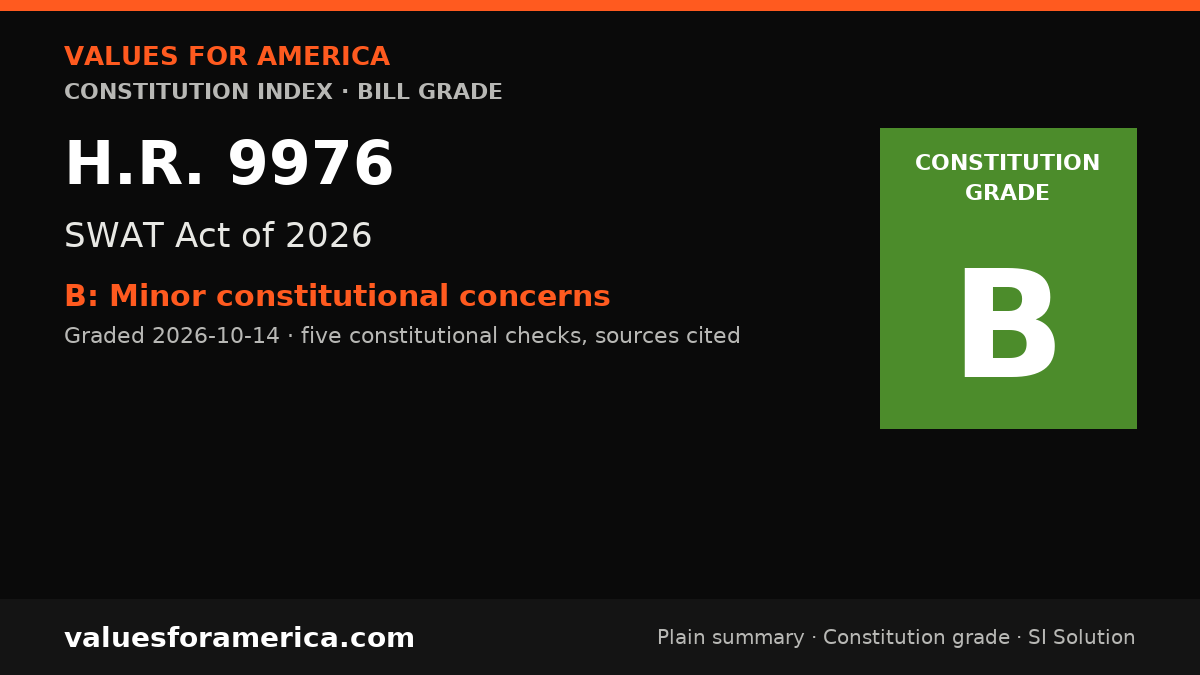
“VFA Constitution grade”
Minor constitutional concerns
Graded 2026-10-14
SI-generated grade · five published checks · not individually reviewed by a person · methodology
The bill establishes a federal fund for research and mitigation of an invasive agricultural pest. It falls within Congress's enumerated power to regulate interstate and foreign commerce, as the pest directly affects agricultural products that move in interstate and foreign commerce. The bill does not infringe on individual rights, does not restrict personal sovereignty, and does not involve takings or due process concerns. However, the federal role in agricultural pest management could be handled at the state or local level, and the bill consolidates decision-making at the federal level, failing one decentralization question. Overall, the bill is mostly sound with minor federalism concerns.
-
✓ Passes · Enumerated powers
Congress has authority under Article I, Section 8, Clause 3 (the Commerce Clause) to regulate interstate and foreign commerce. Spotted wing drosophila directly affects agricultural products that are sold across state lines and internationally, and the federal government has a long-established role in preventing the spread of invasive species that threaten interstate commerce. The Animal and Plant … -
✓ Passes · Bill of Rights
The bill does not implicate any of the first ten amendments. It imposes no restrictions on speech, religion, assembly, press, petition, arms, quartering, search and seizure, self-incrimination, due process, takings, trial rights, or cruel and unusual punishment. It merely establishes a fund for research and mitigation activities. -
✓ Passes · Individual sovereignty
The bill does not restrict what individuals can do with their person, property, speech, labor, or belief. It imposes no mandates or prohibitions on private citizens. It creates a voluntary fund for research and mitigation, which does not burden individual liberty. -
✗ Concern · Decentralization
The bill fails one of the four questions. While individuals and local communities cannot effectively address a widespread invasive species on their own, and states could potentially handle this, the federal government is not the minimum necessary level. States have their own agricultural departments and could coordinate regional efforts. The bill consolidates decision-making at the federal level, … -
✓ Passes · Due process and takings
The bill does not bypass due process, does not affect the presumption of innocence, and does not take private property. It establishes a fund for research and mitigation, which does not involve any deprivation of life, liberty, or property. No procedural or substantive due process concerns arise.
Sources: Congress.gov: HR 9976 summary
Report an error in this grade
What should pass
“VFA SI Solution”
No solution yet
A sourced SI draft appears here once it passes automated checks (Constitution citation, source verification, independent SI critic). How publication works.
Related on VFA

For journalists and bloggers
“Embed this grade”
Free to use with the link back. The badge and card update when the grade changes. Embed terms →
