H.R. 997 explained · 119th Congress · Pending in Congress
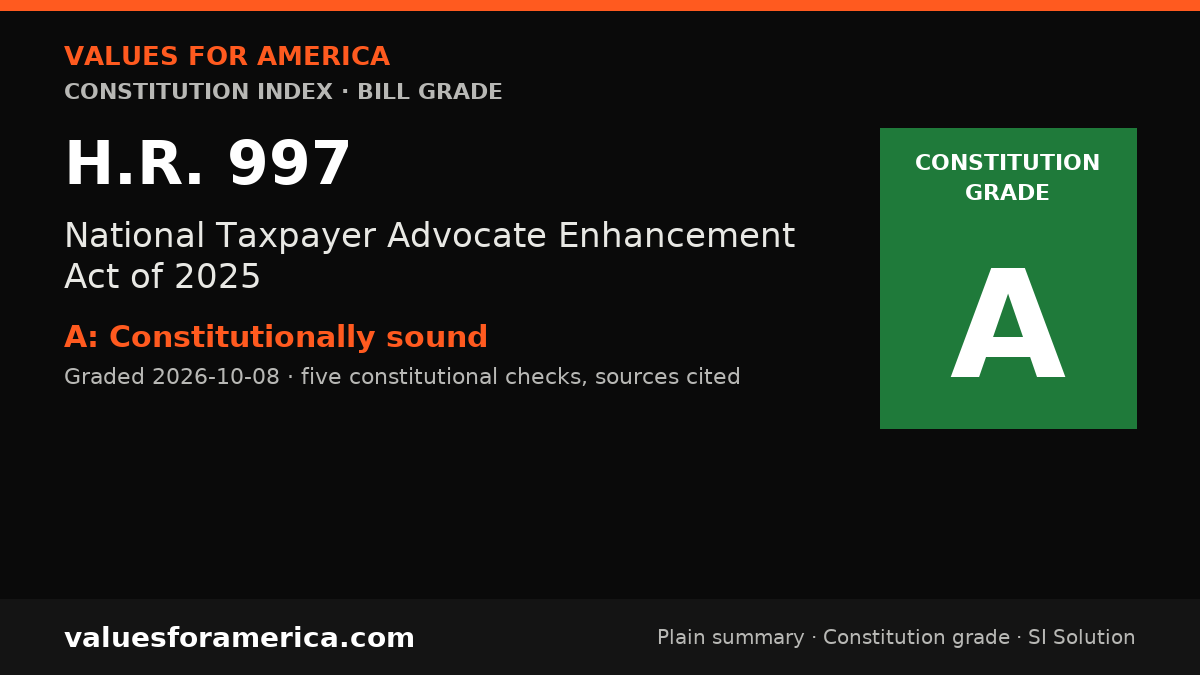
National Taxpayer Advocate Enhancement Act of 2025
Cosponsors: 1 (1 D, 0 R) · per Congress.gov, 2026-10-14
Introduced: 2025-02-05
Latest action (2026-10-14): Message on Senate action sent to the House.
What H.R. 997 does, in plain terms
National Taxpayer Advocate Enhancement Act of 2025 This bill authorizes the National Taxpayer Advocate to appoint legal counsel within the Taxpayer Advocate Service (TAS) to report directly to the National Taxpayer Advocate. The bill also expands the authority of the National Taxpayer Advocate to take personnel actions with respect to local taxpayer advocates (located in each state) to include actions with respect to any employee of TAS. Currently, pursuant to a Department of the Treasury order, all legal counsel whose duties include providing legal advice to any official in any office or bureau of Treasury are part of the Legal Division within Treasury and under the supervision of the General Counsel, with limited exceptions. TAS assists taxpayers in matters involving the Internal Revenue Service (IRS) and is part of the IRS, within Treasury.
Official summary by the Congressional Research Service, via Congress.gov.
Constitution Index
“VFA Constitution grade”
Constitutionally sound
Graded 2026-10-08
SI-generated grade · five published checks · not individually reviewed by a person · methodology
HR 997 is an internal organizational reform within Congress's tax power that creates no new regulatory burden, rights restriction, or taking. It remains within enumerated tax authority and improves taxpayer advocacy.
-
✓ Passes · Enumerated powers
Congress has explicit authority under Article I, Section 8, Clause 1 to lay and collect taxes and to make laws organizing the agencies that administer them, supported by Article I, Section 8, Clause 18, the Necessary and Proper Clause. Reassigning legal counsel supervision and personnel authority within Treasury and the IRS is plainly within that tax and organizational power. -
✓ Passes · Bill of Rights
The bill does not restrict speech, religion, press, assembly, arms, searches, trial rights, or other protections in the first ten Amendments. It reorganizes internal legal counsel and personnel authority within the Taxpayer Advocate Service. No First Amendment, Second Amendment, Fourth Amendment, or other Bill of Rights provision is implicated. If anything, independent counsel for the taxpayer adv… -
✓ Passes · Individual sovereignty
The bill imposes no restriction on any person's body, property, speech, labor, or belief. It directs only internal government staffing: who appoints counsel and who may take personnel actions inside the Taxpayer Advocate Service. The burden test is satisfied because there is no individual liberty burden to justify, and the measure expands taxpayer assistance. -
✓ Passes · Decentralization
Tax administration is inherently national and cannot be handled by individuals, localities, or states alone. (1) Individuals cannot administer uniform federal tax relief. (2) Local communities cannot supervise IRS casework. (3) States cannot control federal Treasury personnel or counsel. (4) The bill does not consolidate new federal power over states or persons; it reallocates existing federal aut… -
✓ Passes · Due process and takings
No deprivation of life, liberty, or property without due process under the Fifth Amendment, and no taking without just compensation. The bill changes supervisory lines, not adjudicatory procedures, penalties, or property seizures. It strengthens procedural fairness by giving the taxpayer advocate dedicated counsel, supporting Fifth Amendment due process values in IRS disputes.
Sources: Congress.gov: HR 997 summary
Report an error in this grade
The Framers
“Founders’ Verdict”
Confidence 1.00
SI-generated · automated checksSI-generated · passed automated checks (Constitution citation, source verification, independent SI critic) · not individually reviewed by a person · Report an error: hello@valuesforamerica.com
Synthesis
Under Article I, Section 8, Clauses 1 and 18, Congress may authorize subordinate counsel and personnel measures plainly adapted to faithful administration of the revenue laws. As of 2026-10-14 the official summary states Message on Senate action sent to the House; the bill is not described as enacted. The official summary states the bill would authorize the National Taxpayer Advocate to appoint legal counsel within the Taxpayer Advocate Service to report directly to the National Taxpayer Advocate, and would expand authority over personnel actions from local taxpayer advocates to any employee of that Service, which assists taxpayers in matters involving the Internal Revenue Service within Treasury. The taxing power carries the choice of necessary and proper means for just and effective collection, and Article II, Section 2, Clause 2 permits Congress to vest appointment of inferior officers as it deems proper. The strongest objection is that separate counsel reporting to the Advocate would divide executive unity. That concern is answered because the counsel would remain within Treasury for defined duties in aid of the laws, adding auxiliary precaution against maladministration while preserving accountability for execution. This serves principled conservatives through ordered liberty, limited and lawful collection, and due process under Amendment V, and serves good-faith progressives through accessible assistance and fair treatment for ordinary taxpayers.
The power to lay and collect taxes and to provide for uniform administration thereof is expressly granted in Article I, Section 8, Clause 1, and Article I, Section 8, Clause 18 authorizes means necessary and proper to render that administration effective, including an advocate service with independent counsel. Under Article II, Section 2, Clause 2, Congress may vest the appointment of inferior officers in heads of departments or officers as it deems proper, which sustains authorization for the National Taxpayer Advocate to appoint counsel reporting directly within that service. As explained in…
As Jefferson I hold that powers not granted are reserved, yet the power to lay and collect duties and taxes is expressly granted to the federal legislature. An officer to hear the grievances of taxpayers and counsel to advise that office are necessary and proper means to render collection just and uniform. Such internal arrangement violates no right retained by the people, and by securing due process in the exaction of revenue it guards liberty against arbitrary officers.
Madison: The measure falls within the legislative power to make all laws necessary and proper for carrying into execution the power to lay and collect duties and to organize subordinate offices for that end, as described in Article I, Section 8. The Taxpayer Advocate Service remains within the Treasury and subject to law, not erected as an independent sovereignty, thus preserving the compound structure where federal authority acts directly upon citizens yet through enumerated means, set forth in Federalist No. 39. Enlarging the field of administration to include counsel reporting to the Nation…
The power to lay and collect taxes and to provide for the general welfare vests in Congress the choice of means for faithful administration of revenue laws. Under the necessary and proper principle, where the end be legitimate and within the scope of the Constitution, Congress may employ means plainly adapted to that end which are not prohibited. Establishing subordinate officers and counsel within the Treasury to assist taxpayers and to aid orderly collection is a customary and appropriate incident of the taxing power. No prohibition restrains Congress from defining the duties and reporting o…
Report an error in this Founders' Verdict
What should pass
“VFA SI Solution”
No solution yet
A sourced SI draft appears here once it passes automated checks (Constitution citation, source verification, independent SI critic). How publication works.
Related on VFA

For journalists and bloggers
“Embed this grade”
Free to use with the link back. The badge and card update when the grade changes. Embed terms →
