H.R. 9958 explained · 119th Congress · Pending in Congress
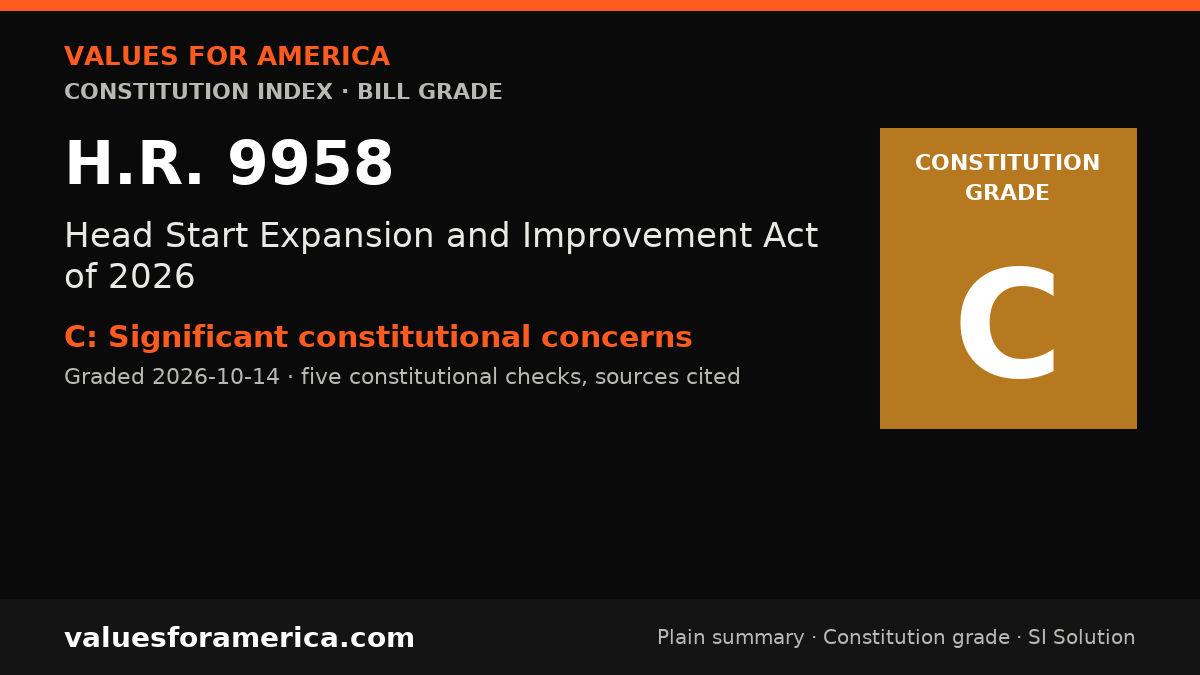
Head Start Expansion and Improvement Act of 2026
Cosponsors: 22 (22 D, 0 R) · per Congress.gov, 2026-10-14
Introduced: 2026-07-27
Latest action (2026-07-27): Referred to the House Committee on Education and Workforce.
What H.R. 9958 does, in plain terms
Head Start Expansion and Improvement Act of 2026 This bill reauthorizes through FY2032 and otherwise revises Head Start programs. Specifically, the bill expands eligibility for Head Start programs to include families with incomes below 138% of the federal poverty level. The bill also adds a definition for public assistance under the Head Start Act to include Temporary Assistance for Needy Families (TANF); Supplemental Security Income (SSI); the Supplemental Nutrition Assistance Program (SNAP); the Special Supplemental Nutrition Program for Women, Infants, and Children (WIC); or the Children’s Health Insurance Program (CHIP). The bill directs the Department of Health and Human Services (HHS) to establish a program to make grants to Head Start agencies (including Early Head Start agencies) to construct or improve facilities. HHS must also establish and carry out a program to make grants to Head Start agencies for increasing the compensation paid to employees. The bill also provides student loan forgiveness for certain Head Start and Early Head Start child care workers. In particular, the Department of Education must cancel the outstanding balance of principal, interest, and fees due on Federal Direct Loans for a borrower who (1) has been employed full-time by a Head Start or Early Head Start program for three years, and (2) has provided care or instruction to children enrolled in such a program.
Official summary by the Congressional Research Service, via Congress.gov.
Constitution Index
“VFA Constitution grade”
Significant constitutional concerns
Graded 2026-10-14
SI-generated grade · five published checks · not individually reviewed by a person · methodology
The bill expands federal involvement in early childhood education, which is not among the enumerated powers of Congress. While the spending clause allows Congress to attach conditions to federal funds, the expansion of Head Start eligibility, facility grants, and loan forgiveness programs represents a significant federal role in an area traditionally reserved to the states and families. The bill does not directly infringe on individual rights, but it does consolidate decision-making at the federal level, failing the decentralization test. The loan forgiveness provision raises due process concerns by creating a benefit that may be arbitrarily denied or revoked without clear procedural safeguards.
-
✗ Concern · Enumerated powers
The Constitution grants Congress specific enumerated powers under Article I, Section 8. Education is not among them. While the Spending Clause (Article I, Section 8, Clause 1) allows Congress to spend for the 'general welfare,' the Supreme Court has interpreted this broadly, but the expansion of Head Start into a comprehensive federal program with facility construction and loan forgiveness goes be… -
✓ Passes · Bill of Rights
The bill does not directly infringe on any of the first ten amendments. It does not restrict speech, religion, assembly, press, petition, arms, quartering, search and seizure, self-incrimination, due process, takings, fair trial, jury, cruel and unusual punishment, or unenumerated rights. The provisions are spending and regulatory in nature, not prohibitions on individual conduct. -
✓ Passes · Individual sovereignty
The bill does not restrict individual liberty. It expands eligibility for federal programs and provides benefits, which does not limit what individuals can do with their person, property, speech, labor, or belief. The loan forgiveness provision is a benefit, not a restriction. However, the expansion of federal programs may indirectly influence family choices by creating incentives, but this does n… -
✗ Concern · Decentralization
The bill fails the decentralization test. (1) Families and local communities can and do handle early childhood education without federal involvement, as evidenced by the existence of private and state-run preschools. (2) Local communities and states have the capacity to fund and operate Head Start-like programs. (3) States can handle early childhood education without federal involvement, as many d… -
✗ Concern · Due process and takings
The loan forgiveness provision creates a benefit that may be subject to arbitrary denial or revocation. The bill does not specify procedural safeguards for determining eligibility or for appealing adverse decisions. While the government has broad discretion in administering benefit programs, the lack of clear due process protections for borrowers who have met the stated requirements raises concern…
Sources: Congress.gov: HR 9958 summary
Report an error in this grade
What should pass
“VFA SI Solution”
No solution yet
A sourced SI draft appears here once it passes automated checks (Constitution citation, source verification, independent SI critic). How publication works.
Related on VFA

For journalists and bloggers
“Embed this grade”
Free to use with the link back. The badge and card update when the grade changes. Embed terms →
