H.R. 9946 explained · 119th Congress · Pending in Congress
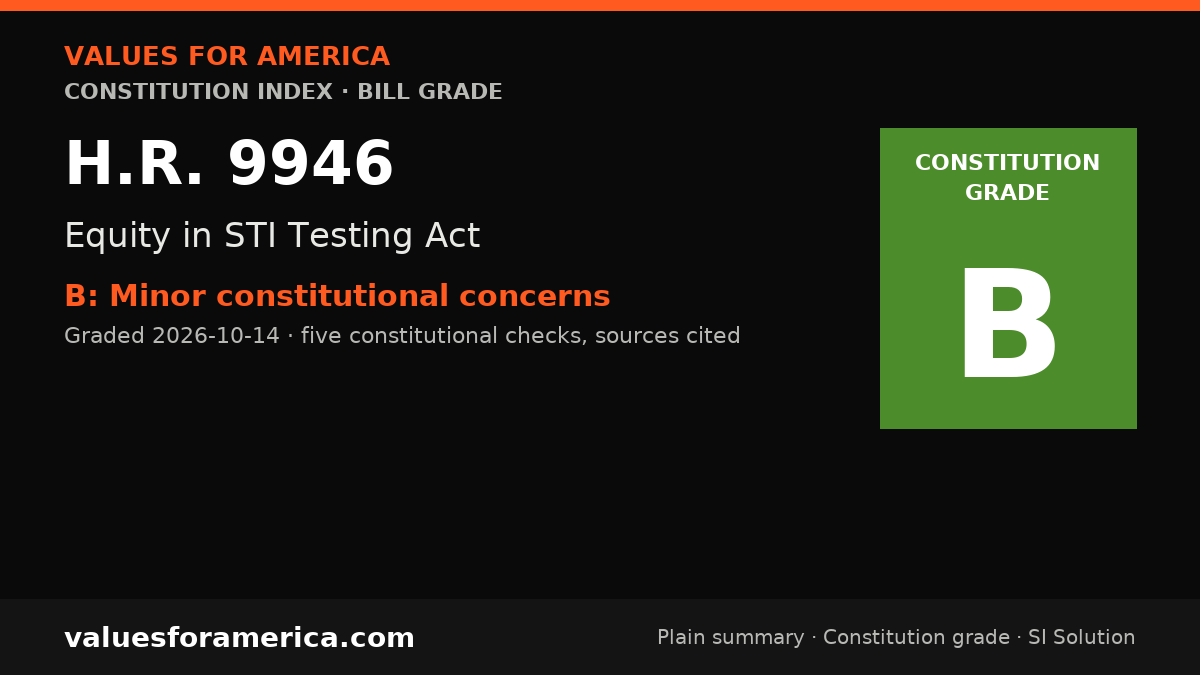
Equity in STI Testing Act
Cosponsors: 11 (11 D, 0 R) · per Congress.gov, 2026-10-14
Introduced: 2026-07-23
Latest action (2026-07-30): Referred to the Subcommittee on Health.
What H.R. 9946 does, in plain terms
Equity in STI Testing Act This bill provides for coverage, without cost-sharing, of testing for certain sexually transmitted infections under Medicare Advantage, Medicaid, the Children's Health Insurance Program (CHIP), TRICARE, Department of Veterans Affairs health benefits, and the Indian Health Service.
Official summary by the Congressional Research Service, via Congress.gov.
Constitution Index
“VFA Constitution grade”
Minor constitutional concerns
Graded 2026-10-14
SI-generated grade · five published checks · not individually reviewed by a person · methodology
The bill is a federal health coverage mandate that likely falls within Congress's spending and commerce powers, but it raises concerns about federal overreach into state-administered programs and individual choice. It does not directly infringe on rights, but the cost-shifting and centralization of health policy decisions warrant a 'B' grade.
-
✓ Passes · Enumerated powers
Congress has authority under the Spending Clause (Article I, Section 8, Clause 1) to condition federal funds and under the Commerce Clause (Article I, Section 8, Clause 3) to regulate interstate commerce. Health insurance coverage mandates, especially for federal programs like Medicare, TRICARE, and VA, fall within these powers. For Medicaid and CHIP, the federal government can attach conditions t… -
✓ Passes · Bill of Rights
The bill does not infringe on any enumerated rights in the Bill of Rights. It does not restrict speech, religion, assembly, press, petition, arms, quartering, search and seizure, self-incrimination, due process, trial rights, or cruel and unusual punishment. It imposes a coverage requirement, which is not a rights violation. -
✗ Concern · Individual sovereignty
The bill mandates coverage for STI testing without cost-sharing, which could be seen as a restriction on individual choice regarding health care decisions. However, it does not force individuals to undergo testing; it only requires insurers to cover the test. The burden on individual sovereignty is minimal, but the mandate does override individual preferences in insurance plan design. The governme… -
✗ Concern · Decentralization
The bill fails the decentralization test because it consolidates health coverage decisions at the federal level. While individuals and families could handle STI testing without government involvement, the bill mandates coverage across multiple federal and state programs. States could handle this within their own Medicaid and CHIP programs without federal mandates, and the federal government is con… -
✓ Passes · Due process and takings
The bill does not bypass due process or take property without just compensation. It does not deprive individuals of life, liberty, or property without a hearing. The mandate on insurers to cover testing without cost-sharing is a regulatory requirement, not a taking of private property. It does not violate the Fifth Amendment's Takings Clause or Due Process Clause.
Sources: Congress.gov: HR 9946 summary
Report an error in this grade
What should pass
“VFA SI Solution”
No solution yet
A sourced SI draft appears here once it passes automated checks (Constitution citation, source verification, independent SI critic). How publication works.
Related on VFA

For journalists and bloggers
“Embed this grade”
Free to use with the link back. The badge and card update when the grade changes. Embed terms →
