H.R. 993 explained · 119th Congress · Pending in Congress
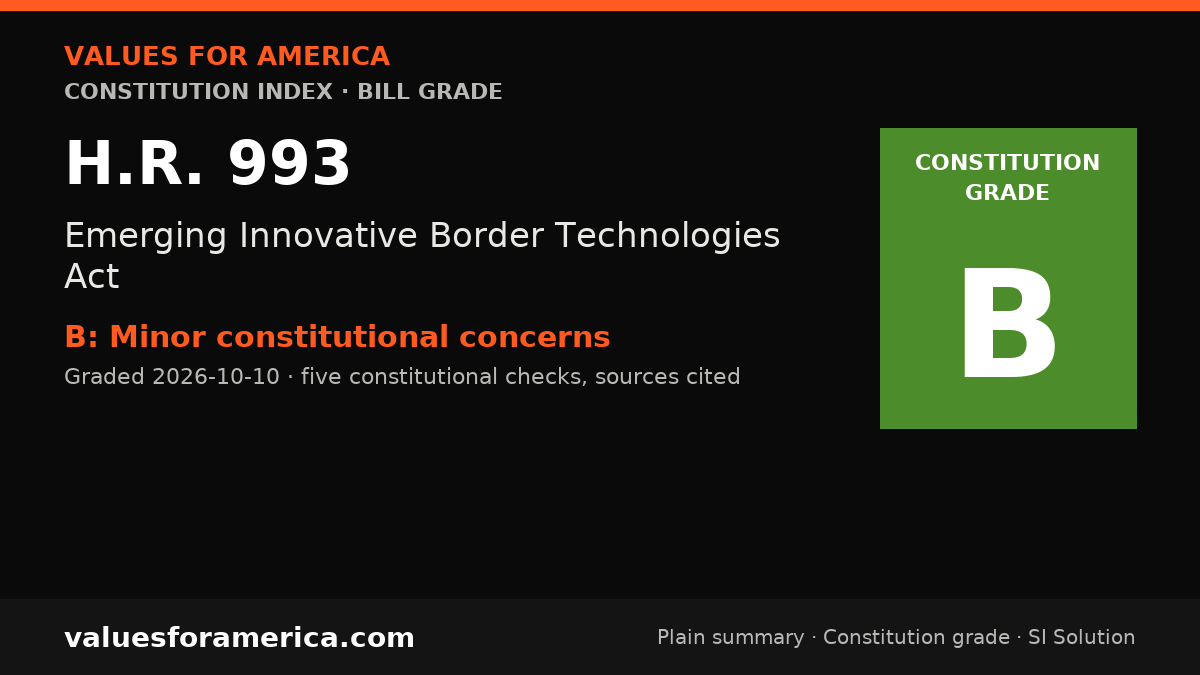
Emerging Innovative Border Technologies Act
Cosponsors: 2 (1 D, 1 R) · per Congress.gov, 2026-10-12
Introduced: 2025-02-05
Latest action (2025-03-11): Received in the Senate and Read twice and referred to the Committee on Homeland Security and Governmental Affairs.
What H.R. 993 does, in plain terms
Emerging Innovative Border Technologies Act This bill requires U.S. Customs and Border Protection (CBP) and the Science and Technology Directorate of the Department of Homeland Security to develop a plan to identify, integrate, and deploy emerging and innovative technologies to improve border security operations. Such technologies may incorporate artificial intelligence, machine-learning, automation, fiber-optic sensing technology, nanotechnology, optical and cognitive radar, modeling and simulation technology, hyperspectral and LIDAR sensors, and imaging, identification, and categorization systems. The bill authorizes CBP to establish one or more Innovation Teams to research and adapt commercial technologies that may be used by CBP. The plan must describe how the Innovation Teams have been implemented and also detail goals and timelines for adoption of qualifying technologies, metrics and key performance parameters for determining the plan's effectiveness, which technologies used by other federal agencies CBP may also utilize, which existing authorities CBP may use to procure technologies, how CBP legacy border technology programs may be replaced, the expected privacy and security impact of security-related technology on border communities, and recent technological advancements in specified technologies. CBP must provide the plan to Congress within 180 days of the bill’s enactment. The bill also requires CBP to annually report to Congress regarding the activities of the Innovation Teams.
Official summary by the Congressional Research Service, via Congress.gov.
Constitution Index
“VFA Constitution grade”
Minor constitutional concerns
Graded 2026-10-10
SI-generated grade · five published checks · not individually reviewed by a person · methodology
The bill directs federal agencies to develop a plan for deploying border security technologies, which falls within the federal government's enumerated power over immigration and border control. While the bill raises privacy and civil liberties concerns, it does not itself authorize specific surveillance or enforcement actions; it only requires planning and reporting. The main constitutional tension is the potential for future technology deployment to infringe on Fourth Amendment rights, but the bill's current scope is limited to planning and reporting, making it mostly sound with minor issues.
-
✓ Passes · Enumerated powers
The federal government has explicit constitutional authority over immigration and border control. Article I, Section 8, Clause 3 grants Congress the power to regulate commerce with foreign nations, and the Naturalization Clause (Article I, Section 8, Clause 4) supports federal authority over immigration. Additionally, the federal government's inherent sovereign power to control its borders is well… -
✓ Passes · Bill of Rights
The bill itself does not authorize any specific search, seizure, or surveillance activity. It only requires the development of a plan and reports to Congress. However, the plan must address 'the expected privacy and security impact of security-related technology on border communities,' indicating an awareness of potential Fourth Amendment concerns. Since the bill does not directly infringe on any … -
✓ Passes · Individual sovereignty
The bill does not directly restrict individual liberty. It requires planning and reporting, not the deployment of specific technologies. The burden of justification for any future restrictions on individual sovereignty would fall on the government when specific technologies are proposed. The bill's requirement to assess privacy impacts suggests a procedural safeguard, but the lack of explicit limi… -
✗ Concern · Decentralization
Border security is inherently a federal responsibility, as the Constitution assigns the federal government authority over immigration and foreign commerce. An individual, local community, or state cannot effectively secure the nation's borders. However, the bill consolidates decision-making at the federal level, which is appropriate for border security. The four-question test fails on the first th… -
✓ Passes · Due process and takings
The bill does not bypass due process or take property. It requires planning and reporting, not direct action. The plan must include metrics and performance parameters, which suggests a structured approach. There is no deprivation of life, liberty, or property without due process, and no taking of private property for public use without just compensation. The bill's requirements for privacy impact …
Sources: Congress.gov: HR 993 summary
Report an error in this grade
What should pass
“VFA SI Solution”
No solution yet
A sourced SI draft appears here once it passes automated checks (Constitution citation, source verification, independent SI critic). How publication works.
Related on VFA

For journalists and bloggers
“Embed this grade”
Free to use with the link back. The badge and card update when the grade changes. Embed terms →
