H.R. 9918 explained · 119th Congress · Pending in Congress
Enhancing K–12 Cybersecurity Act
Cosponsors: 1 (0 D, 1 R) · per Congress.gov, 2026-10-14
Introduced: 2026-07-23
Latest action (2026-07-24): Referred to the Subcommittee on Cybersecurity and Infrastructure Protection.
What H.R. 9918 does, in plain terms
Enhancing K-12 Cybersecurity Act This bill establishes resources and a program to address cybersecurity of elementary and secondary schools. First, the bill directs the Cybersecurity and Infrastructure Security Agency (CISA) to establish an information exchange to disseminate information, best practices, training, and resources to improve cybersecurity in elementary and secondary schools. In addition, CISA must establish a registry to track cyber incidents affecting information technology systems that are owned or managed by schools and educational agencies. Schools and educational agencies may voluntarily submit information to the registry. Finally, the bill requires CISA to establish a program to address cybersecurity threats to school information systems.
Official summary by the Congressional Research Service, via Congress.gov.
Constitution Index
“VFA Constitution grade”
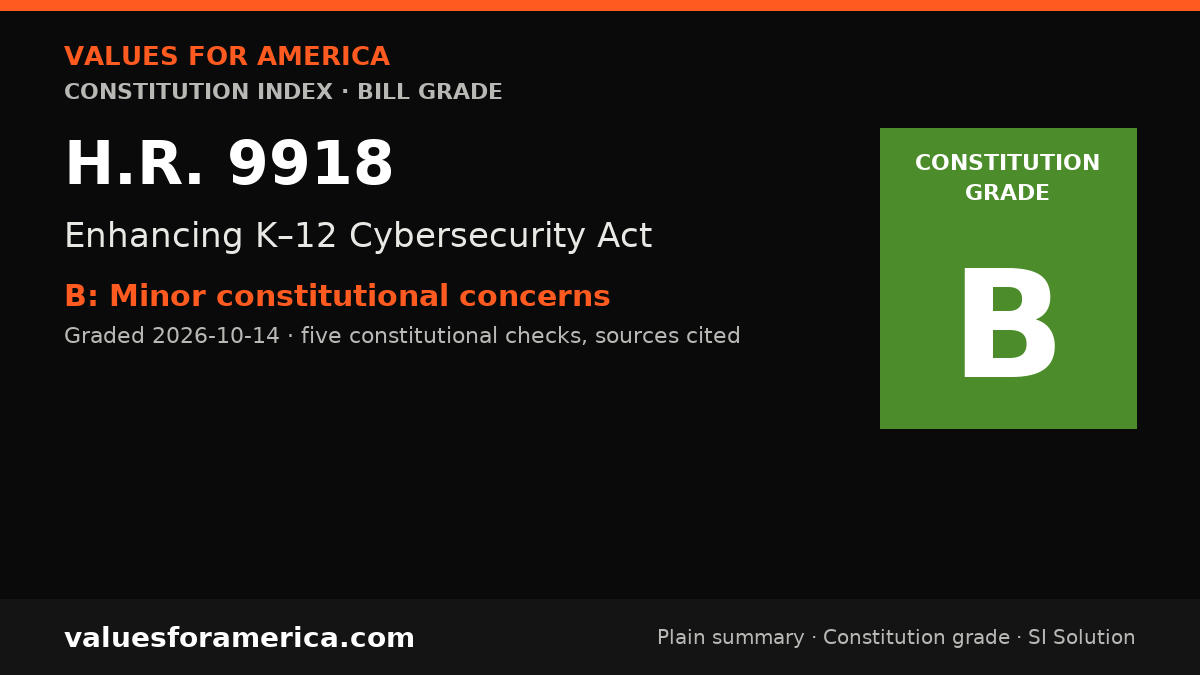
Minor constitutional concerns
Graded 2026-10-14
SI-generated grade · five published checks · not individually reviewed by a person · methodology
The bill is largely constitutional, as it operates within federal authority to protect interstate commerce and national security infrastructure, and it respects individual and local autonomy by making participation voluntary. However, the creation of a federal cyber incident registry, even if voluntary, raises minor concerns about privacy and the potential for future mandatory reporting, which could infringe on individual sovereignty and the Fourth Amendment. The bill's centralization of cybersecurity resources at the federal level is a minor deviation from the principle of decentralization, but it does not rise to a significant constitutional issue.
-
✓ Passes · Enumerated powers
The federal government has authority to regulate interstate commerce and to provide for the common defense and general welfare. Cybersecurity threats to K-12 schools often involve interstate and international communications networks, and the protection of these systems falls within the Commerce Clause (Article I, Section 8, Clause 3). Additionally, CISA's role in protecting critical infrastructure… -
✓ Passes · Bill of Rights
The bill does not infringe on any of the first ten amendments. It does not restrict speech, religion, assembly, press, or petition. It does not involve search and seizure, as the registry is voluntary and does not authorize government access to school systems without consent. There is no deprivation of life, liberty, or property without due process, and no cruel or unusual punishment. The voluntar… -
✓ Passes · Individual sovereignty
The bill does not restrict individual freedom. It provides resources and voluntary participation, which enhances the ability of individuals and schools to protect their own systems. The registry is voluntary, so no one is compelled to provide information. The program is designed to assist, not to coerce. The burden of justification for any restriction is not triggered because there is no restricti… -
✗ Concern · Decentralization
The bill fails the decentralization test because it consolidates cybersecurity resources and incident tracking at the federal level. While individuals and local communities could handle some cybersecurity measures, the federal government is better equipped to disseminate threat intelligence and coordinate responses to cyber incidents that cross state lines. However, the bill does not mandate parti… -
✓ Passes · Due process and takings
The bill does not deprive anyone of property or liberty without due process. It does not take property without just compensation. The registry is voluntary, so there is no compelled disclosure that would implicate due process. The program provides notice and resources, and there is no punitive or arbitrary action against schools or individuals.
Sources: Congress.gov: HR 9918 summary
Report an error in this grade
What should pass
“VFA SI Solution”
No solution yet
A sourced SI draft appears here once it passes automated checks (Constitution citation, source verification, independent SI critic). How publication works.
Related on VFA

For journalists and bloggers
“Embed this grade”
Free to use with the link back. The badge and card update when the grade changes. Embed terms →
