H.R. 9867 explained · 119th Congress · Pending in Congress
Expand the Behavioral Health Workforce Now Act
Cosponsors: 1 (0 D, 1 R) · per Congress.gov, 2026-10-15
Introduced: 2026-07-22
Latest action (2026-07-22): Referred to the House Committee on Energy and Commerce.
What H.R. 9867 does, in plain terms
Expand the Behavioral Health Workforce Now Act This bill requires the Centers for Medicare & Medicaid Services to issue guidance for states on ways to increase education, training, recruitment, and retention of mental health and substance use disorder providers under Medicaid and the Children's Health Insurance Program (CHIP), particularly in rural and underserved areas.
Official summary by the Congressional Research Service, via Congress.gov.
Constitution Index
“VFA Constitution grade”
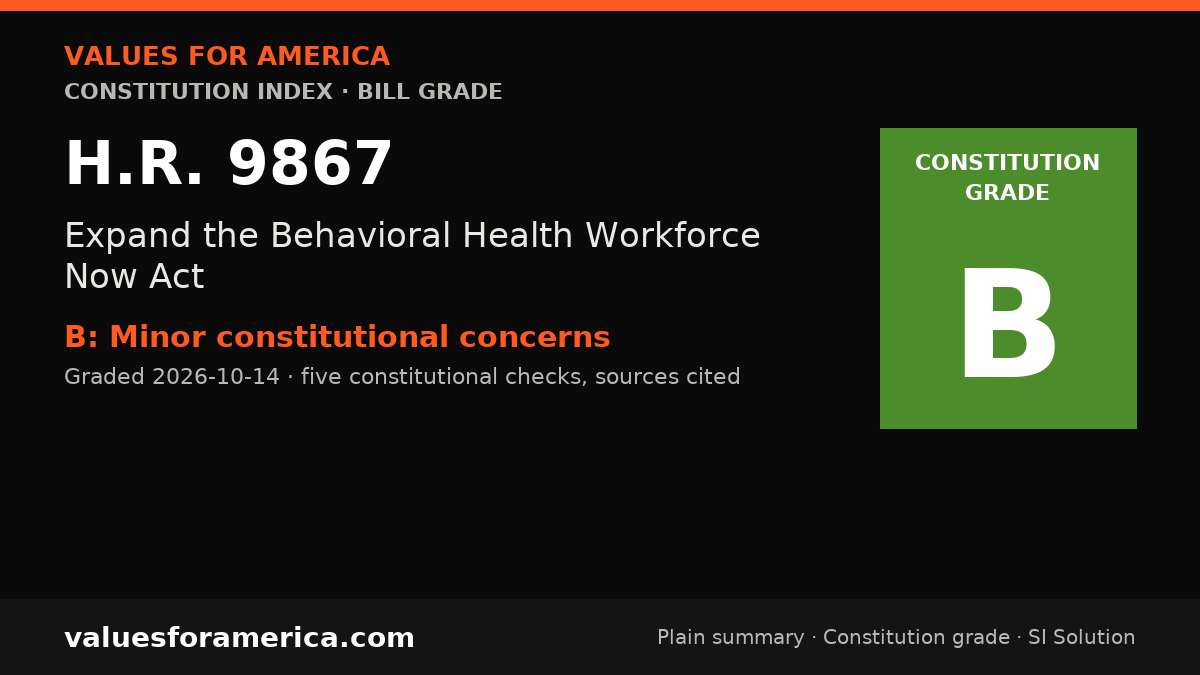
Minor constitutional concerns
Graded 2026-10-14
SI-generated grade · five published checks · not individually reviewed by a person · methodology
This bill is mostly sound but has minor tension with enumerated powers and decentralization. It directs states to expand behavioral health workforce training under Medicaid and CHIP, which falls within Congress's spending power, but the federal guidance may nudge states toward specific policies, creating a minor federal overreach concern. No rights are infringed, and due process is unaffected.
-
✓ Passes · Enumerated powers
Congress has authority under Article I, Section 8, Clause 1 (the Spending Clause) to attach conditions to federal funds like Medicaid and CHIP. The bill merely requires CMS to issue guidance to states on workforce expansion, which is a permissible exercise of spending power. No direct regulation of states or individuals outside the spending context occurs. -
✓ Passes · Bill of Rights
The bill does not restrict speech, religion, assembly, press, petition, arms, quartering, search and seizure, self-incrimination, due process, fair trial, jury, cruel and unusual punishment, or any other enumerated right. It is a funding and guidance measure with no coercive or punitive elements affecting individual liberties. -
✓ Passes · Individual sovereignty
The bill imposes no restrictions on individual person, property, speech, labor, or belief. It encourages states to expand training and recruitment of healthcare providers, which does not compel or prohibit any individual action. The government has no burden to justify a restriction because none exists. -
✗ Concern · Decentralization
The bill fails the decentralization test because it consolidates decision-making at the federal level (CMS guidance) for matters that states and localities could handle independently. However, it does not mandate compliance, so the failure is minor. -
✓ Passes · Due process and takings
The bill does not bypass due process, presume guilt, or take property without just compensation. It involves no adjudicative or enforcement actions against individuals or entities. Guidance issuance is a purely administrative function with no deprivation of life, liberty, or property.
Sources: Congress.gov: HR 9867 summary
Report an error in this grade
What should pass
“VFA SI Solution”
No solution yet
A sourced SI draft appears here once it passes automated checks (Constitution citation, source verification, independent SI critic). How publication works.
Related on VFA

For journalists and bloggers
“Embed this grade”
Free to use with the link back. The badge and card update when the grade changes. Embed terms →
