H.R. 9851 explained · 119th Congress · Pending in Congress
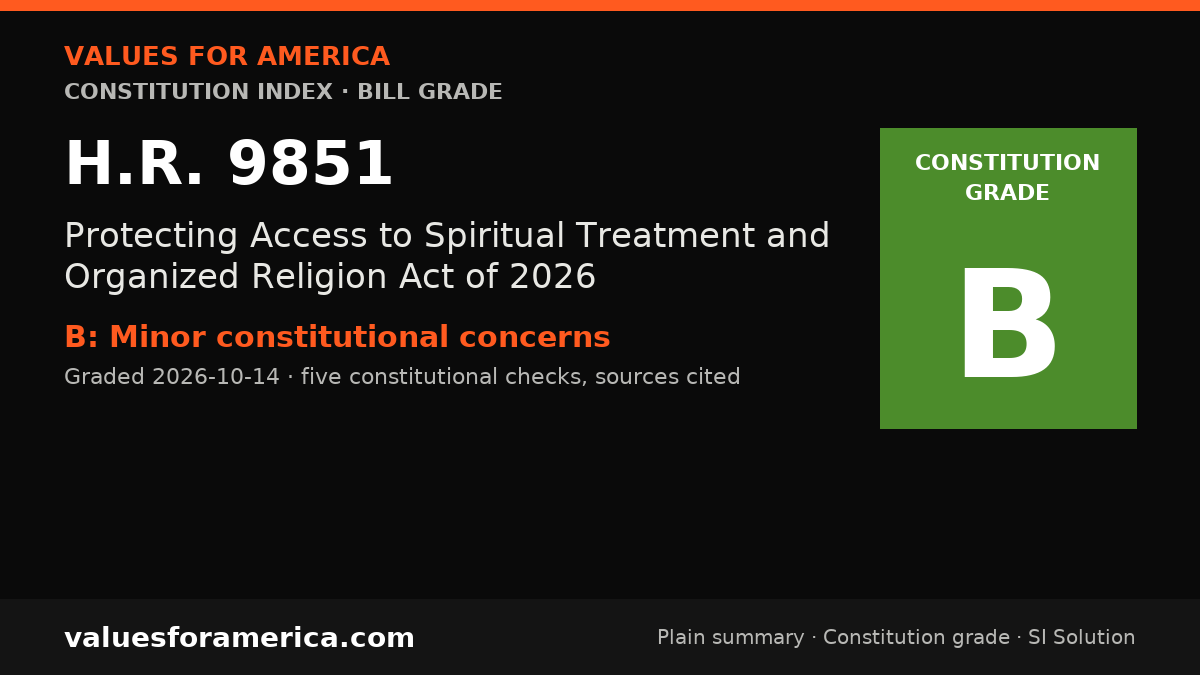
Protecting Access to Spiritual Treatment and Organized Religion Act of 2026
Cosponsors: none · per Congress.gov, 2026-10-15
Introduced: 2026-07-22
Latest action (2026-07-22): Referred to the Committee on Ways and Means, and in addition to the Committee on Energy and Commerce, for a period to be subsequently determined by the Speaker, in each case for consideration of such provisions as fall within the jurisdiction of the committee concerned.
What H.R. 9851 does, in plain terms
Protecting Access to Spiritual Treatment and Organized Religion Act of 2026 or the PASTOR Act of 2026 This bill requires, as a condition of Medicare participation, health care providers to allow a clergy member access to a patient upon the patient's designation and request.
Official summary by the Congressional Research Service, via Congress.gov.
Constitution Index
“VFA Constitution grade”
Minor constitutional concerns
Graded 2026-10-14
SI-generated grade · five published checks · not individually reviewed by a person · methodology
The PASTOR Act of 2026 conditions Medicare participation on allowing clergy access to patients upon request. This is a federal action tied to the spending power under Article I, Section 8, Clause 1, and it does not directly infringe on constitutional rights. However, it imposes a condition on healthcare providers that may raise concerns about religious establishment and provider autonomy, though these are not clearly unconstitutional. The bill is mostly sound but has minor tensions that could be addressed.
-
✓ Passes · Enumerated powers
The federal government has the power to spend for the general welfare under Article I, Section 8, Clause 1. Conditioning Medicare participation on certain requirements is a valid exercise of the spending power, as long as the conditions are related to the federal interest in the program. Requiring clergy access is arguably related to patient welfare and religious freedom, which is a legitimate fed… -
✓ Passes · Bill of Rights
The bill does not infringe on any enumerated rights in the Bill of Rights. It actually facilitates the free exercise of religion by ensuring patients can access clergy, which aligns with the First Amendment's Free Exercise Clause. However, there is a potential concern under the Establishment Clause if the requirement is seen as favoring religion, but the bill is neutral and only responds to patien… -
✓ Passes · Individual sovereignty
The bill does not restrict individual freedom; it expands it by allowing patients to request clergy access. It respects the patient's autonomy and religious beliefs. The burden is on the government to justify restrictions, and here there is no restriction on individual action. -
✗ Concern · Decentralization
The bill fails the decentralization test because it consolidates decision-making at the federal level by imposing a uniform condition on all Medicare providers. While an individual or local community could handle this without federal involvement, the federal government has a legitimate interest in Medicare, which is a federal program. However, the requirement could be left to states or individual … -
✓ Passes · Due process and takings
The bill does not bypass due process or take property without just compensation. It imposes a condition on Medicare participation, which is voluntary for providers. Providers are not deprived of property without due process; they can choose to comply or not participate in Medicare. There is no arbitrary government action, and the requirement is clear and related to the program's goals.
Sources: Congress.gov: HR 9851 summary
Report an error in this grade
What should pass
“VFA SI Solution”
No solution yet
A sourced SI draft appears here once it passes automated checks (Constitution citation, source verification, independent SI critic). How publication works.
Related on VFA

For journalists and bloggers
“Embed this grade”
Free to use with the link back. The badge and card update when the grade changes. Embed terms →
