H.R. 9832 explained · 119th Congress · Pending in Congress
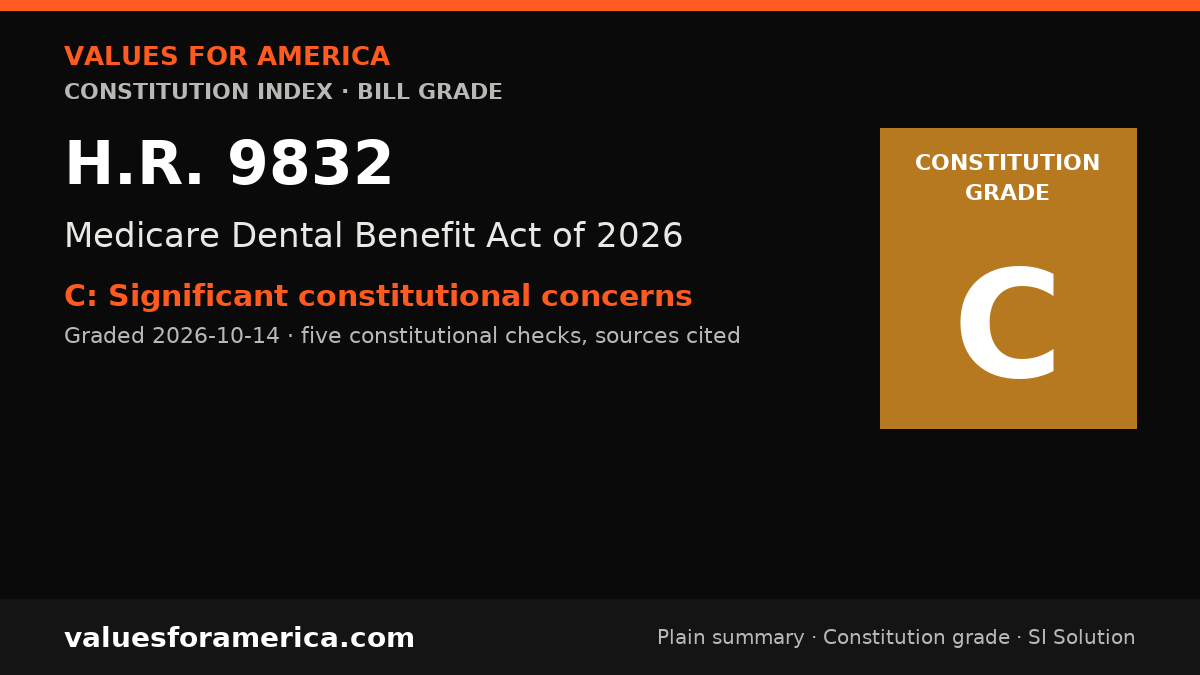
Medicare Dental Benefit Act of 2026
Cosponsors: 16 (16 D, 0 R) · per Congress.gov, 2026-10-15
Introduced: 2026-07-22
Latest action (2026-07-22): Referred to the Committee on Energy and Commerce, and in addition to the Committee on Ways and Means, for a period to be subsequently determined by the Speaker, in each case for consideration of such provisions as fall within the jurisdiction of the committee concerned.
What H.R. 9832 does, in plain terms
Medicare Dental Benefit Act of 2026 This bill provides for Medicare coverage of dental and oral health services, including routine diagnostic and preventive services, basic and major dental services, and emergency care; dental prostheses are also covered. Currently, such services are excluded from Medicare coverage.
Official summary by the Congressional Research Service, via Congress.gov.
Constitution Index
“VFA Constitution grade”
Significant constitutional concerns
Graded 2026-10-14
SI-generated grade · five published checks · not individually reviewed by a person · methodology
The Medicare Dental Benefit Act of 2026 expands a federal health insurance program to cover dental services. While the federal government has broad authority to spend for the general welfare, this expansion raises significant constitutional concerns regarding enumerated powers, individual sovereignty, and decentralization. The bill does not directly violate the Bill of Rights, but it consolidates decision-making at the federal level for a service that could be handled by individuals, families, or states, and it imposes a federal mandate that may not be justified by a compelling constitutional interest.
-
✗ Concern · Enumerated powers
The federal government's authority to establish and modify Medicare is typically grounded in the Spending Clause (Article I, Section 8, Clause 1) and the Necessary and Proper Clause (Article I, Section 8, Clause 18). However, the expansion of Medicare to cover dental services is not directly tied to an enumerated power such as regulating interstate commerce or providing for the common defense. Whi… -
✓ Passes · Bill of Rights
The bill does not infringe upon any of the first ten amendments. It does not restrict speech, religion, assembly, press, petition, the right to bear arms, quartering of soldiers, search and seizure, self-incrimination, due process, fair trial, jury trial, cruel and unusual punishment, or unenumerated rights. The Tenth Amendment reserves powers not delegated to the United States to the states or th… -
✗ Concern · Individual sovereignty
The bill restricts individual sovereignty by compelling individuals to participate in a federal dental insurance program through Medicare taxes, even if they do not want or need dental coverage. This is a restriction on how individuals can use their own property (their earnings) and make personal health care decisions. The government has not demonstrated a compelling constitutional justification f… -
✗ Concern · Decentralization
The bill fails the decentralization test. (1) Individuals and families can handle dental care without government involvement by purchasing private insurance or paying out-of-pocket. (2) Local communities and counties can handle dental care through local clinics and public health programs. (3) States can handle dental care through Medicaid or state-run insurance programs. (4) This bill consolidates… -
✓ Passes · Due process and takings
The bill does not bypass due process or take property without just compensation. It does not deprive individuals of life, liberty, or property without a fair hearing or notice. The expansion of Medicare is a legislative act that does not involve a taking of private property for public use without compensation. The bill does not violate the Fifth Amendment's Due Process or Takings Clauses.
Sources: Congress.gov: HR 9832 summary
Report an error in this grade
What should pass
“VFA SI Solution”
No solution yet
A sourced SI draft appears here once it passes automated checks (Constitution citation, source verification, independent SI critic). How publication works.
Related on VFA

For journalists and bloggers
“Embed this grade”
Free to use with the link back. The badge and card update when the grade changes. Embed terms →
