H.R. 979 explained · 119th Congress · Pending in Congress
AM Radio for Every Vehicle Act of 2025
Cosponsors: 317 (158 D, 159 R) · per Congress.gov, 2026-10-14
Introduced: 2025-02-05
Latest action (2026-09-16): Received in the Senate. Read twice. Placed on Senate Legislative Calendar under General Orders. Calendar No. 622.
What H.R. 979 does, in plain terms
AM Radio for Every Vehicle Act of 2025 This bill requires the Department of Transportation (DOT) to issue a rule requiring AM radio capabilities to be standard in all new passenger vehicles. (AM radio is often used to deliver emergency alerts and news and entertainment programming; some newer vehicles do not include AM equipment.) Specifically, this bill applies to passenger vehicles (1) manufactured in the United States for sale in the United States, imported into the United States, or shipped in interstate commerce; and (2) manufactured after the rule's effective date. The rule must require all such vehicles to have devices that can receive signals and play content transmitted by AM stations or digital audio AM stations installed as standard equipment and made easily accessible to drivers. Prior to the rule's effective date, manufacturers that do not include devices that can access AM radio as standard equipment (1) must inform purchasers of this fact through clear and conspicuous labeling, and (2) may not charge an additional or separate fee for AM radio access. DOT may assess civil penalties for any violation of the rule. The Department of Justice may also bring a civil action to enjoin a violation. The rule, including DOT’s authority to enforce it, must expire 10 years after the bill’s enactment. Further, the Government Accountability Office must study and report on the dissemination of emergency alerts to the public, including by conducting an assessment of AM radio relative to other Integrated Public Alert and Warning System communication technologies.
Official summary by the Congressional Research Service, via Congress.gov.
Constitution Index
“VFA Constitution grade”
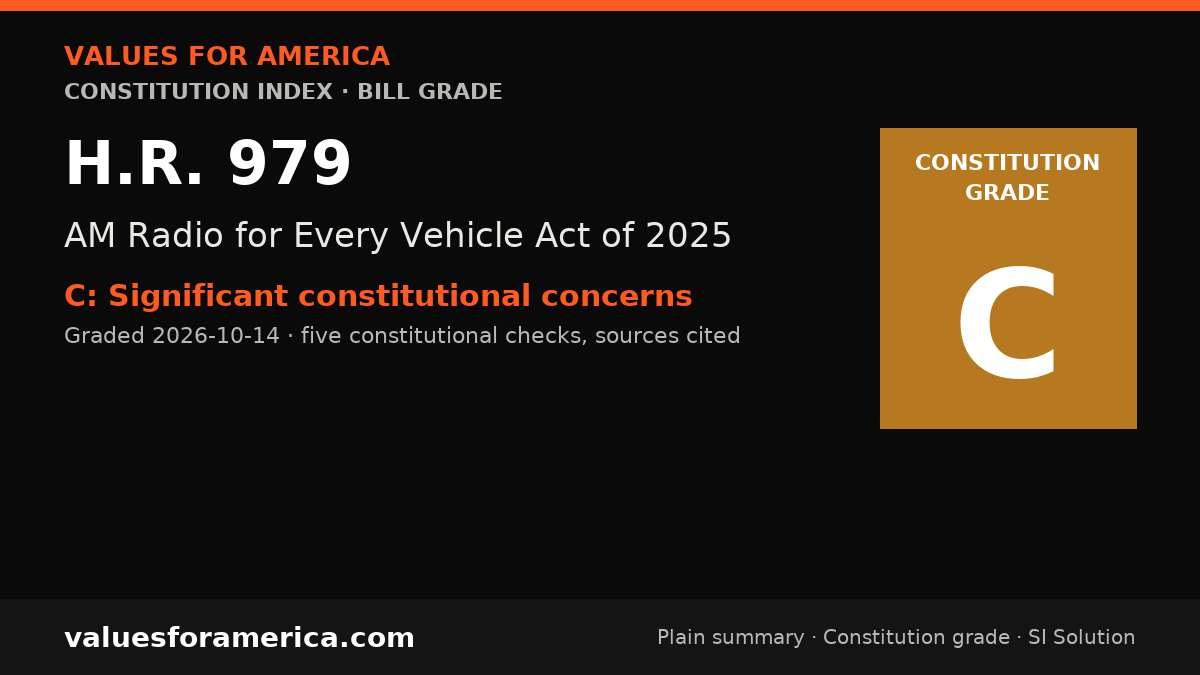
Significant constitutional concerns
Graded 2026-10-14
SI-generated grade · five published checks · not individually reviewed by a person · methodology
The bill mandates a specific technology (AM radio) in all new passenger vehicles, which is a significant federal intrusion into private manufacturing decisions and consumer choice. While Congress has authority over interstate commerce, the requirement is not closely tied to a legitimate commercial objective and imposes a costly, technology-specific mandate that restricts individual and business sovereignty. The bill also centralizes decision-making at the federal level when state or local action, or even private market solutions, could address the stated emergency alert concern. The mandate is not a direct violation of the Bill of Rights, but it raises serious federalism and individual liberty concerns.
-
✗ Concern · Enumerated powers
Congress's power under the Commerce Clause (Article I, Section 8, Clause 3) extends to regulating interstate commerce, and this bill applies to vehicles manufactured, imported, or shipped in interstate commerce. However, the mandate is not a regulation of commerce itself but a product design mandate that is only tangentially related to commerce. The Supreme Court has limited Commerce Clause power … -
✓ Passes · Bill of Rights
The bill does not directly infringe on the First, Second, Fourth, Fifth, Sixth, Seventh, Eighth, or Ninth Amendments. It does not restrict speech, religion, assembly, press, or petition. It does not involve searches or seizures. It does not compel self-incrimination or take property without just compensation. It does not affect trial rights. The mandate is a commercial regulation, not a restrictio… -
✗ Concern · Individual sovereignty
The bill restricts the freedom of manufacturers to decide what features to include in their products and the freedom of consumers to choose vehicles without AM radio. This is a restriction on the use of private property (the vehicle) and the freedom of contract. The government has not demonstrated a compelling justification for this restriction; while emergency alerts are important, the bill does … -
✗ Concern · Decentralization
The four-question test: (1) Could an individual or family handle this without government? Yes, individuals can purchase aftermarket AM radios or use other alert systems. (2) Could a local community or county handle this without state? Yes, local emergency management could use other alert methods. (3) Could a state handle this without federal? Yes, states could mandate AM radio within their borders… -
✓ Passes · Due process and takings
The bill does not deprive any person of life, liberty, or property without due process. It does not take private property for public use without just compensation. The mandate imposes a cost on manufacturers, but that is a regulatory burden, not a taking. The bill provides for civil penalties and injunctions, but these are subject to judicial review, so procedural due process is satisfied.
Sources: Congress.gov: HR 979 summary
Report an error in this grade
What should pass
“VFA SI Solution”
No solution yet
A sourced SI draft appears here once it passes automated checks (Constitution citation, source verification, independent SI critic). How publication works.
Related on VFA

For journalists and bloggers
“Embed this grade”
Free to use with the link back. The badge and card update when the grade changes. Embed terms →
