H.R. 9736 explained · 119th Congress · Pending in Congress
Stop CHEATERS Act
Cosponsors: 42 (42 D, 0 R) · per Congress.gov, 2026-10-08
Introduced: 2026-07-16
Latest action (2026-07-16): Referred to the House Committee on Appropriations.
What H.R. 9736 does, in plain terms
Stop Corporations and High Earners from Avoiding Taxes and Enforce the Rules Strictly Act or the Stop CHEATERS Act This bill provides additional appropriations to the Internal Revenue Service (IRS) for FY2026-FY2031 and establishes reporting requirements related to tax enforcement for high-income individuals and corporations. The bill provides specified appropriations to the IRS for FY2026-FY2031 for purposes such as tax enforcement, taxpayer services, technology and operations support, and business systems modernization. The funds provided by the bill remain available until expended. The bill also requires the IRS to submit a report to Congress every two years that includes a comprehensive description of a plan to shift more IRS auditing and enforcement assets toward high-income individuals and large corporations, recruit and retain auditors with the skills essential to audit high-income individuals and large corporations, and increase voluntary compliance among high-income individuals and large corporations. The report must also include (1) a description of the progress that has been made in implementing the plan; and (2) an analysis of how much of the difference between the taxes owed and the taxes collected by the IRS is attributable to taxpayers at different income levels, including high-income individuals and large corporations. The bill also requires the Treasury Inspector General for Tax Administration to submit a report to Congress evaluating the IRS's plan and its progress in implementing the plan.
Official summary by the Congressional Research Service, via Congress.gov.
Constitution Index
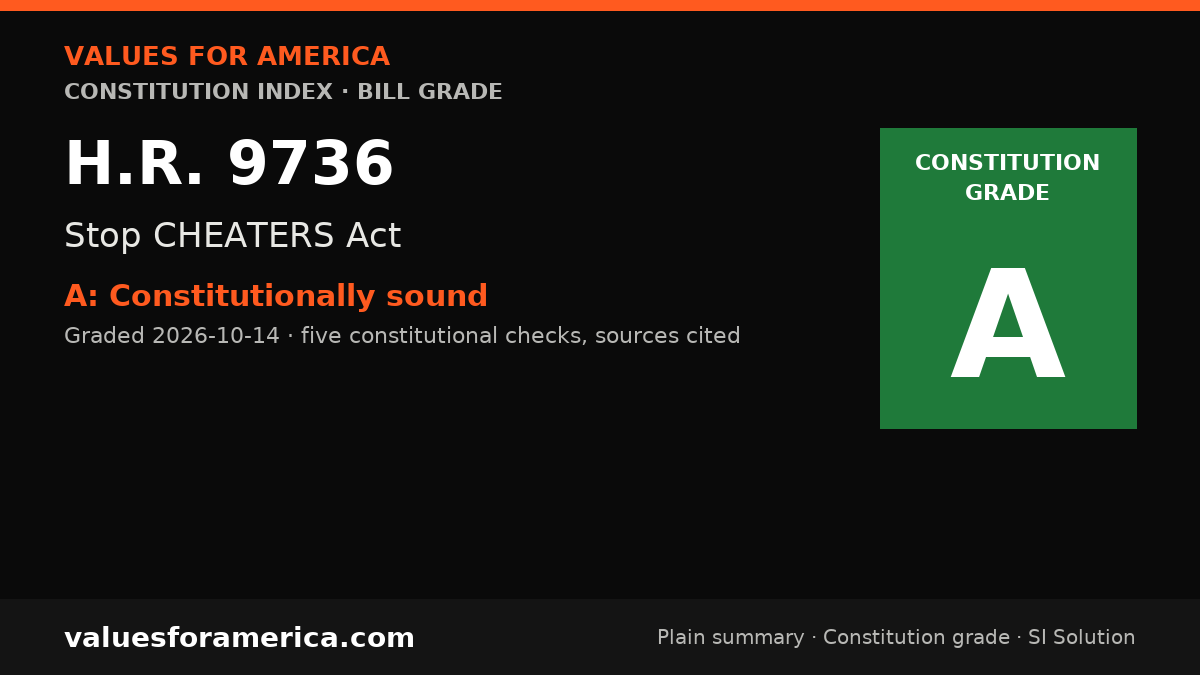
“VFA Constitution grade”
Constitutionally sound
Graded 2026-10-14
SI-generated grade · five published checks · not individually reviewed by a person · methodology
The Stop CHEATERS Act is constitutional. It operates within Congress's enumerated power to lay and collect taxes (Article I, Section 8, Clause 1), does not infringe any Bill of Rights protections, respects individual sovereignty by targeting only tax compliance and reporting, passes all four decentralization questions (individuals and states cannot enforce federal tax law), and provides full due process through existing IRS procedures and reporting requirements.
-
✓ Passes · Enumerated powers
Congress has explicit constitutional authority under Article I, Section 8, Clause 1 to 'lay and collect Taxes, Duties, Imposts and Excises.' This bill appropriates funds to the IRS for tax enforcement and requires reporting on tax compliance—directly within that enumerated power. The bill does not regulate beyond the tax power. -
✓ Passes · Bill of Rights
The bill does not restrict speech, religion, assembly, press, petition (First Amendment), bear arms (Second), quarter soldiers (Third), or impose unreasonable searches (Fourth). It does not compel self-incrimination (Fifth) because it only requires the IRS to report on its own enforcement plans and tax gap analysis—not to compel taxpayer testimony. It does not violate the Sixth, Seventh, Eighth, N… -
✓ Passes · Individual sovereignty
The bill does not restrict what individuals or corporations may do with their person, property, speech, labor, or belief. It merely directs the IRS to focus enforcement resources on high-income individuals and large corporations and to report on tax compliance. Taxpayers retain all existing rights to challenge audits and assessments through established procedures. The burden of justification is me… -
✓ Passes · Decentralization
The bill passes all four questions: (1) Individuals and families cannot enforce federal tax law on their own—this requires a federal agency. (2) Local communities cannot enforce federal tax law without state or federal involvement. (3) States cannot enforce federal tax law without federal involvement because the Constitution vests tax collection power in Congress. (4) The bill does not consolidate… -
✓ Passes · Due process and takings
The bill does not bypass due process or take property without just compensation. It does not authorize any new seizure, penalty, or enforcement action without existing procedural safeguards. The reporting requirements are informational and do not deprive any person of life, liberty, or property. The Fifth Amendment's Due Process Clause and Takings Clause are not implicated.
Sources: Congress.gov: HR 9736 summary
Report an error in this grade
What should pass
“VFA SI Solution”
No solution yet
A sourced SI draft appears here once it passes automated checks (Constitution citation, source verification, independent SI critic). How publication works.
Related on VFA

For journalists and bloggers
“Embed this grade”
Free to use with the link back. The badge and card update when the grade changes. Embed terms →
