H.R. 973 explained · 119th Congress · Pending in Congress
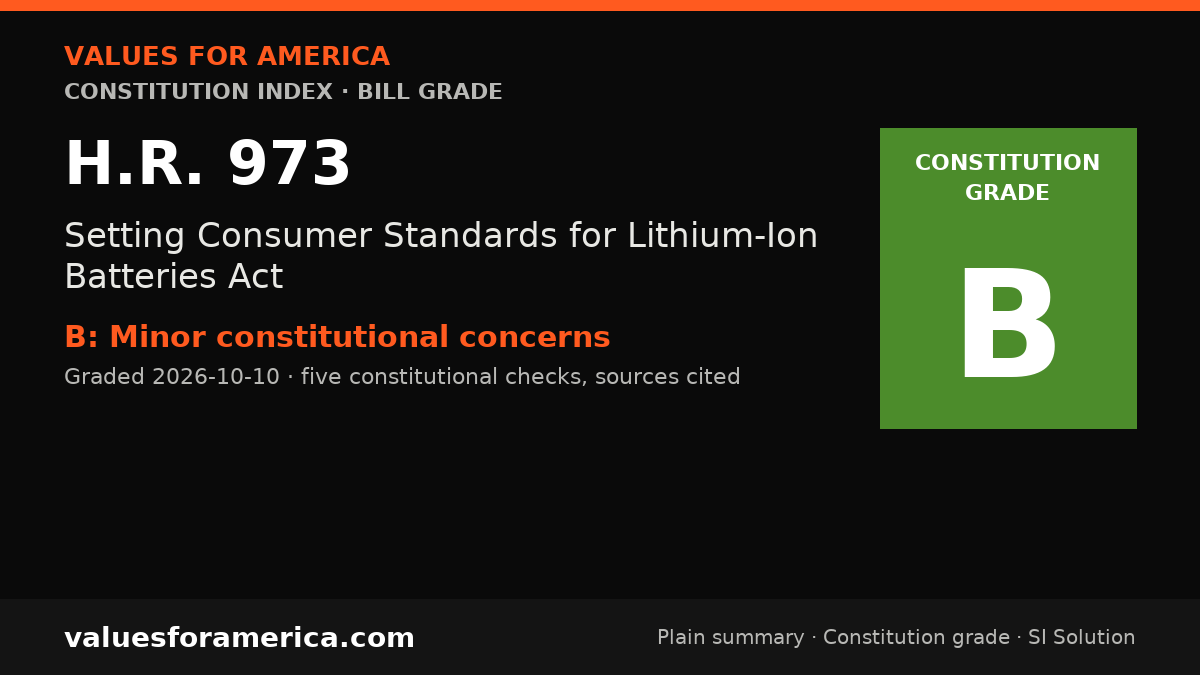
Setting Consumer Standards for Lithium-Ion Batteries Act
Cosponsors: 23 (17 D, 6 R) · per Congress.gov, 2026-10-11
Introduced: 2025-02-04
Latest action (2025-04-29): Received in the Senate.
What H.R. 973 does, in plain terms
Setting Consumer Standards for Lithium-Ion Batteries Act This bill requires the Consumer Product Safety Commission to issue a final consumer product safety rule for rechargeable lithium-ion batteries used in micromobility devices, such as electric bikes and electric scooters. Specifically, the rule must require manufacturers and distributors of such products to comply with the applicable safety standards jointly established by the American National Standards Institute, the Standards Council of Canada, and UL Solutions Inc.
Official summary by the Congressional Research Service, via Congress.gov.
Constitution Index
“VFA Constitution grade”
Minor constitutional concerns
Graded 2026-10-10
SI-generated grade · five published checks · not individually reviewed by a person · methodology
The bill is a federal consumer safety regulation of lithium-ion batteries in micromobility devices, grounded in the Commerce Clause. It does not infringe on specific Bill of Rights protections, but it imposes mandatory standards on manufacturers and distributors, which raises minor individual sovereignty and decentralization concerns. The delegation to private standard-setting organizations is a significant issue that requires careful oversight to ensure due process and accountability.
-
✓ Passes · Enumerated powers
Congress has authority under Article I, Section 8, Clause 3 (Commerce Clause) to regulate products that substantially affect interstate commerce. Lithium-ion batteries in micromobility devices are sold across state lines and present safety risks that are national in scope. The Consumer Product Safety Commission is a federal agency with delegated authority to issue safety rules for consumer product… -
✓ Passes · Bill of Rights
The bill does not implicate speech, religion, assembly, press, petition, arms, quartering, search and seizure, self-incrimination, due process, takings, trial rights, or cruel and unusual punishment. It is a commercial regulation that does not touch upon the enumerated rights in the first ten amendments. -
✗ Concern · Individual sovereignty
The bill restricts the freedom of manufacturers and distributors to choose which safety standards to follow, mandating compliance with specific private standards. While the government has a compelling interest in public safety, the restriction on commercial liberty is not minimal; it forces adherence to standards set by private organizations without direct public input or legislative enactment. Ho… -
✗ Concern · Decentralization
The bill fails the decentralization test because it consolidates standard-setting at the federal level when states and localities could potentially address the safety issue. However, the interstate nature of the product market and the need for uniform safety standards justify federal involvement. The bill does not pass all four questions: (1) individuals cannot handle this alone, (2) local communi… -
✗ Concern · Due process and takings
The bill delegates the substance of the safety rule to private standard-setting organizations (ANSI, SCC, UL Solutions) without providing for public notice and comment on the actual standards themselves. This raises procedural due process concerns because affected parties may not have a meaningful opportunity to challenge the standards before they are imposed. Additionally, the bill does not provi…
Sources: Congress.gov: HR 973 summary
Report an error in this grade
What should pass
“VFA SI Solution”
No solution yet
A sourced SI draft appears here once it passes automated checks (Constitution citation, source verification, independent SI critic). How publication works.
Related on VFA

For journalists and bloggers
“Embed this grade”
Free to use with the link back. The badge and card update when the grade changes. Embed terms →
