H.R. 9616 explained · 119th Congress · Pending in Congress
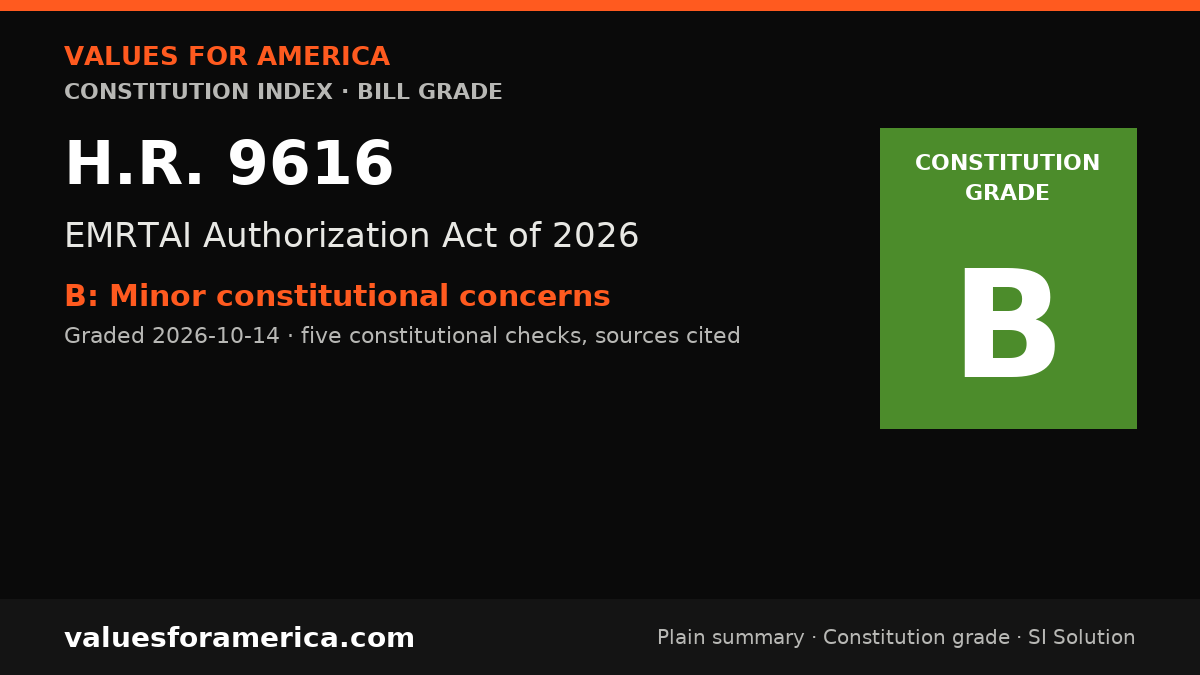
EMRTAI Authorization Act of 2026
Cosponsors: 1 (1 D, 0 R) · per Congress.gov, 2026-10-14
Introduced: 2026-07-09
Latest action (2026-09-16): Received in the Senate and Read twice and referred to the Committee on Environment and Public Works.
What H.R. 9616 does, in plain terms
Environmental Monitoring and Remediation Technology Assessment Initiative Authorization Act of 2026 or the EMRTAI Authorization Act of 2026 This provides statutory authority for an initiative within the Environmental Protection Agency (EPA) that recovers critical materials from contaminated sites. A critical material means (1) any non-fuel mineral, element, substance, or material that the Department of Energy determines has a high risk of a supply chain disruption and serves an essential function in energy technologies; and (2) any critical mineral. A critical mineral means any mineral, element, substance, or material designated as critical by the U.S. Geological Survey. Under the program, the EPA must investigate, evaluate, and support processes, methods, and systems which may be used to identify sources of critical materials at contaminated sites and recover such critical materials from those sites. In carrying out the program, the EPA may provide assistance (e.g., awards) to persons, nonprofit organizations, and state, local, and tribal government entities. The bill prohibits the EPA from providing assistance (1) in an amount that exceeds $10 million in any fiscal year in the aggregate; or (2) to any person, nonprofit organization, or government entity, in an amount that exceeds $3 million. The bill terminates the program after 10 years.
Official summary by the Congressional Research Service, via Congress.gov.
Constitution Index
“VFA Constitution grade”
Minor constitutional concerns
Graded 2026-10-14
SI-generated grade · five published checks · not individually reviewed by a person · methodology
The bill authorizes an EPA program to recover critical materials from contaminated sites, which falls within the federal government's enumerated powers under the Commerce Clause and the Property Clause, and is a reasonable exercise of the spending power. It does not infringe on the Bill of Rights, respects individual sovereignty by providing voluntary assistance, and does not consolidate decision-making beyond what is necessary for a national program addressing supply chain and environmental concerns. Minor concerns arise from the potential for federal involvement in areas traditionally handled by states, but the program's limited scope and sunset provision mitigate these issues.
-
✓ Passes · Enumerated powers
The federal government has authority to act in this area under Article I, Section 8, Clause 3 (Commerce Clause) because the recovery of critical materials from contaminated sites affects interstate commerce and national supply chains. Additionally, the Property Clause (Article IV, Section 3, Clause 2) grants Congress authority over federal lands, which may include contaminated sites. The spending … -
✓ Passes · Bill of Rights
The bill does not restrict speech, religion, assembly, press, petition, arms, quartering, search and seizure, self-incrimination, due process, takings, fair trial, jury, cruel and unusual punishment, or unenumerated rights. It only authorizes a voluntary assistance program, with no coercive or punitive measures. -
✓ Passes · Individual sovereignty
The bill does not restrict individual liberty. It provides voluntary assistance to persons and organizations, with no mandates or prohibitions on individual conduct. The burden of justification for any restriction is not triggered because there is no restriction. -
✓ Passes · Decentralization
The program addresses a national concern—critical material supply chains and contaminated site remediation—that is beyond the capacity of individuals, local communities, or states alone. The federal role is limited to providing assistance and does not preempt state or local authority. The program does not consolidate decision-making upward beyond the minimum necessary because it involves federal c… -
✓ Passes · Due process and takings
The bill does not bypass due process or take property without just compensation. It provides assistance voluntarily, with no compulsory acquisition of property. The program's procedures for providing assistance are not specified in the summary, but there is no indication of arbitrary government action or denial of fair notice or hearing.
Sources: Congress.gov: HR 9616 summary
Report an error in this grade
What should pass
“VFA SI Solution”
No solution yet
A sourced SI draft appears here once it passes automated checks (Constitution citation, source verification, independent SI critic). How publication works.
Related on VFA

For journalists and bloggers
“Embed this grade”
Free to use with the link back. The badge and card update when the grade changes. Embed terms →
