H.R. 9500 explained · 119th Congress · Pending in Congress
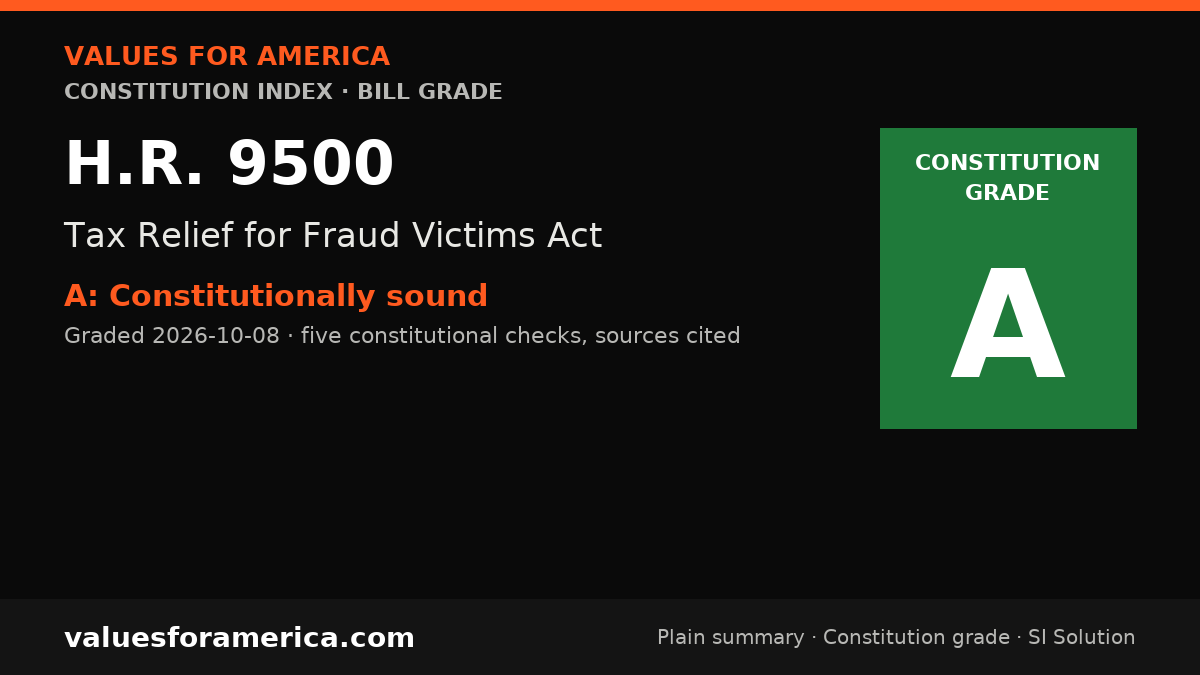
Tax Relief for Fraud Victims Act
Cosponsors: 2 (1 D, 1 R) · per Congress.gov, 2026-10-14
Introduced: 2026-06-29
Latest action (2026-09-16): Received in the Senate and Read twice and referred to the Committee on Finance.
What H.R. 9500 does, in plain terms
Tax Relief for Fraud Victims Act This bill expands the federal tax deduction for personal casualty and theft losses by eliminating certain limits, including the requirement that such losses arise from certain disasters. The bill also extends the tax refund deadline and modifies certain retirement plan rules related to certain fraud losses. The bill repeals the limit on the federal tax deduction for personal casualty losses (not attributable to a trade, business, or transaction entered into for profit) that allows such losses only if arising from a federal or state declared disaster or to the extent that such losses offset personal casualty gains. The bill allows taxpayers to elect to claim a tax deduction for losses arising from a theft involving fraud, deceit, or misrepresentation in the tax year such losses occur (rather than in the tax year discovered). Further, the bill extends the deadline for a refund claim related to a tax deduction for such losses to no less than one year after the date on which the losses are discovered and eliminates certain restrictions on the amount of such refund. For early distributions from a qualified retirement plan arising from a theft loss involving fraud, deceit, or misrepresentation for which a tax deduction is allowed, the bill waives the 10% penalty, extends the deadline for filing a refund claim and eliminates certain restrictions on the amount of such refund, and allows one year (beginning on the day after the theft loss is discovered) to repay such early distributions.
Official summary by the Congressional Research Service, via Congress.gov.
Constitution Index
“VFA Constitution grade”
Constitutionally sound
Graded 2026-10-08
SI-generated grade · five published checks · not individually reviewed by a person · methodology
Constitutional tax-relief measure within Congress's enumerated taxing power that infringes no rights, expands individual financial recovery, stays at the proper federal level for federal taxes, and adds due process protections.
-
✓ Passes · Enumerated powers
Congress has explicit authority to lay and collect taxes under Article I, Section 8, Clause 1, as modified by the Sixteenth Amendment granting power to tax incomes. Defining deductions, timing of theft-loss deductions, refund periods, and retirement-distribution penalties is squarely within that enumerated taxing power. -
✓ Passes · Bill of Rights
The bill does not restrict speech, religion, press, assembly, arms, search protections, trial rights, or other Bill of Rights guarantees. It expands a tax deduction and extends refund deadlines under the Sixteenth Amendment tax power. No First through Tenth Amendment infringement is present. -
✓ Passes · Individual sovereignty
The bill reduces government burden on persons who suffered fraud by restoring deductions, waiving the 10% early-distribution penalty, and extending repayment and refund windows. It restricts no personal conduct regarding person, property, speech, labor, or belief, and the government needs no additional compelling justification because it lifts rather than imposes a restraint consistent with the Ni… -
✓ Passes · Decentralization
(1) Individuals cannot set federal deduction rules. (2) Local communities cannot amend the Internal Revenue Code. (3) States cannot grant federal income tax relief. (4) The bill does not consolidate upward beyond the minimum necessary; it operates within the existing federal tax system under Article I, Section 8, Clause 1 and the Sixteenth Amendment, and Tenth Amendment is not violated because no … -
✓ Passes · Due process and takings
No deprivation of life, liberty, or property without due process under the Fifth Amendment Due Process Clause. No taking without just compensation under the Fifth Amendment Takings Clause. The bill extends procedural opportunities — longer refund periods and penalty relief — rather than bypassing notice, hearing, or presumption of innocence.
Sources: Congress.gov: HR 9500 summary
Report an error in this grade
What should pass
“VFA SI Solution”
No solution yet
A sourced SI draft appears here once it passes automated checks (Constitution citation, source verification, independent SI critic). How publication works.
Related on VFA

For journalists and bloggers
“Embed this grade”
Free to use with the link back. The badge and card update when the grade changes. Embed terms →
